Forces, free-body diagrams, and momentum
A force is a vector interaction between objects. It can change an object's velocity, deform it, or both. To predict motion, choose the object or system being studied and add all external forces as vectors. This vector sum is the resultant or net force.
In an inertial frame, the resultant external force equals the rate of change of the chosen system's total momentum. For a constant-mass object this becomes , so acceleration points in the direction of the resultant force, not necessarily velocity. When material enters or leaves, track the momentum carried with it as part of a consistently defined system; simply inserting a changing mass into , or differentiating only the momentum remaining in the object, can miss that transfer.
Momentum is also a vector. Forces acting over time transfer momentum through impulse. This viewpoint unifies apparently different situations such as a car accelerating, a ball bouncing, two carts colliding, and an object moving in a circle.
Key terms
- Force
- A vector interaction capable of changing momentum or deforming an object.
- Resultant force
- The vector sum of all external forces acting on the chosen object or system.
- Inertia
- The tendency of an object to resist a change in velocity; mass measures inertia.
- Momentum
- Mass multiplied by the velocity vector; momentum has the same direction as velocity.
Worked examples
Resultant force with resistance
A car has a driving force of and total resistive forces of . Find its acceleration.
- 1Choose forward as positive. The resultant force is forward.
- 2Apply : .
- 3The positive result means acceleration is forward. If the car was already moving forward, its speed increases.
Answer: The acceleration is forward.
Rules and formulas
Resultant external force
- resultant external force ()
Newton's second law in momentum form
- momentum ()
- time ()
Newton's second law for constant mass
- mass ()
- acceleration ()
Free-body diagrams and system boundaries
A free-body diagram isolates one object or chosen system and replaces every external interaction with a labelled force arrow. Draw the object as a simple dot or box. Arrows should begin on the object, point in the force direction, and be labelled by force type rather than by motion.
Common contact forces include normal force , tension , friction , drag, buoyancy and spring force. Field forces act without direct contact: gravity produces weight , electric fields exert forces on electric charges, and magnetic fields exert forces on magnets, electric currents and moving charges. Include each relevant force on the chosen object's free-body diagram. Velocity and acceleration arrows belong on a separate motion sketch because they are not forces.
A system boundary can simplify a multi-object problem. When two blocks are treated as one system, their mutual contact forces are internal and cancel in the system equation. If one block is isolated, that contact force becomes external and must appear.
Key terms
- Free-body diagram
- A diagram showing only the external forces acting on one selected object or system.
- System boundary
- An imagined boundary separating the chosen system from its surroundings.
- External force
- A force exerted on the system by something outside the system boundary.
- Internal force
- An interaction between parts included inside the chosen system.
- Weight
- The gravitational force on a mass, directed toward the centre of Earth near its surface.
Worked examples
Book at rest on a table
A book rests on a horizontal table. Draw the force model and find the normal force.
- 1The book has weight downward.
- 2The table exerts a normal force upward. There is no vertical acceleration, so the vertical resultant is zero.
- 3Therefore , giving upward.
Answer: The table's normal force on the book is upward.
Choosing a two-block system
Two boxes of masses and move together. A external push acts right and total external resistance is left. Find their acceleration.
- 1Choose both boxes as one system. The contact force between them is internal, so it is omitted from the system equation.
- 2The external resultant is right and total mass is .
- 3Thus right.
Answer: The two-box system accelerates at to the right.
Rules and formulas
Translational equilibrium
- vector sum of external forces ()
Weight near Earth's surface
- weight ()
- mass ()
- gravitational field strength ()
Newton's three laws and equilibrium
In an inertial reference frame, Newton's first law states that an object remains at rest or moves with constant velocity unless acted on by a resultant external force. Both rest and constant-velocity motion are states of translational equilibrium because acceleration is zero; zero resultant force alone does not establish rotational equilibrium for an extended body.
Newton's second law is vectorial. Apply it separately along chosen axes: and . A zero resultant along one axis does not require zero resultant along another.
Newton's third law states that when object A exerts a force on object B, B simultaneously exerts an equal-magnitude, opposite-direction force of the same interaction type on A. The pair acts on different objects, so the forces do not cancel on either object's free-body diagram.
Key terms
- Dynamic equilibrium
- Motion at constant velocity because the resultant external force is zero.
- Inertial frame
- A reference frame in which Newton's first law holds.
- Action–reaction pair
- Equal and opposite forces of the same interaction acting on two different objects.
- Apparent weight
- The support or normal force experienced by an object, which need not equal its weight.
Worked examples
Apparent weight in an accelerating lift
A passenger accelerates upward at . Find the lift floor's normal force on the passenger.
- 1Choose upward positive. The forces on the passenger are upward and downward.
- 2Apply , so .
- 3.
Answer: The apparent weight is , greater than the passenger's true weight.
Finding a third-law pair
A swimmer pushes water backward. Identify the third-law force pair and explain the forward acceleration.
- 1The swimmer exerts a backward contact force on the water.
- 2The water exerts an equal-magnitude forward contact force on the swimmer.
- 3These forces act on different objects, so they do not cancel in the swimmer's force equation. The swimmer accelerates forward when the forward thrust from the water exceeds the total backward resistive force.
Answer: Swimmer-on-water backward and water-on-swimmer forward form the third-law pair.
Rules and formulas
Newton's second law by components
- force components ()
- acceleration components ()
Newton's third law
- force exerted by A on B ()
- force exerted by B on A ()
Resolving forces and inclined planes
Choose axes that make the physics simple. On an inclined plane, take one axis parallel to the surface and the other perpendicular to it. The normal force then lies entirely on the perpendicular axis and friction lies on the parallel axis.
Weight remains vertical. Resolving gives down the plane and into the plane. These are components of one weight force, not two extra forces. If there is no acceleration perpendicular to the surface, the normal force balances the net inward component.
Friction points opposite the actual or impending relative motion. A block sliding down a slope experiences friction up the slope; a block being pulled upward can experience friction down the slope.
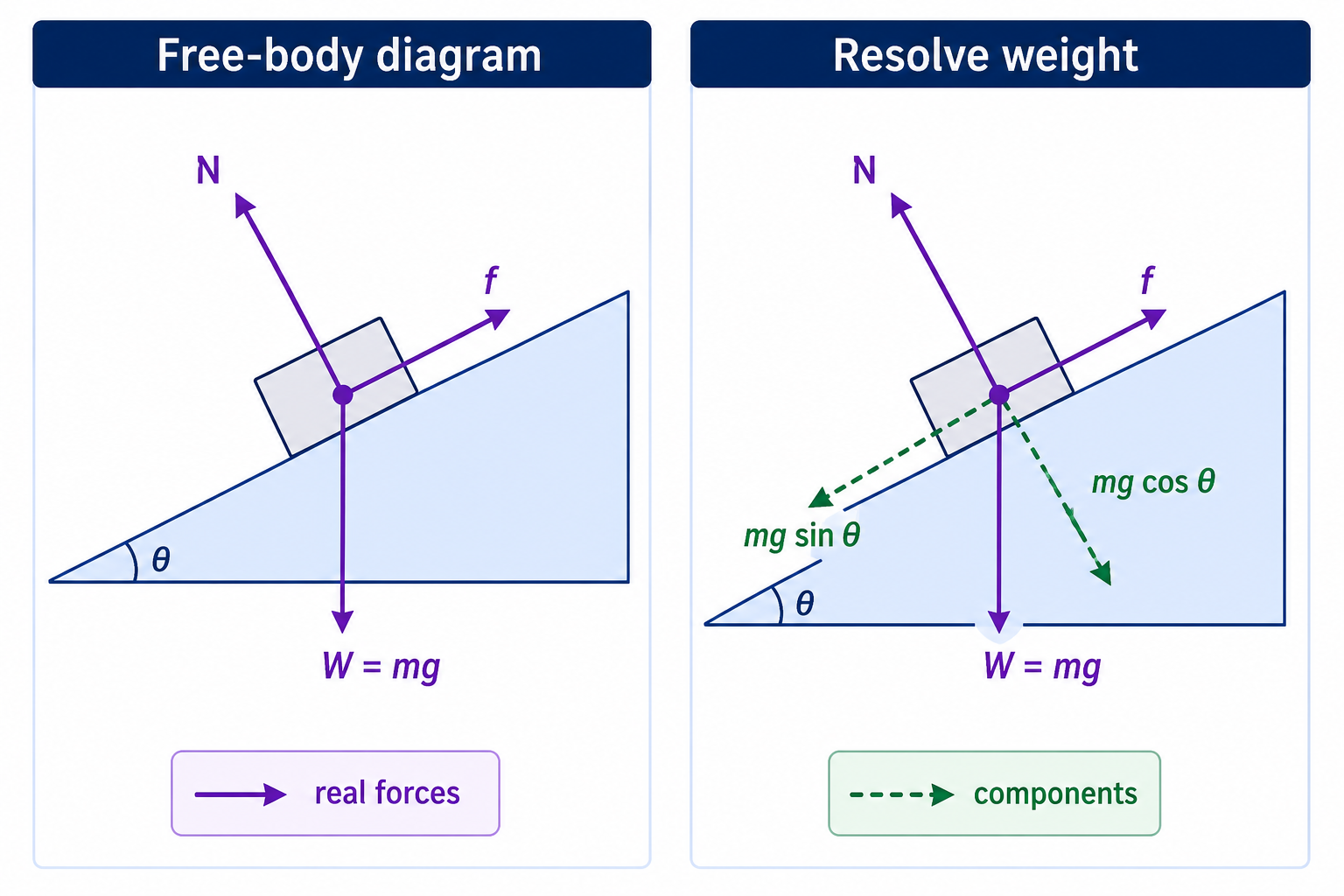 Qualitative schematic: arrow lengths and drawn geometry are not to scale. The block is sliding, or tending to slide, down the plane, so friction acts up the plane. Purple arrows are real forces. Green dashed arrows resolve the single weight vector into down the slope and into it. Use these components instead of in the chosen axes; do not count all three as forces.
Key terms
- Resolve
- Replace a vector by perpendicular components whose vector sum equals the original vector.
- Parallel component
- The part of a force directed along the chosen surface or axis.
- Perpendicular component
- The part of a force directed normal to the chosen surface or axis.
- Inclination angle
- The angle between the slope and the horizontal.
Worked examples
Frictionless slope
A block is released on a frictionless incline. Find its acceleration and the normal force.
- 1Down-slope weight component: .
- 2Parallel motion gives , or down the slope. Use the unrounded weight component rather than the displayed .
- 3Perpendicular equilibrium gives .
Answer: Acceleration down the slope; .
Sliding with kinetic friction
The same block slides down the incline with . Find its acceleration.
- 1The normal force remains .
- 2Kinetic friction is up the slope.
- 3The down-slope resultant is .
- 4Use unrounded force components in : down the slope.
Answer: The block accelerates at down the slope.
Rules and formulas
Weight components on an incline
- weight component down the slope ()
- weight component into the slope ()
Normal force on a simple incline
- normal force ()
Normal force, friction, tension and coupled objects
The normal force is a contact force perpendicular to a surface. It prevents interpenetration and takes the value required by the perpendicular motion. It is not automatically equal to weight.
Static friction self-adjusts from zero up to . It equals whatever value is needed to prevent slipping until this limit is reached. Once surfaces slide, the kinetic-friction model is commonly used, with friction opposite relative motion.
Tension pulls along a taut string or cable. For an ideal massless string over an ideal frictionless pulley, the tension magnitude is the same throughout. Connected objects share a kinematic constraint, so their acceleration magnitudes are linked.
Key terms
- Normal force
- A contact force perpendicular to a surface.
- Static friction
- A self-adjusting friction force that prevents relative sliding up to a maximum value.
- Kinetic friction
- Friction opposing surfaces that are sliding relative to each other.
- Coefficient of friction
- A dimensionless parameter relating a friction limit or magnitude to the normal force.
- Tension
- A pulling force transmitted by a taut string, rope or cable.
Worked examples
Two connected blocks
Blocks of and are connected by a taut, light, inextensible string on a smooth horizontal surface. A horizontal force pulls the block along the string away from the block. Find the acceleration and string tension.
- 1For both blocks as one system, .
- 2Isolate the block. Its only horizontal force is tension, so .
- 3Check with the block: , again giving .
Answer: Acceleration ; tension .
Static friction is not always at its maximum
A crate on a level floor has . A horizontal push is applied. Does it move?
- 1Normal force is .
- 2Use the unrounded normal force: maximum static friction is .
- 3Only of static friction is needed to balance the push, which is below the maximum.
Answer: The crate remains at rest; actual static friction is , not .
Rules and formulas
Static-friction range
- static friction magnitude ()
- coefficient of static friction
Limiting and kinetic friction
- kinetic friction magnitude ()
- coefficient of kinetic friction
Ideal-string tension
- tension magnitude in an ideal massless string ()
Spring forces and Hooke's law
A spring exerts a force opposing its extension or compression from its natural (unloaded) length. Within its linear range, the force magnitude is proportional to this deformation. The spring constant measures stiffness: a larger means more force is required for the same extension or compression.
Along the spring axis, , where represents extension or compression relative to the natural length. The minus sign gives the opposing direction; the force magnitude is . A spring can exert a non-zero force when a loaded system is in equilibrium: for a hanging mass, its upward force balances weight. Displacement from that loaded equilibrium describes the net restoring force of the combined forces, not the spring force alone.
Hooke's law is a model with a limit. Beyond the limit of proportionality the force–extension graph is no longer straight, and after the elastic limit the spring may not return to its original length.
Key terms
- Extension
- Change in spring length from its natural or unloaded length.
- Spring constant
- The positive gradient of a linear applied-force-magnitude versus extension graph, measured in N ; a signed restoring-force versus deformation graph has gradient −k.
- Restoring force
- A force directed toward the equilibrium position.
- Limit of proportionality
- The point beyond which force is no longer proportional to extension.
Worked examples
Mass supported by a vertical spring
A spring with extends by while supporting a mass at rest. Find the mass.
- 1Spring force magnitude is .
- 2At rest, the vertical forces balance, so .
- 3Thus .
Answer: The supported mass is .
Acceleration toward equilibrium
A cart attached to a horizontal spring with is displaced right on a smooth surface. Find its initial acceleration.
- 1The spring force magnitude is .
- 2Because displacement is right, the restoring force is left.
- 3The initial acceleration magnitude is , directed left.
Answer: The initial acceleration is toward equilibrium.
Rules and formulas
Hooke's law
- spring restoring force ()
- spring constant ()
- extension or compression vector along the spring axis, measured relative to the natural length ()
Drag, buoyancy and terminal motion
Drag opposes an object's velocity relative to a fluid and usually increases with relative speed. It depends on shape, cross-sectional area and fluid properties, so acceleration is generally non-uniform. In slow laminar flow around a small sphere, Stokes' law provides a specific viscous-drag model.
Buoyancy is the upward force caused by fluid pressure increasing with depth. Archimedes' principle gives : the buoyant force equals the weight of displaced fluid.
For steady vertical falling through a still fluid, with weight, buoyancy and drag as the only forces, the upward drag and buoyancy balance weight at terminal velocity. The resultant and acceleration are then zero while the object continues downward at constant non-zero velocity. If the fluid itself moves, determine the drag direction from velocity relative to the fluid before writing the force balance.
Key terms
- Drag
- A fluid force opposing motion relative to the fluid.
- Viscosity
- A measure of a fluid's resistance to flow.
- Buoyancy
- The upward resultant of pressure forces exerted by a fluid.
- Displaced volume
- The volume of fluid replaced by the submerged part of an object.
- Terminal speed
- A constant non-zero speed reached when the resultant force is zero.
Worked examples
Buoyant force on a submerged object
A object of volume is fully submerged in water of density . Ignore drag at the instant considered. Find buoyant force and initial downward acceleration.
- 1 upward.
- 2Weight is downward.
- 3Use the unrounded forces: the net downward force is , so downward.
Answer: Buoyant force upward; initial acceleration downward.
Stokes drag on a small sphere
A sphere of radius moves at through a fluid of viscosity . Assuming Stokes flow, find the drag.
- 1Convert radius: .
- 2Use .
- 3.
Answer: The viscous drag is , opposite the sphere's motion relative to the fluid.
Rules and formulas
Archimedes' principle
- buoyant force ()
- fluid density ()
- displaced fluid volume ()
Stokes' law
- viscous drag on a slowly moving sphere ()
- dynamic viscosity ()
- sphere radius ()
Terminal-motion balance
- weight magnitude ()
Momentum, impulse and force–time graphs
Momentum combines inertia and motion. Because velocity is a vector, momentum signs and directions matter. In one dimension, choose a positive direction before calculating .
The impulse of an individual force is its time integral, or the signed area under its force–time graph in one dimension. The net external impulse equals the system's change in momentum: . Add the impulses of all external forces, or use the resultant-force graph directly. Net impulse has the direction of the momentum change.
The same momentum change can be produced by a large force for a short time or a smaller force for a longer time. This is why airbags, helmets and crumple zones reduce average collision force by increasing stopping time.
Key terms
- Momentum
- Mass multiplied by velocity; a vector measured in kg m .
- Impulse
- The time integral of a force, equal to the signed area under its force–time graph; the net external impulse equals the system's change in momentum.
- Average force
- A constant force that would produce the same impulse over the same interval.
- Force–time graph
- A graph whose signed area represents impulse.
Worked examples
Ball reversing direction
A ball travels east at , then rebounds west at . Contact lasts . Find impulse and average force on the ball.
- 1Take east positive: and .
- 2.
- 3.
Answer: Impulse west; average force west.
Area under a triangular force pulse
A graph of the resultant horizontal force on a cart is a triangular pulse of base and height , entirely above the time axis. The cart is initially at rest. Find its final speed.
- 1Impulse is triangle area: .
- 2Impulse equals momentum change: .
- 3Thus in the force direction.
Answer: The final speed is .
Rules and formulas
Momentum
- momentum ()
- mass ()
- velocity ()
Net external impulse
- net external impulse ()
- change in momentum ()
Average resultant external force
- average resultant external force on the chosen system ()
Conservation of momentum, collisions and explosions
For an isolated system with negligible external impulse, total momentum is conserved. Internal forces can be very large during a collision, but their impulses are equal and opposite, so they do not change the system's total momentum.
Choose a sign convention and keep every velocity signed. For SL, quantitative collision and explosion problems are one-dimensional. In two dimensions the same physical conservation law applies separately in perpendicular components; quantitative two-dimensional applications are required at HL. Include all objects in the chosen system both before and after the interaction.
Momentum is conserved in both elastic and inelastic collisions when net external impulse is negligible. Total kinetic energy is conserved in an elastic collision. When objects stick together, the collision is perfectly inelastic and kinetic energy is transferred to deformation, thermal energy and sound. In an explosion, stored internal energy can become kinetic energy of the separating parts, even when their total momentum remains unchanged; total energy is conserved throughout.
Key terms
- Isolated system
- A system receiving negligible net external impulse during the interaction.
- Elastic collision
- A collision conserving both total momentum and total kinetic energy.
- Inelastic collision
- A collision conserving momentum but not total kinetic energy.
- Explosion
- An interaction in which internal stored energy separates parts while total momentum remains conserved.
Worked examples
Carts stick together
A cart moves right at and collides with a cart moving left at . They stick together. Find their common velocity.
- 1Take right positive. Initial momentum is .
- 2After sticking, total mass is , so .
- 3Thus .
Answer: The joined carts move right at .
Explosion from rest
A object initially at rest separates into and parts. The part moves east at . Find the other part's velocity.
- 1Initial total momentum is zero.
- 2Take east positive: .
- 3Solving gives , so the part moves west.
Answer: The part moves west at .
Two-dimensional momentum (HL extension)
A puck moves east at and hits a stationary puck. Afterwards the first puck moves north at . Neglect external horizontal impulse and external work; stored internal energy is released during this collision. Find the second puck's velocity.
- 1Initial momentum is . The first puck's final momentum is .
- 2The second puck therefore has momentum .
- 3Divide by : .
- 4Its speed is , at south of east.
Answer: , or at south of east.
Rules and formulas
Momentum conservation
- total momentum of the chosen system, the vector sum of the momenta of all parts ()
Translational kinetic energy
- kinetic energy used to classify collision behaviour ()
Circular motion and centripetal force
In uniform circular motion, speed is constant but velocity changes direction. Acceleration is then purely radial, toward the centre, and perpendicular to the tangential velocity. If the speed changes, there is also a tangential acceleration . The radial component remains at the instantaneous speed, but the total acceleration is no longer purely centripetal.
The required inward resultant is . “Centripetal force” is not a new type of force: it is the inward resultant supplied by real forces such as tension, gravity, friction or normal contact.
Choose the inward radial direction as positive and add the components of real forces along it. For a mass on a taut string in a vertical circle, at the top ; at the bottom . The speeds need not be equal. Use the instantaneous speed at each point and check that the calculated tension is non-negative; a string cannot push. These top and bottom balances apply whether the circular motion is uniform or non-uniform.
Key terms
- Uniform circular motion
- Motion at constant speed around a circle.
- Tangential velocity
- Velocity directed along the tangent to the circular path.
- Centripetal acceleration
- The radial component of acceleration directed toward the centre of a circular path; in uniform circular motion it is the entire acceleration.
- Radial resultant
- The net inward component of real forces producing circular motion.
- Angular speed
- Angle swept per unit time, measured in radians per second.
Worked examples
Car rounding a flat curve
A car travels at around a flat curve of radius . Find the required inward force and the minimum friction coefficient.
- 1.
- 2On a flat road, static friction supplies this inward force and .
- 3.
Answer: Required inward force ; minimum .
Tension at the bottom of a vertical circle
A ball moves at at the bottom of a vertical circle of radius . Find the string tension.
- 1At the bottom, inward is upward. Tension points inward and weight points outward.
- 2Apply .
- 3.
Answer: The string tension is .
Rules and formulas
Speed, period and angular speed (uniform circular motion)
- tangential speed ()
- radius ()
- period ()
- angular speed ()
Angular speed and period (uniform circular motion)
- angular speed ()
Centripetal acceleration
- inward centripetal acceleration ()
Required radial resultant
- resultant force directed toward the centre ()
Applications, experiments and exam workflow
Safety systems apply impulse physics. For the same initial and final momentum, increasing stopping time lowers average force. Seat belts spread force across stronger body regions, airbags increase stopping time and area, helmets deform, and vehicle crumple zones absorb energy while extending the collision.
Force investigations should connect measurements to a model. A force sensor and motion sensor can test ; a force–extension graph can determine ; a force–time graph can be integrated for impulse; and colliding carts can test momentum conservation. Record uncertainty, use best-fit relationships and identify systematic effects such as track tilt or friction.
For every problem: define the system, draw a force or before/after momentum diagram, choose axes, list signed values, write one equation per independent direction, solve, then interpret direction and units. Check whether assumptions such as constant mass, ideal string, negligible external impulse or uniform circular motion are justified.
Key terms
- Stopping time
- The interval over which an object's momentum is brought to its final value.
- Systematic error
- A consistent measurement bias that shifts results in one direction.
- Force sensor
- A device measuring force as a function of time.
- Model assumption
- A stated simplification defining when an equation can be applied.
Worked examples
Crumple zone and average force
A car stops from . Compare the average force magnitudes for stopping times of and .
- 1Momentum change magnitude is in both cases.
- 2For , .
- 3For , .
- 4Increasing stopping time by a factor of five reduces average force by a factor of five.
Answer: Average force falls from to .
Pulling a sled at an angle
An sled is sliding to the right on a level surface. It is pulled to the right by at above horizontal. The kinetic-friction coefficient is . Find the acceleration.
- 1Vertical equilibrium gives .
- 2Use the unrounded normal force: , or to three significant figures. Keep the unrounded value for the acceleration calculation.
- 3Horizontal pull is , so net horizontal force is .
- 4Acceleration is .
Answer: The sled accelerates at horizontally.
Topic summary
- A force is a vector interaction; the resultant is the vector sum of external forces on the chosen system.
- Newton's second law is , reducing to for constant mass.
- Zero resultant force means zero acceleration and therefore constant velocity, which may be non-zero.
- A third-law pair consists of equal and opposite forces of the same interaction acting on different objects.
- A free-body diagram contains only forces acting on the selected object or system.
- On an incline, weight components are down the slope and into the slope.
- Static friction adjusts up to a maximum; kinetic friction opposes sliding motion.
- Normal force is set by the perpendicular force balance and is not automatically equal to weight.
- Within its linear range, a spring obeys , where measures extension or compression relative to its natural length.
- Drag opposes motion relative to a fluid; buoyancy equals the weight of displaced fluid.
- At terminal speed, resultant force and acceleration are zero while velocity remains non-zero.
- Momentum is . The net external impulse equals the change in momentum; an individual force's impulse is the signed area under that force's time graph.
- Total momentum is conserved when the external impulse on the chosen system is negligible.
- When net external impulse is negligible, total momentum is conserved in elastic and inelastic collisions. Total kinetic energy is conserved in an elastic collision, but not in an inelastic collision.
- Uniform circular motion has purely inward acceleration despite constant speed. When speed changes, radial acceleration remains and a tangential component also changes the speed.
- Centripetal force is the inward resultant of real forces, not an additional force type.
- For the same momentum change, a longer stopping interval reduces the magnitude of the average resultant external force on the chosen system.
- Strong solutions define the system, draw a diagram, choose axes, keep vector signs and state model assumptions.