Annuities and regular cash flows
An annuity is a finite series of equal payments or deposits made at equal time intervals. Examples include monthly loan repayments, monthly retirement deposits, annual insurance premiums and fixed pension withdrawals. The word “annuity” describes the payment pattern; payments do not have to be annual.
Let be the regular payment, the interest rate per payment period and the number of payments. A valid model requires the payment interval and interest period to match. If payments are monthly, the model must use a monthly rate and a monthly period count.
A cash flow is money entering or leaving an account from one point of view. A deposit is an outflow from the saver now but an inflow to the investment account. A loan is an inflow when received and repayments are later outflows. The chosen point of view determines calculator signs.
A level-payment annuity assumes equal payments, a constant interest rate, regular timing and no unmodeled fees, missed payments or rate changes. Real contracts may violate these assumptions, so interpretation matters as much as calculation.
Key terms
- Annuity
- A finite sequence of equal cash flows made at regular intervals.
- Regular payment
- The fixed deposit, repayment or withdrawal made each period.
- Cash flow
- Money entering or leaving an account or person at a particular time.
- Payment period
- The time between consecutive cash flows, such as one month or one quarter.
- Term
- The total duration of the annuity or loan.
- Level payment
- A payment amount that stays constant throughout the model.
Worked examples
Recognize annuity situations
Which are annuities: depositing AED 500 every month for four years; investing one lump sum today; paying a different electricity bill each month; receiving USD 900 at the end of every month for ten years?
- 1Equal monthly deposits over a fixed term form an annuity.
- 2One lump sum is a single cash flow, not an annuity.
- 3Varying electricity bills are not a level-payment annuity.
- 4Equal monthly receipts over a fixed term form an annuity.
Answer: The monthly deposits and monthly receipts are annuities; the lump sum and unequal bills are not.
Identify the annuity variables
A saver deposits USD at the end of each month for years into an account paying interest monthly. Identify , the payment frequency and .
- 1The regular payment is .
- 2Payments occur monthly, so there are 12 periods each year.
- 3The number of deposits is .
Answer: , monthly payments, and . The monthly interest rate must still be obtained from the quoted annual rate.
Ordinary annuities and annuities due
An ordinary annuity makes each payment at the end of a period. Its first payment is at and its last is at . Most loan repayments and many savings questions use this convention unless the problem says payments begin immediately.
An annuity due makes each payment at the beginning of a period. Its first payment is at and its last is at . Rent, leases and “deposit today, then monthly” plans often use this pattern.
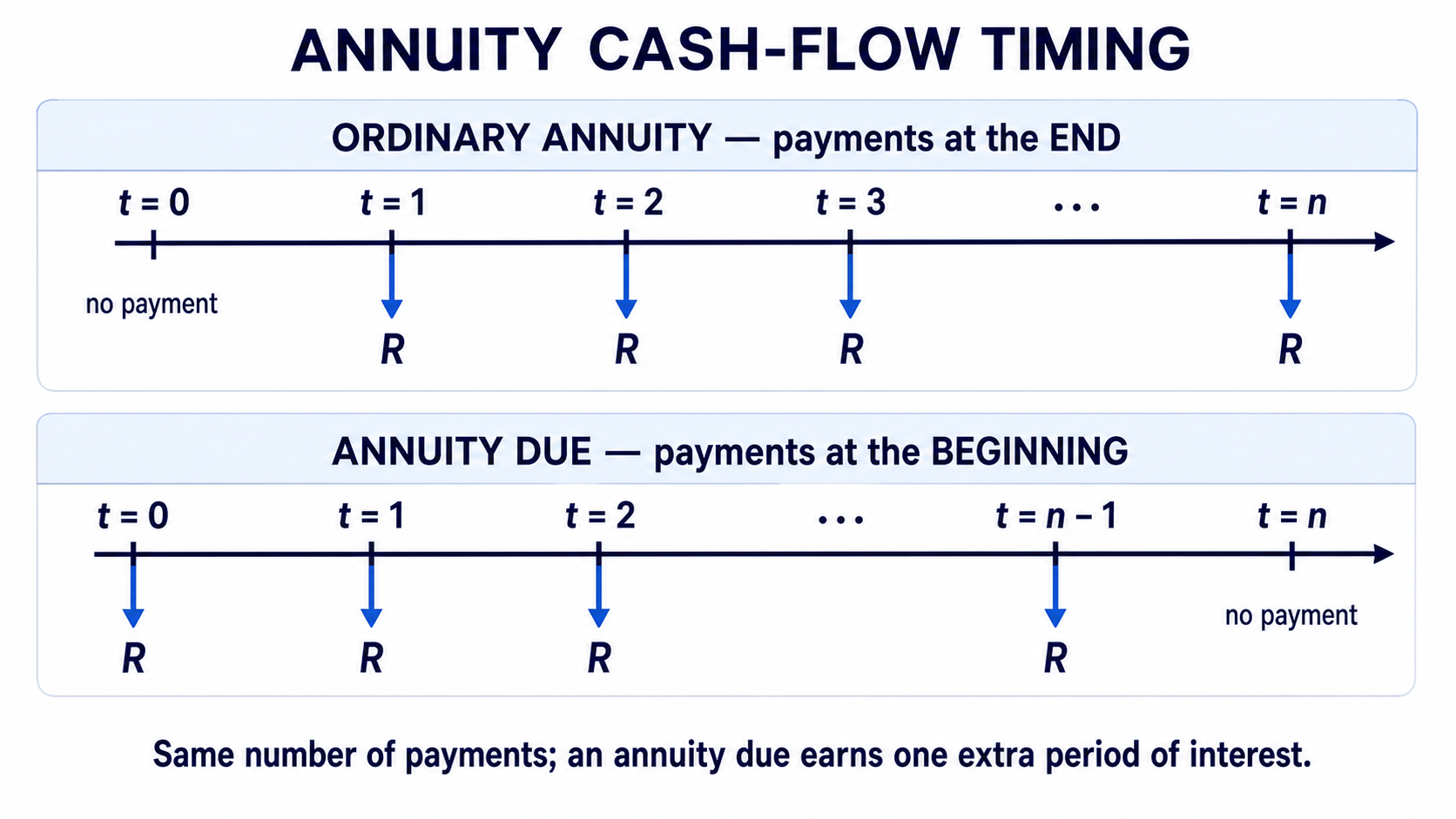 With the same payment and number of deposits, an annuity due earns one additional period of interest.
Because every annuity-due payment is invested for one extra period, its value at a common future date is the corresponding ordinary-annuity value multiplied by . This relationship is valid only when the payment, rate and number of payments are otherwise identical.
A timeline is the safest way to decide the calculator setting. Mark the valuation date, first payment, last payment and any period with no cash flow before selecting END or BEGIN.
Key terms
- Ordinary annuity
- An annuity with payments at the end of each period.
- Annuity due
- An annuity with payments at the beginning of each period.
- END mode
- A TVM setting for end-of-period payments.
- BEGIN mode
- A TVM setting for beginning-of-period payments.
- Valuation date
- The date at which all cash flows are being compared or valued.
Worked examples
Choose END or BEGIN
A worker deposits money on the final day of each month. A tenant pays rent on the first day of each month. Classify each cash flow.
- 1A final-day deposit occurs after the month's interest period, so use an ordinary annuity and END mode.
- 2A first-day rent payment occurs at the beginning of the period, so use an annuity due and BEGIN mode.
Answer: Worker's deposits: ordinary annuity (END). Rent: annuity due (BEGIN).
Compare payment timing
USD is deposited monthly for years at a nominal annual rate of , compounded monthly. Compare end-of-month and beginning-of-month future values.
- 1Use and .
- 2The ordinary-annuity value is approximately USD .
- 3The annuity-due value is .
- 4The beginning deposits earn one extra month of interest.
Answer: End of month: USD 20,298.05. Beginning of month: USD 20,379.25, about USD 81.19 more.
Rules and formulas
Annuity-due timing adjustment
Interest rates and repayment periods
Financial models work one period at a time. If a nominal annual rate is compounded times per year, the periodic rate is . If the term is years, the period count is . Use as a decimal in formulas.
A quoted rate of per year compounded monthly gives , or per month. A five-year monthly loan has payments.
Payment frequency and compounding frequency are often equal, but not always. When they differ, use the effective rate for one payment interval or the GDC's P/Y and C/Y settings correctly. Do not divide an annual rate by a guessed number without checking the contract convention.
The number of periods is a count, so it must usually be a whole number. A computed value such as 47.3 payments requires contextual interpretation: the target is reached during a period, or the next scheduled full payment may be needed.
Key terms
- Nominal annual rate
- A quoted annual rate allocated across compounding periods, such as 6% compounded monthly.
- Periodic rate
- The interest rate applied during one payment or compounding period.
- Compounding frequency
- The number of times interest is added each year.
- Payment frequency
- The number of payments made each year.
- P/Y
- Payments per year in many TVM solvers.
- C/Y
- Compounding periods per year in many TVM solvers.
Worked examples
Convert a monthly contract
A loan charges nominal annual interest compounded monthly and is repaid over years. Find and .
- 1Monthly rate: .
- 2Number of payments: .
Answer: per month and .
Convert a quarterly savings plan
An investment pays nominal annual interest compounded quarterly. Deposits are made quarterly for years.
- 1There are quarters per year.
- 2 per quarter.
- 3 deposits.
Answer: Use and .
Detect inconsistent periods
A student enters and for a ten-year loan with monthly repayments. Explain the likely error.
- 1The solver usually expects the total number of payment periods, not the number of years.
- 2For monthly repayments, .
- 3The annual rate can remain 6 in a TVM package only if P/Y and C/Y are set as the calculator expects; otherwise enter the monthly rate consistently.
Answer: The period count should be 120, and the interest-frequency settings must be checked.
Rules and formulas
Periodic rate
- nominal annual rate as a decimal
- compounding periods per year
Number of periods
- term in years
Effective annual rate
Future value of regular deposits
The future value of a savings annuity is the account balance at a chosen future date after all modeled deposits and interest. End-of-period deposits form a geometric series because earlier deposits earn interest for more periods.
For an ordinary annuity with payment , periodic rate and payments, . For , there is no interest and .
For beginning-of-period deposits, multiply the ordinary result by . To find a regular deposit needed for a target, rearrange or use a financial solver with the target entered as .
The future value includes deposits and interest. Total contributions are nR, so interest earned equals future value minus contributions when there are no fees or withdrawals.
Key terms
- Future value
- The accumulated value of all cash flows at a specified future date.
- Contribution
- Money deposited into a savings or investment account.
- Accumulated interest
- Future value minus total deposits, assuming no other cash flows or fees.
- Savings target
- A desired future account balance.
Worked examples
Find a savings balance
USD is deposited at the end of every month for years at nominal annual interest compounded monthly. Find the balance.
- 1Use , and .
- 2.
- 3Evaluate with full precision.
Answer: The future value is approximately USD 20,298.05.
Find the interest earned
Using the previous savings plan, calculate total deposits and interest earned.
- 1Total deposits are .
- 2Interest earned is .
Answer: Total contributions are USD 18,000 and interest earned is approximately USD 2,298.05.
Find the deposit for a target
How much must be deposited at the end of each month to accumulate USD in years at nominal annual interest compounded monthly?
- 1Use and .
- 2Rearrange: .
- 3A real plan must use cents and may require a slightly larger deposit to guarantee reaching the target.
Answer: The mathematical payment is USD 467.773..., so deposit at least USD 467.78 per month.
Rules and formulas
Future value of an ordinary annuity
Future value of an annuity due
- constant periodic rate greater than -1; zero-interest case is shown separately
- positive integer number of payments; n beginning-of-period deposits at times0,...,n-1; valued at
Regular deposit for a target
Interest earned on a savings annuity
Present value of regular payments
The present value of an annuity is the single amount today that is financially equivalent to its future payments at a stated interest rate. It discounts every payment back to the valuation date.
For end-of-period payments of , . This model applies to loan repayments, fixed withdrawals, pensions, leases and any level stream valued today.
An annuity-due present value is multiplied by because every payment occurs one period earlier. If the first withdrawal is today, select BEGIN mode rather than END.
Present value is not simply nR. Future payments are worth less today when the discount rate is positive. The choice of rate is a model assumption and can substantially change the answer.
Key terms
- Present value
- The value today of future cash flows discounted at a stated periodic rate.
- Discounting
- Moving a future amount back in time by dividing by growth factors.
- Withdrawal annuity
- A plan that pays equal amounts from an invested balance at regular intervals.
- Discount rate
- The periodic rate used to compare money at different dates.
Worked examples
Value a withdrawal plan today
An account will pay USD at the end of each month for years. If money earns nominal annual interest compounded monthly, how much is needed now?
- 1Use , , and .
- 2.
Answer: Approximately USD 108,088.14 is needed today.
Interpret the discounting effect
For the previous plan, compare the present value with the total withdrawals.
- 1Total withdrawals are .
- 2The present value is about .
- 3The difference is funded by interest earned on the remaining balance over time.
Answer: USD 108,088.14 today can support USD 144,000 of modeled withdrawals because the balance continues earning interest.
Beginning withdrawals
A retirement plan makes monthly withdrawals of USD , starting immediately, at nominal annual interest compounded monthly. Find the required balance.
- 1Use and .
- 2The ordinary-annuity present value is about USD .
- 3Because the first withdrawal is immediate, multiply by .
Answer: The annuity-due present value is approximately USD 328,025.75.
Rules and formulas
Present value of an ordinary annuity
Present value of an annuity due
Loans and amortization
An amortizing loan is repaid through regular payments that cover both interest and principal, reducing the balance to a specified final value—usually —after payments. Examples include mortgages, car loans and personal loans.
Interest is calculated on the outstanding balance each period. Early in a long loan, the balance is large, so a greater part of each payment is interest. As the balance falls, interest decreases and more of the fixed payment repays principal.
At the loan date, the amount borrowed is the present value of the repayment annuity: . A financial solver normally finds the payment directly.
The simple model excludes arrangement fees, insurance, penalties, variable rates, irregular payments and balloon amounts unless they are entered as separate cash flows. A lender's quoted annual percentage measure may also include charges not captured by the nominal rate alone.
Key terms
- Principal
- The amount borrowed or the portion of a payment that reduces the loan balance.
- Amortization
- The process of reducing a debt through scheduled payments of interest and principal.
- Amortizing loan
- A loan designed to reach a target balance through regular payments.
- Balloon payment
- A large final payment left after smaller scheduled payments.
- Outstanding balance
- The amount still owed at a specified date.
Worked examples
Interpret the repayment structure
A fixed-rate mortgage has equal monthly payments. Explain why the interest part falls while the principal part rises.
- 1Monthly interest equals the periodic rate times the previous balance.
- 2Each payment reduces the balance, so next month's interest is calculated on a smaller amount.
- 3Because the total payment is fixed, the amount left for principal increases.
Answer: Interest falls and principal repayment rises as the outstanding balance decreases.
Identify modeled and unmodeled costs
A repayment model uses only the amount borrowed, interest rate and 60 equal payments. Name two costs it may omit.
- 1Possible omissions include origination fees, insurance, late fees, early-settlement penalties and account charges.
- 2Any omitted cost makes the simple model understate the real cost if that cost is actually charged.
Answer: For example, arrangement fees and compulsory insurance are not included unless modeled separately.
Rules and formulas
Loan as a present-value annuity
Loan repayments and total cost
For a fully amortizing ordinary loan with present value , periodic rate and payments, the equal payment is . In AI SL, a TVM solver or spreadsheet is the expected main method; the formula explains and checks the technology.
If each repayment is , total scheduled repayments are . Ignoring fees, total interest is . A longer term usually reduces the periodic payment but increases the total interest because the debt remains outstanding for longer.
Currency payments are normally rounded to the nearest cent. Calculators use unrounded values internally, whereas lenders may round each payment and adjust the final one by a few cents. Keep full precision for mathematical balances, then explain real payment rounding.
Key terms
- Periodic repayment
- The regular amount paid each period under the model.
- Total repayment
- The sum of all scheduled payments, excluding separately modeled fees.
- Total interest
- Total repayments minus the amount borrowed when no other charges are included.
- Final adjustment
- A small change to the last payment caused by currency rounding or contract details.
Worked examples
Find a mortgage repayment
A mortgage of USD is repaid monthly over years at nominal annual interest compounded monthly. Find the monthly payment.
- 1Use , and .
- 2.
- 3Retain the unrounded payment for later balance calculations.
Answer: The monthly payment is approximately USD 1,702.76.
Find total mortgage interest
Using the previous mortgage, calculate total scheduled payments and total interest, ignoring fees.
- 1Using the unrounded payment, total payments are .
- 2Total interest is .
Answer: Total repayments are approximately USD 510,829.13 and total interest is approximately USD 230,829.13.
Interpret a longer term
A borrower extends a loan term while keeping the principal and interest rate unchanged. Describe the usual effects.
- 1The same debt is spread over more payments, so the periodic payment usually falls.
- 2Interest is charged for more periods, so total interest usually rises.
- 3Affordability per month improves at the cost of a larger total payment.
Answer: A longer term normally lowers each payment but raises total interest.
Rules and formulas
Periodic loan repayment
- constant periodic rate greater than -1; zero-interest case is shown separately
- positive integer number of payments; n equal end-of-period repayments of a fully amortizing loan
Total scheduled repayments
Total interest without fees
Outstanding balance and early repayment
The outstanding balance after payments is the debt immediately after payment , unless the question states another time. Timing matters because the balance immediately before a payment includes one more period of interest.
One method grows the original loan for periods and subtracts the accumulated value of the first payments: .
A second method values the remaining payments at time : . The two methods agree when the same timing and unrounded payment are used.
An early-settlement quote may differ from the mathematical balance because of payment rounding, daily interest, fees or penalties. Treat the model result as conditional on its stated assumptions.
Key terms
- Outstanding balance
- The present value, at a stated date, of the remaining debt.
- Settlement value
- The amount required to close a loan, possibly including contract fees or accrued interest.
- Immediately after payment
- A timing convention in which the scheduled payment has already reduced the balance.
- Remaining term
- The number of payments still due.
Worked examples
Mortgage balance after five years
For the USD mortgage at over years, find the balance immediately after payments.
- 1Use the unrounded payment , and .
- 2.
- 3Alternatively, value the 240 remaining payments at month 60.
Answer: The outstanding balance is approximately USD 249,580.04.
Interpret principal repaid
Using the previous result, find how much principal was repaid in the first five years.
- 1Principal repaid is .
- 2Payments made were about .
- 3The difference between payments and principal reduction is interest paid over those periods.
Answer: Approximately USD 30,419.96 of principal was repaid; much of the early payment total was interest.
Compare settlement with remaining payments
A USD car loan at nominal annual interest is repaid monthly over years. Its unrounded model payment is approximately USD . After payments, the balance is approximately USD . Compare immediate settlement with the remaining scheduled payments, retaining full model precision.
- 1There are payments left.
- 2Compute , then retain the stored value.
- 3The remaining payments total . The unrounded balance is approximately .
- 4Subtract before rounding: , or USD of future model interest before fees.
Answer: The model balance is about USD 21,996.82 versus USD 23,662.47 of future payments. The difference, computed before rounding, is USD 1,665.66; real payment rounding and settlement fees may alter actual amounts.
Rules and formulas
Outstanding balance from original loan
Outstanding balance from remaining payments
Principal repaid by time k
Amortization tables and spreadsheets
An amortization table follows a loan period by period. Typical columns are payment number, opening balance, interest, payment, principal repaid and closing balance. Each row's closing balance becomes the next row's opening balance.
If is the opening balance for period , then interest is . Principal repaid is , and the new balance is . Equivalently, .
A spreadsheet should keep unrounded internal values while formatting currency cells to two decimal places. If every row is mathematically rounded to cents, the final balance may need a small adjustment; that is normal in real schedules.
Tables reveal structure that one TVM answer cannot: how interest changes, how much principal has been repaid, the effect of an extra payment and the balance at any date.
Key terms
- Opening balance
- The amount owed at the start of a repayment period.
- Interest component
- The part of a payment covering interest on the opening balance.
- Principal component
- The part of a payment that reduces the debt.
- Closing balance
- The balance after interest and the scheduled payment for a period.
- Amortization schedule
- A table showing the period-by-period development of a loan.
Worked examples
Build the first amortization row
A USD loan charges nominal annual interest compounded monthly and has a monthly payment of USD . Find the first row.
- 1Opening balance: .
- 2Interest: .
- 3Principal: .
- 4Closing balance: .
Answer: Row 1: opening USD 10,000.00; interest USD 50.00; payment USD 443.21; principal about USD 393.21; closing balance about USD 9,606.79.
Continue the schedule
Use the unrounded first closing balance to find the interest and closing balance in month 2.
- 1Month 2 interest: .
- 2Principal: .
- 3Closing balance: .
Answer: Month 2 interest is about USD 48.03 and the closing balance is about USD 9,211.62.
Write spreadsheet formulas
Suppose row 2 contains the first payment, opening balance is B2, periodic rate is stored in $H$1, and payment is stored in $H$2. Give formulas for interest, principal and closing balance.
- 1Interest in C2: =B2*$H$1.
- 2Payment in D2: =$H$2.
- 3Principal in E2: =D2-C2.
- 4Closing balance in F2: =B2-E2; the next opening balance is =F2.
Answer: Use absolute references for the fixed rate and payment, then fill the formulas down the schedule.
Rules and formulas
Interest component
Principal component
Balance recurrence
Savings plans and investment applications
Regular-contribution models support education funds, emergency savings, retirement accounts and sinking funds for future purchases. The mathematical output should be interpreted alongside affordability, inflation, investment risk, fees and possible rate changes.
A target problem may ask for a deposit, number of periods or rate. Technology is especially useful when the unknown appears in an exponent or when the required number of payments must be found by iteration.
Comparisons must use the same valuation date and cash-flow timing. A plan with a larger final value may simply contain larger or earlier deposits. Compare contributions, interest earned, fees and assumptions, not only the headline balance.
Investment returns are often uncertain, unlike a fixed loan rate. Treat a constant-return annuity calculation as a scenario, not a guaranteed forecast, unless the product genuinely guarantees the rate.
Key terms
- Sinking fund
- Regular deposits accumulated for a known future expense.
- Scenario
- A modeled outcome based on stated assumptions rather than a guaranteed prediction.
- Contribution horizon
- The time over which regular deposits are made.
- Target shortfall
- The amount by which a modeled future value falls below a required target.
Worked examples
Project a long-term savings balance
A person deposits USD at the end of each month for years at nominal annual interest compounded monthly. Find the future value.
- 1Use and .
- 2Enter the deposits and future value with opposite cash-flow signs in a TVM solver, using END mode.
- 3Solve for FV.
Answer: The future value is approximately USD 37,928.16.
Required monthly saving
Find the end-of-month deposit needed to reach USD in years at nominal annual interest compounded monthly.
- 1Use and .
- 2Set , ,000, END mode, and solve for PMT using opposite signs.
- 3The mathematical payment is approximately USD .
Answer: Deposit at least USD 600.28 per month to meet the target under the model.
Evaluate a retirement forecast
A retirement projection assumes the same 7% annual return for 30 years. Give two limitations.
- 1Actual investment returns vary and can be negative; sequence and volatility matter.
- 2Fees, taxes and inflation reduce purchasing power and may not be included.
- 3Contribution interruptions or rate changes also alter the outcome.
Answer: The constant-rate result is a scenario. State uncertainty in returns and omitted costs or inflation.
Calculator and GDC financial functions
A TVM solver commonly uses N, I%, PV, PMT and FV. N is the total number of payment periods. I% is usually a quoted annual percentage when P/Y and C/Y are configured, but calculator conventions differ. PV, PMT and FV are cash flows at different dates.
Set P/Y to payments per year and C/Y to compounding periods per year when those fields exist. Select END for ordinary annuities and BEGIN for annuities due. Clear previous TVM values before starting a new question.
Use a consistent sign convention: cash received is one sign and cash paid is the opposite. For a borrower, PV can be positive and PMT negative. For a savings plan, PMT can be negative and FV positive. If every cash flow has the same sign, many solvers cannot find a meaningful solution.
Spreadsheet functions often use PMT, FV and PV, where type = 0 means end and type = 1 means beginning. Enter the periodic rate, not an annual percentage, unless the function documentation says otherwise.
Key terms
- N
- Total number of payment periods in a TVM solver.
- I%
- Interest-rate input; commonly an annual percent when payment-frequency settings are used.
- PV
- Present value cash flow at the valuation date.
- PMT
- Regular payment each period.
- FV
- Future value at the end of the modeled periods.
- Type
- Spreadsheet timing input: usually 0 for end and 1 for beginning.
Worked examples
GDC setup for a loan payment
Set up a TVM solver for a USD loan over years at nominal annual interest, paid monthly.
- 1Enter , , , , P/Y = 12, C/Y = 12, END mode.
- 2Solve for PMT. With PV positive, PMT should be negative because repayments are outflows.
- 3Use the magnitude when reporting the payment.
Answer: The solver gives PMT approximately −432.7046, so the monthly repayment is USD 432.70.
GDC setup for a savings target
Set up a TVM solver to accumulate USD through end-of-month deposits over years at .
- 1Enter , , , , P/Y = 12, C/Y = 12, END.
- 2Solve for PMT.
- 3The solver returns a negative deposit if future value is positive; interpret the magnitude as the cash paid into the account.
Answer: PMT is approximately −467.7732, so deposit at least USD 467.78 each month.
Spreadsheet loan payment
Give a spreadsheet formula for the USD loan with monthly rate and payments.
- 1Use the periodic rate and total number of periods.
- 2Enter =PMT(0.072/12,48,18000,0,0).
- 3The result is negative because it is an outgoing payment when the loan received is positive.
Answer: =PMT(0.072/12,48,18000,0,0), giving approximately −432.7046.
IB-style practice with worked solutions
Attempt each question by drawing or imagining the cash-flow timeline first. Then state the rate per period, total periods, payment mode and TVM signs before using technology.
Worked examples
Practice 1 · Identify the annuity
A customer pays an equal insurance premium at the start of every quarter for three years. Classify the cash flow and state the TVM mode.
- 1Payments are equal and quarterly over a finite term, so the stream is an annuity.
- 2Each premium is paid at the start of a quarter.
Answer: It is a quarterly annuity due; use BEGIN mode.
Practice 2 · Rate and period count
A nominal annual rate is compounded monthly for a -year monthly annuity. Find and .
- 1.
- 2.
Answer: per month and .
Practice 3 · Future value
USD is deposited at the end of each month for years at nominal annual interest compounded monthly. Find the balance.
- 1Use , , , END mode.
- 2Solve for FV using TVM technology or the ordinary-annuity formula.
Answer: The balance is approximately USD 37,928.16.
Practice 4 · Annuity due
The deposits in Practice 3 are instead made at the beginning of each month. Find the future value.
- 1Use the same , and , but BEGIN mode.
- 2Multiply the ordinary value by .
Answer: The future value is approximately USD 38,092.52.
Practice 5 · Deposit for a target
Find the end-of-month deposit required to reach USD in years at nominal annual interest compounded monthly.
- 1Use , , , , P/Y = C/Y = 12, END.
- 2Solve for PMT and interpret its magnitude.
- 3Round upward to the nearest cent if the target must be guaranteed.
Answer: Deposit at least USD 600.28 each month.
Practice 6 · Present value of withdrawals
An account must provide USD at the end of every month for years. It earns nominal annual interest compounded monthly. Find the initial balance.
- 1Use , , , , END.
- 2Solve for PV with the opposite sign.
Answer: The required present value is approximately USD 326,800.25.
Practice 7 · Loan payment
A USD loan is repaid monthly over years at nominal annual interest compounded monthly. Find the repayment.
- 1Use , , , , P/Y = C/Y = 12, END.
- 2Solve for PMT.
Answer: The monthly repayment is approximately USD 432.70.
Practice 8 · Outstanding balance
For the loan in Practice 7, find the outstanding balance immediately after payments.
- 1Use the unrounded payment , and .
- 2Evaluate .
Answer: The outstanding balance is approximately USD 11,847.48.
Practice 9 · Amortization row
For the same loan, find the interest and principal portions of the first payment.
- 1First-month interest is .
- 2Principal repaid is .
- 3New balance is .
Answer: Interest ; principal ; closing balance .
Practice 10 · Total interest
For the USD 18,000 loan, calculate total interest over 48 payments, ignoring fees.
- 1Total payments are .
- 2Subtract the principal: .
Answer: Total modeled interest is approximately USD 2,769.82.
Practice 11 · Missing mode
A TVM calculation for deposits made immediately gives a lower value than the same deposits made at each month-end. Diagnose the likely setup error. Assume a positive periodic interest rate and otherwise identical positive deposits.
- 1Beginning deposits should earn one extra period of interest.
- 2A lower result suggests the two cases were not otherwise identical or BEGIN/END was reversed.
- 3Check N, I%, payment amount and signs as well as the timing mode.
Answer: The immediate-deposit case should use BEGIN and be larger by a factor of 1 + i; recheck the settings.
Practice 12 · Compare loan offers
Loan A has the smaller monthly payment but a longer term than Loan B. What must be calculated before calling A cheaper?
- 1Find total scheduled payments for each loan.
- 2Subtract the amount borrowed to compare total interest.
- 3Include fees, compulsory insurance and any balloon payment.
- 4Consider affordability and rate-change assumptions.
Answer: Compare total cost and assumptions, not only the monthly payment.
Practice 13 · Spreadsheet interpretation
A spreadsheet loan schedule shows the closing balance increasing even though payments are made. Give two possible explanations.
- 1The payment may be smaller than the interest charged, causing negative amortization.
- 2The payment sign, rate period or formula may be wrong.
- 3Check whether the annual rate was used as a monthly decimal.
Answer: The loan may be negatively amortizing, or the rate/payment formulas may be inconsistent; audit the first row.
Practice 14 · Full IB-style savings decision
A student wants at least USD after years. An account pays nominal annual interest compounded monthly. The student can deposit USD at the beginning of every month. Decide whether the target is met and state one limitation.
- 1Use , , , BEGIN mode.
- 2The future value is .
- 3The shortfall is approximately .
- 4The constant rate and absence of fees are model assumptions.
Answer: No. The modeled balance is about USD 24,963.62, a shortfall of USD 36.38; actual rates or fees could change the outcome.
Topic summary and cheat sheet
An annuity has equal cash flows at equal intervals. Convert to one period with and , then decide whether payments occur at the end or beginning.
Use financial technology as the main method: clear old values, set N, I%, P/Y, C/Y and END/BEGIN, enter opposite signs for inflows and outflows, solve, and interpret the date and sign of the result.
For loans, each payment splits into interest and principal . Outstanding balance can be found from the original loan and completed payments or as the present value of remaining payments.
Finish with currency accuracy, total cost or target interpretation, and a limitation such as fees, changing rates, inflation, missed payments or investment uncertainty.
Rules and formulas
Periodic rate and period count
Ordinary-annuity future value
Annuity-due adjustment
Ordinary-annuity present value
Loan repayment
Outstanding balance
Amortization row
Total interest
Topic summary
- An annuity is a finite sequence of equal cash flows made at equal intervals.
- An ordinary annuity pays at period ends; an annuity due pays at period beginnings.
- Beginning payments earn or are discounted for one additional period compared with otherwise identical end payments.
- For a nominal annual rate compounded times per year, use and .
- Payment and compounding periods must be consistent; configure P/Y and C/Y carefully when they differ.
- Future value accumulates regular deposits to a future valuation date.
- Present value discounts regular future payments to an equivalent amount today.
- A savings target may require rounding the regular deposit upward to the nearest currency unit.
- An amortizing loan uses regular payments to cover interest and reduce principal toward a target final balance.
- Early loan payments often contain more interest because the outstanding balance is larger.
- Total interest equals total repayments minus principal only when separate fees and other charges are excluded.
- A longer loan term usually lowers the periodic payment but increases total interest.
- The outstanding balance immediately after k payments is the present value at that date of the remaining payments.
- In an amortization row, interest is , principal is payment minus interest, and closing balance is opening balance minus principal.
- Use unrounded stored values for balances and format currency for display; real contracts may adjust the final payment.
- TVM cash inflows and outflows must have opposite signs.
- Clear old TVM data and state N, I%, PV, PMT, FV, P/Y, C/Y and END/BEGIN as relevant.
- A negative solver result often indicates cash-flow direction rather than an incorrect answer.
- Check results using contribution totals, estimated interest, changing balance patterns and contextual reasonableness.
- State assumptions about constant rates, equal payments, timing, fees, inflation and investment risk.