Geometric change: repeated multiplication
A geometric sequence is an ordered list in which each term is obtained by multiplying the previous term by the same constant , called the common ratio. For example, has first term and ratio .
Geometric change is multiplicative, not additive. The differences in are not constant, but the quotients are: . This makes geometric models suitable for repeated percentage growth or decay.
A sequence lists individual terms, while a series adds them. In an application, a term may describe the amount in one year and a series may describe the total accumulated over several years.
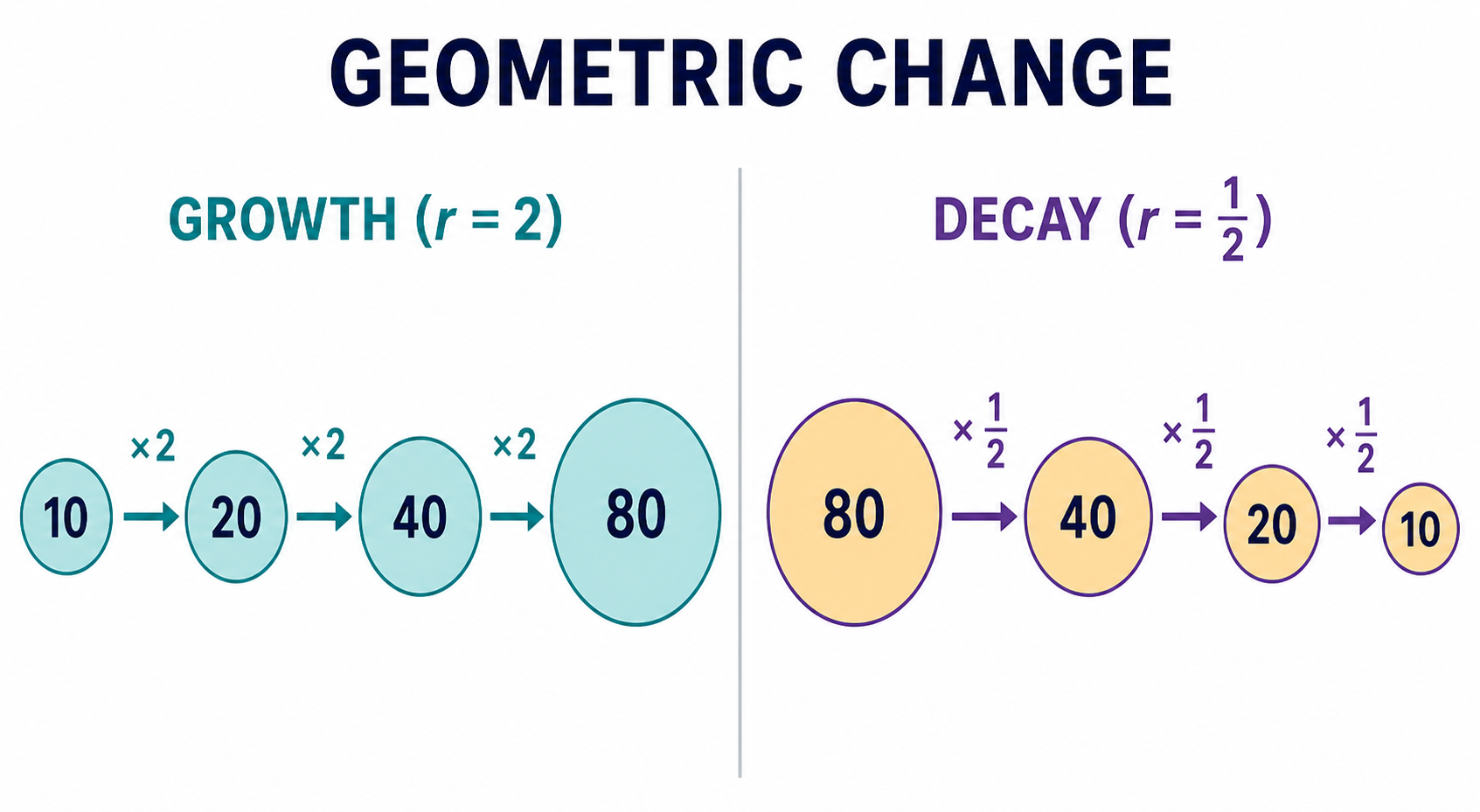 Geometric change repeats the same multiplier. A ratio above 1 produces growth; a positive ratio between 0 and 1 produces decay.
Key terms
- Geometric sequence
- A sequence generated by repeated multiplication by a constant ratio.
- First term
- The starting value, usually written .
- Common ratio
- The multiplier between consecutive terms.
- Geometric series
- A sum of consecutive terms from a geometric sequence.
Worked examples
Sequence or series?
Classify and .
- 1The comma-separated list is a sequence with .
- 2Each term is multiplied by , so .
- 3The expression joined by plus signs is a finite geometric series.
Answer: The list is geometric with ; the sum is a geometric series.
Rules and formulas
Consecutive-term ratio
First term and common ratio
The first term is the value at position 1. To test a sequence, divide each later term by the preceding term. If all defined quotients agree, the sequence is geometric and that value is .
A ratio can be greater than 1, between 0 and 1, negative, 1 or 0. A negative ratio makes signs alternate. If a term is zero, quotient calculations may be undefined, so use the repeated-multiplier description or recurrence relation instead.
Do not confuse a percentage rate with its multiplier. Growth of gives ; decay of gives .
Worked examples
Recognize a negative ratio
Find and for .
- 1The first term is .
- 2Compute , , and .
- 3The constant negative ratio explains the alternating signs.
Answer: and .
Rules and formulas
Growth multiplier
Decay multiplier
Generating terms with recurrence notation
A geometric sequence can be defined recursively by giving a starting term and a rule for moving forward: and .
Recurrence notation mirrors a spreadsheet: enter the first value once, then multiply the preceding cell by the fixed ratio and fill downward.
A recurrence is excellent for generating nearby terms, but the explicit nth-term formula is faster for a distant term.
Worked examples
Generate a decaying sequence
Given and , find the next three terms.
- 1.
- 2.
- 3.
Answer:
Rules and formulas
Geometric recurrence
Finding the nth term
Starting at , reaching requires multiplications by . Therefore the explicit formula is .
The exponent is , not . Check the formula at : it must give .
Keep full calculator precision during the calculation and round only the final contextual value as requested.
Worked examples
Find a distant term
For and , find .
- 1Use .
- 2Substitute: .
- 3Evaluate: .
Answer: to 3 significant figures.
Rules and formulas
Geometric nth term
Behaviour and graphs of geometric sequences
For positive : if , terms grow; if , terms decay toward zero; and if , the sequence is constant. If , every term after the first is zero.
If , signs alternate. When , magnitudes shrink toward zero; when , magnitudes grow. Negative ratios are mathematically valid but often unsuitable for populations, prices or lengths because those quantities cannot alternate in sign.
A sequence graph consists of discrete points at integer values of , not a continuous curve. A smooth exponential curve can show the trend, but values between term numbers are not automatically part of the sequence.
Worked examples
Interpret without calculating every term
Describe .
- 1The ratio is negative, so signs alternate.
- 2Since , magnitudes decrease.
- 3The terms approach , but the sequence is not monotonic because its sign changes.
Answer: An alternating sequence whose terms approach zero.
Finding an unknown term number
To find the position of a given term, solve . Exact powers can sometimes be recognized. Otherwise use a GDC numerical solver, graph intersection or logarithms if appropriate.
For positive , and with , logarithms give . A term number must be a positive integer.
For threshold questions such as “first exceeds,” solve the inequality, move to the next valid integer if necessary, then verify that the previous term fails and the chosen term succeeds.
Worked examples
Find an exact term number
In , which term equals ?
- 1Set .
- 2Divide by 5: .
- 3Therefore , so .
Answer: is the 8th term.
Rules and formulas
Term number from logarithms
Finding unknown terms, first terms and ratios
If two terms are known, and . Dividing eliminates : .
After finding , substitute into either term equation to find . If is even, a positive equation may allow both a positive and a negative ratio; use the data or context to decide whether both are valid.
Do not round a ratio early. Small rounding errors become large when the ratio is raised to a high power.
Worked examples
Use two known terms
A geometric sequence has and . Find and .
- 1Divide: .
- 2Thus .
- 3Use , giving .
Answer: and .
Check for two possible ratios
If and , find the possible ratios.
- 1Divide: .
- 2Therefore or .
- 3A context requiring positive terms would select the positive ratio; otherwise both need consideration.
Answer: .
Rules and formulas
Ratio from two terms
First term from a known term
Geometric series and partial sums
A geometric series is formed by adding geometric-sequence terms: . The symbol means the sum of exactly the first terms.
A term question and a total question are different. “Amount in year 10” requires one term; “total over the first 10 years” requires a series sum.
Always count the number of included terms carefully. From index through , inclusive, there are terms.
Worked examples
Write a geometric series
Write the first five terms of the series with and .
- 1The sequence terms are .
- 2Join the five terms by addition.
- 3Their total is .
Answer: .
Rules and formulas
First n geometric terms
Sum of a finite geometric series
For , a finite geometric sum can be written in two equivalent forms: or . Choose one form and keep numerator and denominator signs consistent.
If , every term equals , so . The usual fraction would divide by zero and must not be used.
The finite-sum formula works for positive, fractional and negative ratios. A finite series does not require a convergence condition.
Worked examples
Calculate a finite sum
Find when and .
- 1Use .
- 2Substitute: .
- 3Evaluate without intermediate rounding: .
Answer: to 3 significant figures.
Rules and formulas
Finite geometric sum
Constant-ratio special case
Why the finite-sum formula works
Begin with . Multiplying by shifts every power: .
Subtracting gives , so . Dividing by produces the formula when .
This derivation is also a useful memory aid: multiplying by the ratio makes the middle terms cancel.
Worked examples
Check a formula against direct addition
Check using the finite-sum formula.
- 1Here , , and .
- 2.
- 3Direct addition also gives .
Answer: .
Finding the number of terms from a sum
When is known, substitute into the finite-sum formula and solve the resulting exponential equation for . Use exact powers, a GDC solver, graph intersection or logarithms.
Because counts terms, it must be a positive integer. A non-integer solution may mean the target total is never attained exactly; a threshold question instead requires the first integer that satisfies an inequality.
Verify by substituting the final integer into the original sum formula, not only the rearranged calculator equation.
Worked examples
Find n from a total
A geometric series has , , and . Find .
- 1Use .
- 2Then , so .
- 3Since , .
Answer: There are terms.
Sigma notation for geometric sums
The capital Greek letter represents addition. A finite geometric sum may be written . Starting at makes the first term .
The index is a counter. Expand the first two and final terms before choosing a formula; this prevents off-by-one errors when the lower limit is not zero.
For , the first term is , the ratio is , and there are terms.
Worked examples
Evaluate a sigma sum
Evaluate .
- 1The first term is , the ratio is , and the indices to give terms.
- 2Use .
- 3This gives .
Answer:
Rules and formulas
Finite geometric sum in sigma notation
Inclusive index count
Infinite geometric series and convergence
An infinite geometric series continues without a final term. This is a relevant extension for repeated processes such as bouncing or recurring payments. It has a finite sum only when .
If , then as . Taking the limit of the finite-sum formula gives .
If , the terms do not approach zero, so the series diverges. The condition is about , not merely : for example, does not converge.
Worked examples
Convergent alternating series
Find .
- 1The first term is and .
- 2Since , the infinite sum exists.
- 3.
Answer: .
Bouncing-ball distance
A ball is dropped 5 m and rebounds to 60% of each previous height. Find its total vertical distance in the idealized infinite model.
- 1The first 5 m downward journey occurs once.
- 2The rebound heights form , with sum m.
- 3Each rebound height is travelled once upward and once downward, so add twice this sum.
Answer: Total distance .
Rules and formulas
Infinite geometric sum
Infinite sigma form
Growth and decay applications
Repeated percentage change is geometric. An increase of uses the multiplier , while a decrease uses . The percentage rate and the multiplier are not the same number.
If is the amount at time , then after complete periods . This time-zero form differs from sequence notation ; choose one convention and label it clearly.
Growth and decay models are common for populations, infections, website traffic, depreciation, medicine concentration and repeated efficiency losses. State the units and whether the model is realistic over the whole interval.
Worked examples
Repeated population growth
A culture starts with 1200 bacteria and grows by 18% each hour. Estimate the population after 6 hours.
- 1The multiplier is .
- 2Use the time-zero model: .
- 3The calculator gives .
Answer: Approximately 3239 bacteria, or 3240 to 3 significant figures.
Repeated depreciation
A car worth $32,000 loses 14% of its value each year. Find its value after 5 years.
- 1The retention multiplier is .
- 2.
- 3.
Answer: Approximately to the nearest dollar.
Rules and formulas
Repeated-change model
Percentage change from ratio
Thresholds, integer time and model constraints
Many AI SL applications ask when a quantity first exceeds or falls below a threshold. The calculator may return a decimal time, but discrete annual, monthly or daily data require an appropriate whole-number period.
If uses for the initial value, then the first sequence term corresponds to time zero. If a question labels that initial value as , the same physical time is .
A model can also have a capacity, non-negativity restriction or practical stopping rule. Check these conditions before summing or extrapolating.
Worked examples
First year above a target
A population is initially 2500 and grows by 7% annually. Find the first whole year when it exceeds 4000.
- 1Solve .
- 2A GDC gives the boundary .
- 3Time is counted in complete years, so test ; the previous value at is still below the target.
Answer: The population first exceeds 4000 after 7 complete years.
When real data are only approximately geometric
Real measurements rarely have identical consecutive ratios. For positive data, an endpoint estimate over positions to is . This spreads the total multiplicative change evenly across the intervals.
Compare predicted and observed values using residuals: . Small, patternless residuals support the model; a curved pattern or steadily changing ratios suggests the model is missing structure.
Interpolation stays within the observed interval and is generally safer than extrapolation. A sensible conclusion states the prediction, units, rounding and at least one model limitation.
Worked examples
Estimate a common ratio from data
Weekly users are . Estimate one geometric ratio using the endpoints.
- 1There are three intervals from the first to the fourth value.
- 2Use .
- 3This represents approximate weekly growth of . Check predictions against the middle observations before relying on the model.
Answer: , or about growth per week.
Rules and formulas
Approximate ratio from endpoints
Residual
Calculator, GDC and spreadsheet methods
Technology is expected in AI SL, but it does not replace mathematical setup. Before using a table or solver, identify the initial value, ratio, index convention and whether the question asks for a term or a sum.
For a sequence table, enter . For a time-zero model, enter . Use integer inputs when the context is discrete.
For an unknown term number, graph the model and target together or use a numerical solver. For imperfect data, use exponential regression, then interpret the regression multiplier and inspect whether extrapolation is reasonable.
Worked examples
Use exponential regression responsibly
A GDC fits to yearly data. Interpret the model.
- 1The predicted value at is .
- 2The multiplier represents approximate growth of per year.
- 3Before predicting, inspect the scatter plot, residuals and distance beyond the observed years.
Answer: Initial model value 82.4 with approximate annual growth of 6.1%.
An AI SL modelling workflow
A strong applied solution follows a repeatable path: define variables and time origin, decide whether change is multiplicative, identify or estimate the ratio, choose a term or sum model, calculate, validate and interpret.
Check multiplicative change by comparing ratios, not differences. If a percentage change repeats, convert it to a multiplier before writing .
Finish with a sentence in context. Include units, appropriate rounding, the required integer decision and any practical reason the model might eventually fail.
Worked examples
Choose term, sum and threshold tools
A campaign reaches 600 people in week 1 and 1.25 times as many each later week. Identify the method for week 8, the first 8 weeks combined, and the first week above 2000.
- 1Week 8 is one term: .
- 2The first 8 weeks combined require .
- 3The first week above 2000 requires solving and checking the first valid integer.
Answer: Use an nth term, a finite series, and a discrete inequality respectively.
Common mistakes and IB AI SL exam strategy
Most lost marks come from indexing, using the percentage instead of the multiplier, confusing a term with a sum, applying the infinite formula without checking convergence, or accepting a non-integer term number.
A quick check is to substitute into an nth-term formula. It should return . For a finite sum, test a small case by direct addition.
Write enough method for another student to reproduce the result: formula, substitution, unrounded technology result, required rounding and contextual statement.
Worked examples
Correct a percentage error
A quantity decreases by per month. A student writes . Correct the model.
- 1The amount retained is .
- 2Therefore the multiplier is , not .
- 3The correct model is .
Answer: Use .
Practice questions with worked solutions
Attempt each question before opening the steps. Questions 1–4 establish the foundations, 5–9 combine formulas, and 10–12 develop application and modelling judgment.
In an exam, give exact forms where sensible and numerical answers to the requested accuracy.
Worked examples
Practice 1 · Identify a geometric sequence
Is geometric? State and .
- 1The consecutive ratios are .
- 2The ratio is constant.
Answer: Yes; and .
Practice 2 · Recurrence relation
Write a recurrence relation for .
- 1The first term is .
- 2The common ratio is .
Answer: .
Practice 3 · Find a term
Find when and .
- 1.
- 2This equals .
Answer: to 3 significant figures.
Practice 4 · Find the term number
Which term of is ?
- 1Solve .
- 2Then .
- 3So .
Answer: It is the 8th term.
Practice 5 · Find a and r
Given and , find the positive ratio and first term.
- 1, so .
- 2Then , so .
Answer: , .
Practice 6 · Finite geometric series
Find the sum of the first 9 terms when and .
- 1Use .
- 2This gives .
Answer: to 3 significant figures.
Practice 7 · Find n from a sum
A series has , , and . Find .
- 1.
- 2Thus , so .
Answer: .
Practice 8 · Sigma notation
Evaluate .
- 1The first term is , the ratio is , and there are terms.
- 2.
Answer:
Practice 9 · Infinite geometric series
Determine whether converges and, if so, find its sum.
- 1The ratio is .
- 2Since , the series converges.
- 3.
Answer: The series converges to .
Practice 10 · Growth application
A social-media account has 750 followers and grows by 12% each month. Predict the number after 8 months.
- 1The multiplier is .
- 2.
- 3Round to a whole follower.
Answer: Approximately 1857 followers.
Practice 11 · Approximate geometric model
Positive observations at years 1 and 5 are and . Estimate a constant annual ratio.
- 1There are intervals.
- 2.
- 3This is approximately growth per year.
Answer: , about annual growth.
Practice 12 · AI SL modelling challenge
A subscription service starts with 500 customers and grows by 15% monthly. Find the first complete month when customers exceed 1000, and estimate total monthly customer-counts from month 0 through that month inclusive.
- 1Use and solve .
- 2The boundary is , so the first complete month is .
- 3Months through give six terms: .
- 4The sum is .
Answer: Month 5; approximately 4377 customer-months.
Topic summary and cheat sheet
Use this final checklist to select a method quickly and present a complete AI SL solution.
A geometric model is powerful because one ratio summarizes repeated proportional change, but every applied conclusion depends on sensible indexing and model assumptions.
Rules and formulas
Common ratio
Nth term
Finite sum
Infinite sum
Repeated-change model
Topic summary
- A geometric sequence repeats multiplication by a constant ratio .
- The first term is .
- When defined, .
- Constant ratios, not constant differences, identify geometric change.
- Recurrence form: , .
- Nth term: .
- The exponent is n − 1 because no multiplication is needed to reach the first term.
- From two terms, .
- An even root can produce positive and negative ratio possibilities.
- A geometric series adds terms: .
- For , .
- Equivalently, .
- When , .
- A finite sum has no convergence requirement.
- With a nonzero first term, an infinite geometric series converges exactly when . A zero first term gives a zero series, which converges for every finite ratio.
- For a convergent infinite series, .
- Finite sigma form: .
- Indices through include terms.
- Growth of uses .
- Decay of uses .
- Time-zero model: .
- Do not confuse a percentage rate with its multiplier.
- For positive endpoint data, .
- Residual equals observed value minus predicted value.
- Term numbers and discrete time values must be integers.
- A first-threshold answer should be checked against the previous period.
- For positive values, logarithms can solve .
- A GDC table should use the correct starting index.
- Exponential regression estimates an initial coefficient and multiplier.
- Interpolation is usually safer than extrapolation.
- Use full calculator precision until the final answer.
- An IB-ready answer includes setup, technology evidence, units, rounding, validation and interpretation.