Reference frames, observers, and relative motion
Motion is always described relative to a reference frame: a coordinate system with synchronized clocks and observers at rest within it. A position, velocity, or time statement is incomplete unless the relevant frame is clear.
An inertial frame is one in which a free object moves with constant velocity. Any frame moving at constant velocity relative to an inertial frame is also inertial. Accelerating and rotating frames are non-inertial, although an accelerating observer can use an instantaneous inertial frame over a sufficiently short interval.
The principle of relativity says that the laws of physics have the same form in every inertial frame. Observers may disagree about measured coordinates and velocities while agreeing on physical laws and on events—specific occurrences at particular places and times.
Key terms
- Reference frame
- A coordinate system and clock network used to assign positions and times to events.
- Inertial frame
- A frame in which an object with zero resultant force has constant velocity.
- Observer
- An idealized set of measuring instruments at rest in a specified frame.
- Event
- A physical occurrence identified by one position and one time in a chosen frame.
Worked examples
Two cars on a straight road
Car A moves east at and car B moves east at , both measured from the road. Find B's velocity relative to A.
- 1Choose east as positive and subtract the frame velocity.
- 2.
- 3The negative sign means B moves west relative to A: A pulls ahead at 7 m .
Answer: B's velocity relative to A is , or west.
One event, two coordinate descriptions
A passenger walking at constant horizontal velocity inside a steadily moving train releases a coin without pushing it. Neglect air resistance. Explain what the passenger and a platform observer agree and disagree about.
- 1Both observers agree that the coin-release event and floor-impact event occur.
- 2Relative to the passenger, the coin falls vertically. Relative to the train, it retains the passenger's horizontal walking velocity while falling.
- 3In the platform frame, the coin's horizontal velocity is the train's velocity plus the passenger's walking velocity relative to the train. Its path is generally parabolic; it is vertical if those horizontal velocities cancel.
- 4At ordinary speeds, both descriptions are related by classical coordinate transformations and predict the same impact.
Answer: They agree on the physical events and laws, but assign different positions, paths, and velocities to the coin.
Rules and formulas
Classical relative velocity
- velocity of B measured in A's frame ()
- a third reference frame
Uniform frame motion
- constant velocity of S' relative to S ()
Galilean transformations and their classical limit
Let frame move at constant velocity in the positive -direction relative to frame , with origins together at . Galilean transformations use , while , , and—most importantly—.
Differentiating the position transformation gives classical velocity addition: , or equivalently . Accelerations are the same in both frames, so Newton's second law keeps the same form for ordinary inertial motion.
The hidden assumption is universal time. If light moved at speed in , Galilean addition would predict or in . Experiments instead show the same vacuum light speed in every inertial frame, so Galilean transformations are only a low-speed approximation when .
Key terms
- Galilean transformation
- The classical mapping between coordinates in inertial frames with universal time.
- Classical velocity addition
- The rule that relative collinear velocities add or subtract directly.
- Classical limit
- The regime v much smaller than c, where relativistic predictions approach Newtonian results.
Worked examples
Transforming a train coordinate
Frame moves at relative to . An event occurs at and in . Find its Galilean coordinates in .
- 1Use .
- 2Galilean time is universal, so .
- 3The event is 70 m ahead of the moving origin at that instant.
Answer: and .
Why classical addition fails for light
A spacecraft travels at and emits a forward light pulse. What speed would Galilean addition predict in the ground frame, and what does special relativity predict?
- 1Classically, .
- 2The second postulate of special relativity requires every inertial observer to measure the pulse at c.
- 3The disagreement is not an experimental uncertainty; it shows that the classical transformation of space and time must change.
Answer: Galilean addition predicts , whereas special relativity predicts exactly .
Rules and formulas
Galilean position transformation
- position in S ()
- position in S' ()
Inverse Galilean transformation
- time in S ()
Galilean velocity transformation
- object velocity in S ()
- object velocity in S' ()
Acceleration invariance classically
- acceleration component in S ()
Einstein's postulates and the light-clock argument
Special relativity begins with two postulates. First, the laws of physics have the same form in all inertial frames. Second, light in vacuum has the same speed c for every inertial observer, independent of the source's or observer's motion.
A light clock sends a pulse between two parallel mirrors. In the clock's own frame, the pulse travels vertically. In a frame where the clock moves sideways, the mirrors change horizontal position during the pulse's journey, so the light follows a longer diagonal trajectory.
Take emission and return of the pulse to the same mirror as the two events. Because both observers measure the same light speed , the longer ground-frame path takes more coordinate time. For uniform relative motion, geometry gives , where is the proper round-trip time measured by a clock fixed at that mirror.
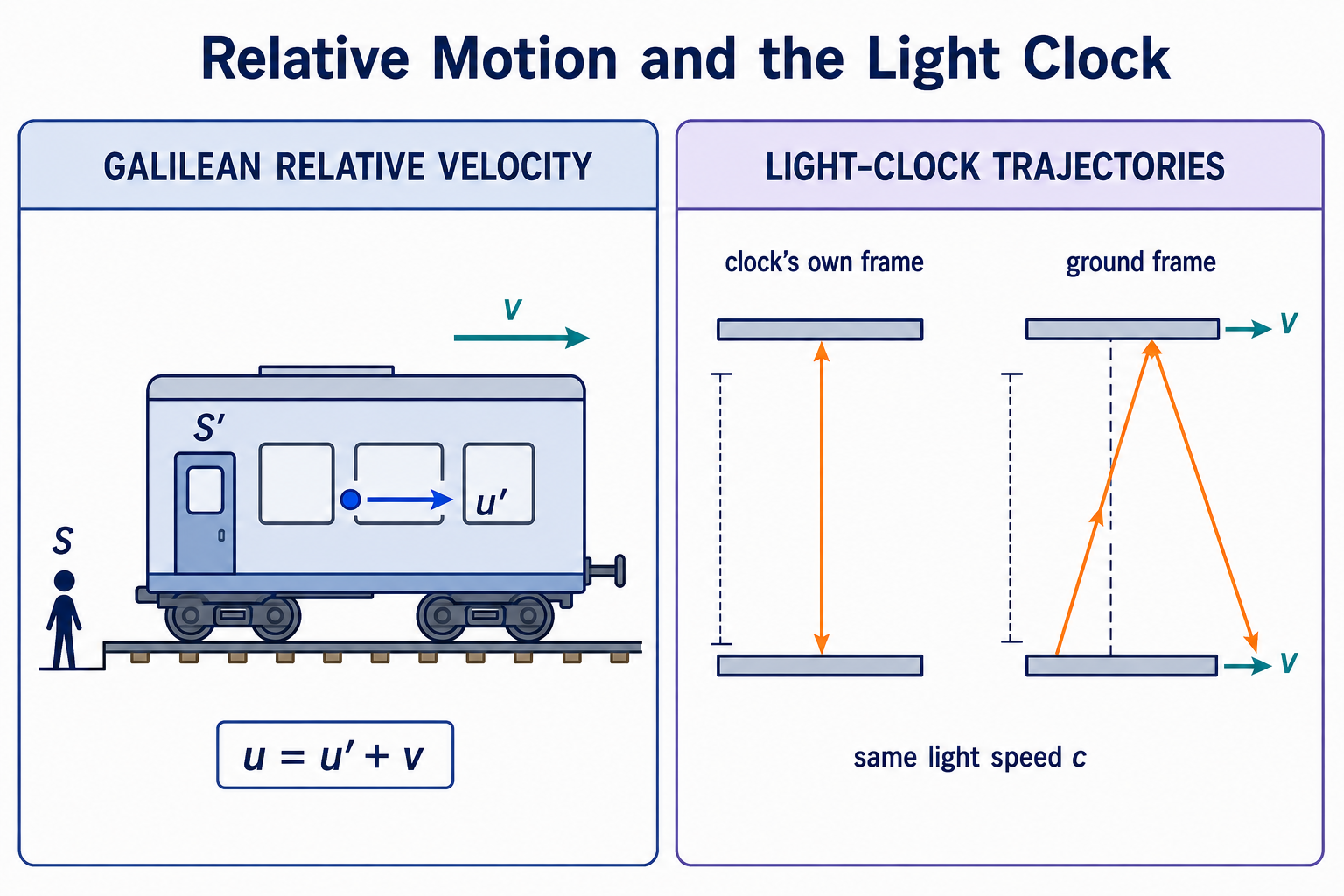 Left: signed collinear velocities in the Galilean model. Right: a transverse light clock in its own frame and in a ground frame where it moves uniformly right at speed . In the ground frame both the outward and return light paths advance right; the returning pulse meets the lower mirror after it has moved. Mirror bars mark schematic initial positions, not their positions throughout the cycle; ray angles and distances are not to scale. One tick is emission and return at the same point of the clock, so and , where is the mirror separation.
Key terms
- First postulate
- All laws of physics have the same form in every inertial reference frame.
- Second postulate
- Every inertial observer measures the same vacuum light speed c.
- Light clock
- An ideal clock that measures time using a light pulse reflected between mirrors.
- Proper time
- The time between two events measured by one clock present at both events.
Worked examples
Deriving time dilation from one light-clock leg
A light clock has mirror separation perpendicular to its constant velocity relative to the ground. Let be the full round-trip time from emission to return at the same mirror in the clock's rest frame, and let be the ground-frame interval between those same events. Assume light travels in vacuum. Show how the photon paths imply time dilation.
- 1In the clock frame, one leg satisfies .
- 2In the ground frame, Pythagoras gives .
- 3Substitute , multiply by 4, and rearrange: .
- 4Therefore .
Answer: The moving clock's two events are separated by coordinate time , which is larger than the proper time.
What the observers agree about
An observer at rest with a transverse light clock and an observer in the ground frame analyze two successive reflections of the same light pulse at opposite mirrors. The clock moves at constant velocity relative to the ground, and the pulse travels in vacuum. Identify what the observers must agree about and what can differ.
- 1They agree on the two physical reflection events and on the speed of light c.
- 2They disagree on the spatial separation between those events because the moving clock changes position in one frame.
- 3They therefore assign different elapsed times while preserving the same light speed and invariant spacetime interval.
Answer: They agree on the two events, physical laws, vacuum light speed , the zero spacetime interval and the order of these light-connected events. They may assign different spatial separations and elapsed coordinate times, but these events cannot become simultaneous in another inertial frame.
Rules and formulas
Vacuum light speed
- speed of light in vacuum ()
Stationary light-clock path
- mirror separation ()
- proper round-trip time ()
Moving light-clock geometry
- round-trip coordinate time ()
The Lorentz factor and the low-speed limit
Relativistic effects are organized by the Lorentz factor . It depends only on the magnitude of relative speed, is dimensionless, and is always at least 1 for a massive observer moving slower than light.
For , . In ordinary low-speed processes, the remaining time-coordinate correction is also negligible at the required precision, and Lorentz predictions are well approximated by Galilean ones. This explains the success of Newtonian mechanics for everyday motion; a small frame speed alone does not make relativity-of-simultaneity effects identically zero over arbitrarily large separations.
As approaches , the denominator approaches zero and grows rapidly. The value becomes very sensitive to rounding, so enter the full ratio , use parentheses around the square root, and keep guard digits.
Key terms
- Lorentz factor
- The dimensionless factor controlling time dilation, length contraction, and Lorentz transformations.
- Beta
- The dimensionless speed ratio .
- Low-speed limit
- The regime β much smaller than 1, where γ approaches 1.
Worked examples
Lorentz factor at 0.60c
Calculate for .
- 1Use .
- 2.
- 3The result is greater than 1 and dimensionless, as required.
Answer: .
Speed corresponding to
Find the speed as a fraction of when .
- 1Rearrange .
- 2.
- 3Therefore to three significant figures.
Answer: .
Rules and formulas
Dimensionless speed
- speed as a fraction of c
Lorentz factor
- Lorentz factor
Speed from Lorentz factor
- relative speed ()
Lorentz transformations of position and time
For standard configuration, moves at speed along positive relative to , and the origins coincide when . The Lorentz transformations are and , with and .
Space and time coordinates mix. The time assigned to an event in one frame depends on both its time and position in another frame. This mixing replaces Galilean universal time and makes the light speed invariant.
The inverse transformation is obtained by replacing with : and . Use signed coordinates and the correct direction of frame motion rather than inserting speed magnitudes blindly.
Key terms
- Lorentz transformation
- The spacetime-coordinate mapping between inertial frames that preserves c and the spacetime interval.
- Standard configuration
- Frames with parallel axes, relative motion along x, and coincident origins at zero time.
- Inverse transformation
- The mapping from primed coordinates back to unprimed coordinates, obtained by reversing v.
Worked examples
An event on the moving origin
Frame moves at . In , an event occurs at and . Find and .
- 1For , . Also .
- 2, so the event lies at the moving origin.
- 3.
- 4.
Answer: and .
Recovering the same event with the inverse transform
An event has and in a frame moving at . Recover its coordinates in .
- 1Use .
- 2This gives .
- 3Use .
- 4The recovered coordinates match the previous example, checking the signs and units.
Answer: and .
Rules and formulas
Lorentz position transformation
- event position in S' ()
Lorentz time transformation
- event time in S' ()
Transverse coordinates
- coordinate perpendicular to relative motion ()
Inverse position transformation
- event position in S ()
Inverse time transformation
- event time in S ()
Relativistic velocity addition and the speed limit
Differentiating the Lorentz transformations gives the collinear velocity-addition rule. If an object moves at in , while moves at relative to , then .
The denominator prevents two subluminal velocities from combining to exceed c. It also ensures that if one observer measures light at c, every inertial observer does as well.
At low speeds, is negligible, so the denominator approaches 1 and . The relativistic rule therefore has the correct classical limit.
Key terms
- Relativistic velocity addition
- The Lorentz-consistent rule for combining velocities measured in different inertial frames.
- Subluminal
- Having speed less than c.
- Invariant speed
- A speed with the same measured value in all inertial frames.
Worked examples
Probe launched from a fast spacecraft
A spacecraft travels at relative to Earth and launches a probe forward at relative to the spacecraft. Find the probe's Earth-frame speed.
- 1Use .
- 2.
- 3The result is below c even though the classical sum is 1.30c.
Answer: The probe moves at approximately relative to Earth.
Checking the invariance of c
Set in the relativistic addition formula and show that for any allowed frame speed .
- 1Substitute: .
- 2Write the numerator as .
- 3The common factor cancels, giving .
Answer: Every inertial frame measures the light pulse at .
Rules and formulas
Forward collinear velocity addition
- object velocity in S ()
- object velocity in S' ()
Inverse velocity transformation
- velocity of S' relative to S ()
Dimensionless velocity form
- invariant light speed ()
Spacetime interval, proper time, and causal type
Although observers disagree on and , they agree on the spacetime interval for one-dimensional motion. Lorentz transformations preserve this quantity.
For timelike-separated events, there is an inertial frame in which both occur at the same place. An inertial clock at rest there measures the proper interval, with . This is the elapsed time along the straight, constant-velocity worldline joining the events. An accelerating clock can also pass through both events but need not record this same elapsed time, so the endpoint-interval formula is not a general shortcut for changing-velocity journeys.
If , the separation is timelike and a subluminal causal influence is possible. If , it is lightlike. If , it is spacelike; no signal traveling at or below can connect the events.
Key terms
- Spacetime interval
- A Lorentz-invariant combination of the time and spatial separations between two events.
- Timelike separation
- An interval for which a slower-than-light causal connection can exist.
- Lightlike separation
- An interval connecting events that can be joined by a light signal.
- Spacelike separation
- An interval whose events cannot be causally connected at or below c.
Worked examples
Finding proper time from an interval
In frame , two events have and . Find their proper-time separation.
- 1Convert the time separation to a light-travel distance: .
- 2.
- 3Thus and .
Answer: The events are timelike separated and .
Classifying a spacelike pair
Two events are separated by and . Classify their separation.
- 1The maximum distance light travels in the time is .
- 2Since , .
- 3The events are spacelike separated, so neither can cause the other without faster-than-light signaling.
Answer: The separation is spacelike; the event order can differ between frames without violating causality.
Rules and formulas
One-dimensional spacetime interval
- invariant spacetime interval ()
Three-dimensional spacetime interval
- transverse spatial separation ()
Inertial-clock proper time from a one-dimensional interval
- elapsed time on the inertial clock joining the timelike-separated events ()
Interval classification
- interval under the +--- sign convention ()
Time dilation and atmospheric-muon evidence
For two events occurring at the same position in an inertial clock's rest frame, the clock measures proper time . A frame in uniform relative motion assigns the larger coordinate-time interval , with calculated from that constant relative speed.
Time dilation is reciprocal between inertial observers comparing steadily moving clocks, but a complete comparison must specify which pair of events and which clocks are used. Apparent contradictions usually come from switching event pairs or ignoring simultaneity.
Atmospheric muons provide direct evidence. Muons created high in the atmosphere have short proper lifetimes, yet many reach Earth's surface. In Earth's frame, their moving decay clocks are time-dilated; in the muon frame, the atmosphere's thickness is length-contracted. Both frames predict the same detections.
Key terms
- Time dilation
- The larger coordinate-time interval measured for a clock moving between two events.
- Proper lifetime
- A particle's lifetime measured in the particle's own rest frame.
- Atmospheric muon
- An unstable particle created by cosmic-ray interactions in the upper atmosphere.
Worked examples
Muon survival distance
A muon has proper mean lifetime and travels at . Estimate its mean lifetime and distance in Earth's frame.
- 1.
- 2.
- 3Distance .
- 4Without time dilation, the classical mean distance would be only about 0.66 km.
Answer: Earth observers measure about and , explaining why many muons reach the surface.
A spacecraft clock
A clock fixed in a spacecraft moving inertially at relative to Earth records between two events at that clock's location. How much coordinate time elapses between these same events in Earth's frame?
- 1The onboard clock is present at both events, so .
- 2For , .
- 3.
Answer: Earth measures .
Rules and formulas
Time dilation for uniform relative motion
- coordinate time in a frame where the clock moves ()
- proper time on the moving clock ()
Uniform-motion proper time
- Lorentz factor
Travel distance in a frame
- coordinate distance traveled ()
Length contraction and proper length
The proper length of an object is measured in the object's rest frame using the positions of its endpoints. An observer who sees the object move parallel to its length measures the contracted length.
Length contraction is , so . It occurs only along the direction of relative motion; transverse dimensions are unchanged.
A length measurement requires both endpoint positions at the same time in the measuring frame. Because simultaneity is frame-dependent, length contraction is inseparable from the relativity of simultaneity and is not a visual-snapshot distortion.
Key terms
- Proper length
- The distance between an object's endpoints measured in the object's rest frame.
- Length contraction
- The reduced longitudinal length measured in a frame where the object moves.
- Longitudinal direction
- The direction parallel to the relative velocity between frames.
Worked examples
Fast spacecraft length
A spacecraft has proper length along its direction of motion and moves at relative to Earth. Find its Earth-frame length using endpoint positions measured simultaneously in Earth's frame.
- 1The spacecraft is at rest in its own frame, so .
- 2At , .
- 3.
Answer: Earth observers measure a longitudinal length of .
Atmosphere in the muon frame
An atmospheric layer has proper thickness in Earth's frame. A muon moves at perpendicular to the layer. What thickness does it measure from the simultaneous positions of the layer's two boundaries in its inertial rest frame?
- 1Earth is the atmosphere's rest frame, so its 10.0 km thickness is the proper length.
- 2Use .
- 3.
- 4This shorter distance is consistent with the muon's 2.2 μs proper lifetime and high speed.
Answer: The muon measures approximately .
Rules and formulas
Length contraction
- length in frame where object moves ()
- proper length ()
Proper length from contracted length
- rest-frame length ()
Simultaneous endpoint condition
- time difference between endpoint measurements ()
Relativity of simultaneity and clock synchronization
For two events, the time-separation transformation is . Even if in , separated events generally have in . Simultaneity at different places is therefore not absolute.
Clocks at different positions in one frame can be synchronized using equal outward and return light-travel times. A frame moving relative to that synchronized clock network does not judge the separated clocks to be synchronized in the same way.
For spacelike-separated events, different inertial frames can disagree on which happened first. This does not threaten causality because no signal traveling at or below c can connect those events. Timelike- and lightlike-separated distinct events keep the same causal order in every inertial frame.
Key terms
- Simultaneous events
- Events assigned the same time coordinate in a specified reference frame.
- Clock synchronization
- A frame-specific procedure for assigning consistent readings to separated clocks.
- Event order
- The temporal sequence assigned to events by a reference frame.
Worked examples
Two events simultaneous in S
Two events are simultaneous in , separated by . Find for a frame moving at in the positive x-direction.
- 1Here and .
- 2.
- 3.
- 4The negative sign means the event at larger x occurs earlier in S' under the stated event-order convention.
Answer: ; the events are not simultaneous in .
Lightning strikes and a moving train
Lightning strikes the front and rear of a platform at the same time in the platform frame. A train moves toward the front strike. Explain why the strikes are not simultaneous in the train frame.
- 1Receiving the front flash first is not by itself the proof, because signal travel time must be corrected.
- 2After applying the train frame's synchronized clocks or Lorentz time transformation, the front event has an earlier time coordinate than the rear event.
- 3Both frames agree on the two strike events but use different planes of simultaneity.
Answer: The Lorentz transformation mixes time and position, so spatially separated events simultaneous on the platform have different train-frame times.
Rules and formulas
Time-separation transformation
- event time separation in S' ()
Simultaneous in S
- event spatial separation in S ()
Einstein synchronization condition
- reading assigned to the reflection event on distant clock B ()
Spacetime diagrams, worldlines, and causality
A basic spacetime diagram plots position horizontally and vertically so both axes have length units. Light rays through the origin satisfy and appear at when the axes use equal scales. A light cone drawn from another event is translated to that event.
A stationary object's worldline is vertical. A particle with constant velocity follows , where is its position at ; through the origin this becomes . On equal-scale – axes, its non-negative angle from the positive -axis satisfies . Faster subluminal motion tilts closer to a light line. The future segment remains inside the light cone drawn from any earlier event on that worldline.
The moving frame's -axis is the worldline , while its -axis is the line , given by . Both tilt toward a light line as increases. Lines parallel to represent simultaneity in ; read primed coordinates by projecting parallel to the other primed axis. The tilted axes do not use the same drawn ruler scale as the unprimed axes. For a chosen positive length unit , the curve locates the mark on the positive -axis and the mark on the positive -axis; these are different events. Similarly, locates the and marks on their respective positive space axes. These constant-interval curves set the tick marks; copying unprimed tick spacing onto a tilted axis gives incorrect coordinates.
Key terms
- Worldline
- The path of an object or signal through spacetime.
- Light cone
- The set of lightlike paths through an event, separating possible causal regions from spacelike regions.
- ct axis
- A time axis scaled by c so that it has the same units as position.
- Plane of simultaneity
- A line in a one-dimensional spacetime diagram containing events simultaneous in a frame.
Worked examples
Reading a constant-velocity worldline
An object moves in the positive -direction at from the origin. Where is it on a spacetime diagram with horizontal and vertical when ? Compare with a right-moving light ray emitted from the origin.
- 1Use .
- 2A right-moving light ray has .
- 3The object's point lies inside the light cone because its worldline is steeper than the light ray when ct is vertical.
Answer: The object is at ; light is at .
Causal reach from an event
Event P is at the origin. Event Q has coordinates and . Can P cause Q?
- 1The future light cone at reaches only .
- 2Q lies outside because .
- 3Equivalently, , so the separation is spacelike.
Answer: No signal at or below c can travel from P to Q, so P cannot cause Q.
Rules and formulas
Light-ray worldlines through the origin
- position coordinate ()
Constant-velocity worldline and angle to the time axis
- time coordinate expressed as a length ()
- position at ()
- constant signed particle velocity ()
- non-negative angle from the positive ct-axis on an equal-scale x–ct diagram ()
Moving time axis
- speed of S' relative to S ()
Moving space axis
- position along the S axis ()
Causal speed condition
- required signal velocity ()
Relativity synthesis and an IB exam workflow
Relativity questions are usually decided before the calculator is used. Identify the two events, name the frames, state which frame moves and in what direction, and determine whether the given time or length is proper.
Choose the smallest appropriate tool: Galilean transformation for an explicitly classical low-speed model; Lorentz transformation for event coordinates; velocity addition for measured velocities; interval methods for invariant separation; or dilation/contraction after identifying proper quantities.
Solve symbolically, convert all times and distances to consistent SI units, calculate the Lorentz factor once with guard digits, and check the result against physical limits: gamma at least 1, speeds no greater than c, dilated time no smaller than proper time, and contracted length no larger than proper length.
Key terms
- Proper quantity
- A time or length measured in the special frame where its defining events have the required same-position or rest condition.
- Invariant
- A quantity on which all inertial observers agree.
- Physical limit check
- A comparison with required bounds and low-speed behavior used to catch errors.
Worked examples
Choosing the correct relationship
Match each task to its most direct method: transform one event; combine two high velocities; compare a moving clock; compare a moving rod; classify whether two events can be causally connected.
- 1One event's coordinates: Lorentz transformations.
- 2Two high collinear velocities: relativistic velocity addition.
- 3Moving clock with same-position events in its rest frame: time dilation.
- 4Moving rod parallel to its length, using simultaneous endpoint positions in the measuring frame: length contraction.
- 5Causal classification: spacetime interval or light-cone comparison.
Answer: Choose from event transformation, velocity addition, time dilation, length contraction, or interval methods according to the quantity and event geometry.
One consistent high-speed journey
A ship moves at for in Earth's frame. Find the onboard elapsed time and the Earth-frame distance, then check the interval.
- 1, so onboard proper time is .
- 2Earth measures distance light-hours.
- 3The interval gives .
- 4The time-dilation and interval calculations agree.
Answer: The ship records 3.0 h, Earth measures 4.0 light-hours of travel, and both descriptions give the same spacetime interval.
Rules and formulas
Core relativity chain
- dimensionless speed
- Lorentz factor
One-dimensional inertial-clock proper-time check
- elapsed time on the inertial clock joining the timelike-separated events ()
- constant signed velocity of that clock in the frame providing Δx and Δt ()
Low-speed consistency
- relative speed ()
Topic summary
- A reference frame assigns coordinates using rulers and synchronized clocks; inertial frames move at constant velocity relative to one another.
- Physical events and laws are frame-independent even though measured coordinates and velocities can differ.
- Galilean transformations use and universal time ; they are accurate only when .
- Special relativity postulates identical physical laws and identical vacuum light speed in all inertial frames.
- The Lorentz factor is at least 1 and approaches 1 in the classical limit.
- Lorentz transformations mix position and time: and .
- The inverse Lorentz transformation is obtained by reversing the sign of the frame velocity.
- Relativistic velocity addition preserves c and never combines subluminal velocities into a superluminal result.
- The invariant interval is in one-dimensional motion.
- Timelike, lightlike, and spacelike intervals determine which events can be causally connected.
- Proper time is measured by one clock present at both events; moving-frame coordinate time is dilated.
- For uniform relative motion, time dilation is , where is measured by the inertial clock present at both events.
- Atmospheric-muon survival agrees with time dilation in Earth's frame and length contraction in the muon frame.
- Proper length is measured in an object's rest frame and is the largest longitudinal length.
- Length contraction is and acts only parallel to relative motion.
- Measuring length requires simultaneous endpoint coordinates in the measuring frame.
- Spatially separated events simultaneous in one frame are generally not simultaneous in another.
- Spacelike event order may change between frames without violating causality.
- On equal-scale – axes, light rays are at and a constant-velocity worldline makes an angle to the positive time axis with . Future subluminal motion from an event lies inside that event's light cone.
- A complete IB solution labels events and frames, identifies proper quantities, uses consistent units and signs, and checks classical and relativistic limits.