Work, energy, and power
Energy is a scalar quantity that makes it possible to predict change without following every force and acceleration at every instant. A force can transfer energy by doing work; the transferred energy can appear in kinetic, gravitational, elastic, thermal, or other stores.
The same situation can be described at two levels. Energy conservation accounts for every energy store and transfer; the total energy of an isolated system remains constant. In the mechanical model, mechanical-energy conservation means that the sum of kinetic and potential energies remains constant: the net work done by non-conservative forces is zero. Friction and drag can transfer mechanical energy into non-mechanical stores.
Power answers a different question: how quickly is energy transferred? Efficiency compares the useful output with the total input. A complete model therefore follows the chain: identify the system, identify the transfers and stores, conserve total energy, and then calculate the rate and useful fraction.
Key terms
- Energy
- A scalar quantity that is conserved in an isolated system and can be transferred between stores.
- Work
- Energy transferred by a force acting through a displacement.
- Power
- The rate at which work is done or energy is transferred.
- Efficiency
- The useful energy or power output divided by the total input.
Worked examples
Lift, work, and power
A weightlifter raises a mass vertically by in . Find the useful work and average useful power. Use .
- 1The useful transfer is into gravitational potential energy: .
- 2 to three significant figures.
- 3.
Answer: The useful work is and the average useful power is .
An energy-transfer snapshot
A device receives in and transfers usefully. Find its input power and efficiency.
- 1Input power is the input energy per time: .
- 2Efficiency is .
- 3The remaining , or 20% of the input, is not included in the stated useful transfer. These figures alone do not establish whether it is stored in the device or transferred elsewhere; describe it as dissipated only if that is specified.
Answer: The input power is and the efficiency is .
Rules and formulas
Conservation of total energy
- total energy of the chosen isolated system ()
Average power
- average power ()
- energy transferred ()
- time interval ()
Efficiency
- efficiency as a decimal ()
Work and force–displacement graphs
For a constant force, work depends on the component parallel to the displacement: , where is the angle between the force and displacement vectors. Work is a scalar and its SI unit is the joule: .
Work is positive when the parallel force component points with the displacement, negative when it points against the displacement, and zero when it is perpendicular. A normal force on an object sliding along a fixed surface therefore does no work because the force and displacement are at .
If force changes with position, split the motion into narrow displacement intervals. The signed area under a force–displacement graph gives the work: area above the displacement axis is positive and area below it is negative. Rectangles, triangles, and trapezia often provide the required area without calculus.
Key terms
- Joule
- The SI unit of work and energy; one joule equals one newton metre.
- Positive work
- Energy transfer associated with a force component in the direction of displacement.
- Negative work
- Energy transfer associated with a force component opposite to displacement.
- Variable force
- A force whose magnitude or direction changes with position.
Worked examples
Pulling at an angle
A student pulls a crate along a horizontal floor with a constant force directed above the horizontal. Find the work done by the pulling force.
- 1The angle between the force and horizontal displacement is .
- 2Use : .
- 3 to three significant figures.
Answer: The pulling force does of positive work.
Triangular force–displacement graph
The component of force along an object's straight-line displacement increases linearly with displacement from to as the object moves . Find the work done by this force from its force–displacement graph.
- 1The area under the graph is a triangle.
- 2.
- 3The area is .
Answer: The work done is .
Rules and formulas
Work by a constant force
- work done by the force ()
- force magnitude ()
- displacement magnitude ()
- angle between force and displacement ()
Work by the parallel component
- signed force component parallel to displacement ()
Work from a variable force
- parallel force plotted against displacement ()
Kinetic energy and the work–energy theorem
Translational kinetic energy is , where is the magnitude of momentum. It is scalar, cannot be negative, and depends on speed rather than velocity direction. Doubling speed multiplies kinetic energy by four; doubling mass at fixed speed only doubles it.
The work–energy theorem states that the net work done by all external forces equals the change in kinetic energy: . Positive net work increases speed, while negative net work decreases speed.
Net work is not generally the work done by just one convenient force. If a driving force, friction, gravity, and a normal force act, add the work done by every force or first find the resultant force component along the displacement.
Key terms
- Kinetic energy
- Energy associated with the translational motion of an object.
- Work–energy theorem
- The net work on an object equals its change in kinetic energy.
- Net work
- The sum of the work done by all forces on the object.
- Speed dependence
- Kinetic energy is proportional to the square of speed.
Worked examples
Car accelerating
A car speeds up from to . Find the net work done on it.
- 1Apply .
- 2.
- 3, which is positive because the speed increases.
Answer: The net work is .
Finding speed without time
A box starts from rest. A constant resultant force does of work. Find the final speed.
- 1The work–energy theorem gives .
- 2Substitute the mass: , so .
- 3Take the positive square root because speed is a magnitude: .
Answer: The final speed is .
Rules and formulas
Translational kinetic energy
- kinetic energy ()
- mass ()
- speed ()
- magnitude of momentum ()
Work–energy theorem
- initial speed ()
- final speed ()
Gravitational potential energy near Earth's surface
Near Earth's surface, a change in height changes gravitational potential energy by . The result depends only on the initial and final heights, not on the path between them, because gravity is a conservative force.
The zero of gravitational potential energy is a chosen reference level. Changing the reference changes the numerical value of , but it does not change or any prediction. State the reference when an absolute value is shown.
Gravity does positive work when an object moves downward and negative work when it moves upward: . When gravity is the only force doing work, a decrease in appears as an equal increase in kinetic energy.
Key terms
- Gravitational potential energy
- Energy associated with the position of masses in a gravitational field.
- Reference level
- The chosen height at which gravitational potential energy is defined to be zero.
- Conservative force
- A force whose work depends only on the initial and final positions, not on the path.
- Gravitational field strength
- Force per unit mass; near Earth its magnitude is approximately 9.81 N .
Worked examples
Climber gaining height
A climber rises through a vertical height of . Find the increase in gravitational potential energy.
- 1Use the vertical height change, not the distance along the climbing route.
- 2.
- 3.
Answer: The gravitational potential energy increases by .
Speed after a vertical drop
A cart is released from rest above the bottom of a frictionless track. Find its speed at the bottom.
- 1The loss in gravitational potential energy equals the gain in kinetic energy: .
- 2Mass cancels, so .
- 3.
Answer: The cart reaches approximately .
Rules and formulas
Change in gravitational potential energy
- change in gravitational potential energy ()
- gravitational field strength ()
- final height minus initial height ()
Gravitational potential energy from a chosen zero
- height above the chosen reference ()
Work done by gravity
- work done by gravity ()
Elastic potential energy and springs
Within its linear elastic range, a spring obeys Hooke's law: the restoring force is opposite to displacement and has magnitude . The extension or compression is measured from the spring's natural, unstrained length.
Because spring force grows from zero to , the work required to deform it is the triangular area under its force–extension graph. The elastic potential energy stored is therefore , not or .
When the spring returns toward its natural length, it can transfer elastic potential energy into kinetic energy or another store. The quadratic energy model requires a linear force–deformation relationship. An object can still be elastic beyond its limit of proportionality; beyond its elastic limit, it may not return fully to its original shape.
Key terms
- Elastic potential energy
- Energy stored when an elastic object is stretched or compressed.
- Spring constant
- The force per unit extension in the linear region; it measures stiffness.
- Natural length
- The unstrained length of a spring, from which extension or compression is measured.
- Elastic limit
- The deformation limit beyond which an object may not return fully to its original shape.
Worked examples
Spring launcher
A spring of constant is compressed by and launches a cart on a level frictionless track. Find the stored energy and launch speed.
- 1.
- 2Conservation gives : .
- 3.
Answer: The spring stores and the cart leaves at .
Extra work over an extension interval
A spring obeys Hooke's law with . How much additional work must an external force do to stretch it slowly, without energy losses, from an extension of to ?
- 1The required work equals the increase in elastic potential energy.
- 2.
- 3.
Answer: The additional work is .
Rules and formulas
Hooke's law
- spring restoring force ()
- spring constant ()
- extension or compression from natural length ()
Elastic potential energy
- elastic potential energy ()
Change in elastic potential energy
- initial deformation ()
- final deformation ()
Conservation of mechanical energy and energy transfers
Mechanical energy is the combined kinetic and potential energy of the chosen system: . If only conservative forces transfer energy within an isolated mechanical system, this total remains constant.
An energy equation compares states rather than describing the route between them. List every relevant store at the initial and final states, include any transfer across the system boundary, and cancel terms that are zero or unchanged. Mass often cancels in gravity-only motion, explaining why the predicted speed is independent of mass.
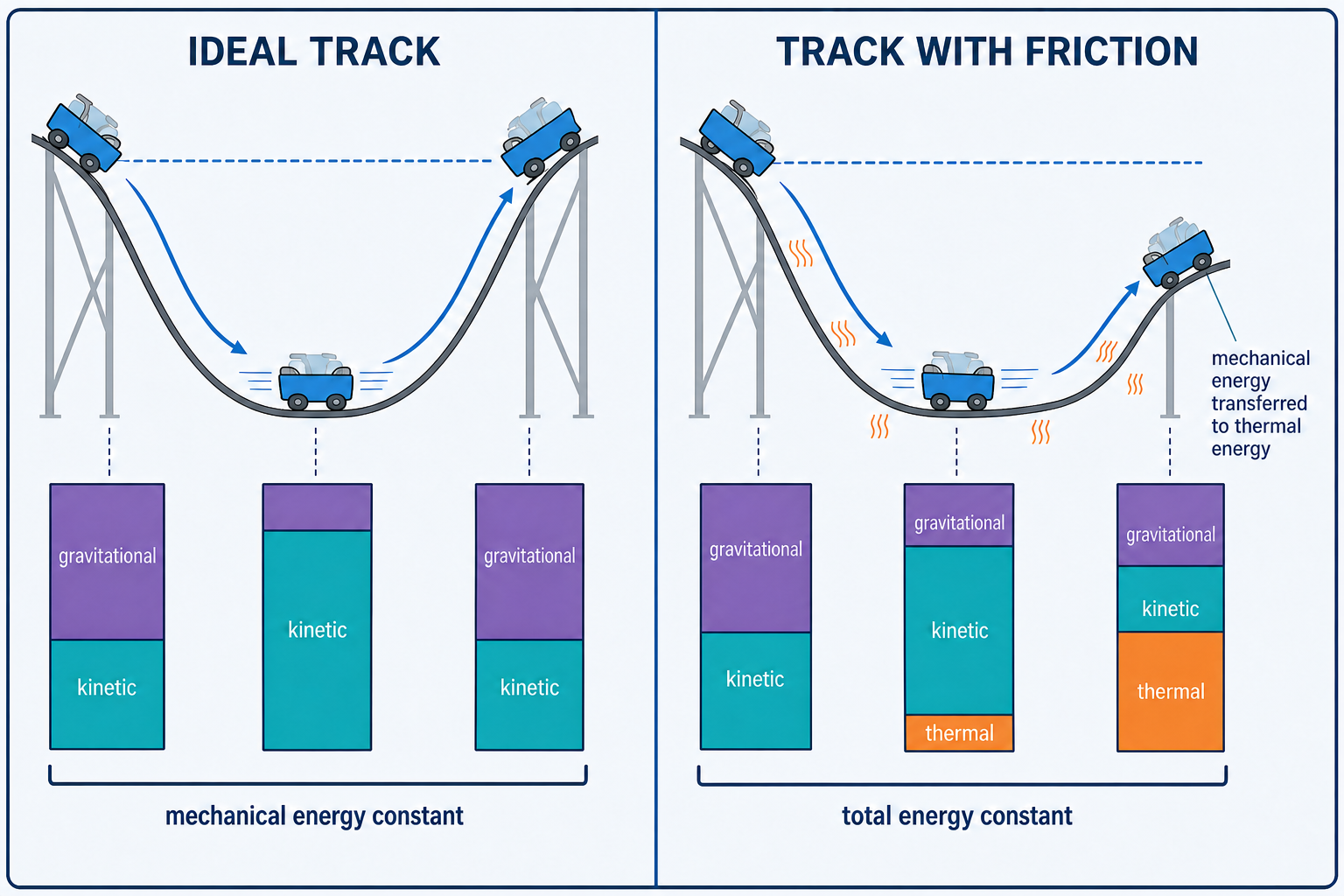 Schematic snapshots, not numerical scale drawings. On the ideal track, kinetic and gravitational potential energy exchange while their sum remains constant. With friction, some mechanical energy becomes thermal energy. Each full bar represents the same total for the cart–track–Earth system, assuming negligible energy transfer to its surroundings. The first and last snapshots still have kinetic energy: they are not release-from-rest or turning points. The right-hand cart is shown at one lower uphill position, not at a calculated maximum height. The gravitational potential-energy reference is arbitrary, so its valley value need not be zero.
Key terms
- Mechanical energy
- The total of kinetic and relevant potential-energy stores in a system.
- Isolated system
- A system that exchanges neither matter nor energy with its surroundings during the process considered.
- System boundary
- The conceptual surface separating the selected system from its surroundings.
- Energy transfer
- A movement of energy between stores or across a system boundary.
Worked examples
Ideal roller-coaster valley
A cart starts from rest and drops on an ideal track. Explain why its mass does not affect its speed at the bottom and find that speed.
- 1Conservation gives .
- 2The same factor appears on both sides, so it cancels: .
- 3.
Answer: The ideal speed is , independent of the cart's mass.
Pendulum through equilibrium
A pendulum bob is released from rest above its lowest point. Ignore air resistance. Find its speed at the lowest point.
- 1Choose the lowest point as . Initially the energy is ; finally it is .
- 2Set the stores equal and cancel mass: .
- 3.
Answer: The speed at the lowest point is .
Rules and formulas
Mechanical energy
- mechanical energy ()
Ideal mechanical-energy conservation
- initial state ()
- final state ()
System energy change when work is the only boundary energy transfer
- net work transferring energy across the system boundary ()
Dissipation, friction, drag, and braking
Friction and drag can do negative work on a moving object. When they reduce its mechanical energy, that energy has not disappeared: it is transferred mainly into internal or thermal energy of the object and surroundings, and sometimes sound. Friction from a moving belt or drag from moving air can instead do positive work on the chosen object; identify the system and the direction of each transfer.
For kinetic friction of approximately constant magnitude, the thermal transfer is . More generally, the work done by non-conservative forces equals the change in mechanical energy of the selected system.
Braking is a direct work–energy application. With the same mass and braking force, , so braking distance is proportional to speed squared. Doubling speed therefore requires about four times the braking distance, before adding the driver's reaction distance.
Key terms
- Dissipation
- Transfer of energy into stores that are less available for the intended useful process.
- Thermal energy
- Energy associated with the microscopic motion and interactions of particles.
- Non-conservative force
- A force whose work depends on the path and can change mechanical energy.
- Braking distance
- Distance travelled while braking forces reduce a vehicle's kinetic energy.
Worked examples
Stopping a sliding block
An block moves at on a horizontal surface. A constant friction force stops it. Find the stopping distance.
- 1Initial kinetic energy is .
- 2Friction transfers this energy thermally: .
- 3.
Answer: The block stops after .
Effect of doubling speed
A car's braking distance on a level road is at speed . Estimate the braking distance at if the mass is unchanged and the same constant resultant braking force acts in both cases.
- 1Braking distance satisfies for constant mass and braking force.
- 2Replacing by multiplies by .
- 3The new distance is .
Answer: The estimated braking distance is , not .
Rules and formulas
Thermal transfer by constant kinetic friction
- kinetic-friction magnitude ()
- sliding distance ()
Non-conservative work
- net work done by non-conservative forces in the mechanical energy balance, including internal dissipative work ()
Idealized braking distance
- braking distance ()
- constant braking-force magnitude, or its average over the braking distance ()
Power and rate of energy transfer
Average power is energy transferred per time interval: . One watt is one joule per second. Two machines can perform the same work but the machine that completes it sooner has greater average power.
For a force acting on an object moving with instantaneous velocity, mechanical power is . Only the force component parallel to velocity transfers energy at that instant.
At constant speed on a level road, the driving force balances the total resistance, so engine output power at the wheels is . At changing speed, distinguish the driving force from the resultant force because some engine power changes kinetic energy while some is dissipated.
Key terms
- Watt
- The SI unit of power; one watt equals one joule per second.
- Average power
- Energy transferred divided by the duration of a process.
- Instantaneous power
- The rate of energy transfer at a particular instant.
- Mechanical power
- Power delivered by a force, equal to the scalar product of force and velocity.
Worked examples
Car cruising at constant speed
A car travels at a constant against total resistive forces of . Find the mechanical power delivered at the wheels.
- 1At constant velocity, the driving force equals the resistance in magnitude.
- 2The force and velocity are parallel, so .
- 3.
Answer: The required mechanical power is .
Elevator's useful power
An elevator of total mass rises in at steady speed. Find its average useful power.
- 1Useful energy transferred is .
- 2.
- 3.
Answer: The average useful power is .
Rules and formulas
Average power
- average power ()
Instantaneous mechanical power
- instantaneous velocity ()
- angle between force and velocity ()
Parallel force form
- force component parallel to velocity ()
Efficiency and Sankey energy-flow diagrams
Efficiency is the fraction of input energy or power delivered in the useful output pathway. It is dimensionless and can be written as a decimal or multiplied by . The numerator and denominator must describe the same time interval and use matching energy or power quantities.
What counts as useful depends on the stated purpose. Light from a lamp may be useful while thermal transfer is dissipated; for a heater, the thermal transfer is the intended useful output. Always identify the function before labelling pathways.
In a Sankey diagram, arrow width represents the amount of energy or power in each pathway. For a device with no net energy storage change, the input arrow splits into useful and dissipated outputs whose combined widths equal the input width. If energy is being stored or released, include that change in the energy balance rather than assuming the output alone equals the input.
Key terms
- Useful output
- The energy or power transferred in the pathway intended for the device's purpose.
- Dissipated output
- Energy transferred into pathways not useful for the stated purpose.
- Sankey diagram
- A flow diagram in which arrow widths represent energy or power transfers.
- Percentage efficiency
- The efficiency fraction multiplied by 100%.
Worked examples
Efficiency from energy data
A machine receives and transfers usefully. Assume that no energy accumulates in the machine and that all non-useful output is dissipated. Find its efficiency and the dissipated energy.
- 1.
- 2Percentage efficiency is .
- 3Dissipated energy is .
Answer: The efficiency is and is dissipated.
Input power for a pump
A pump increases water's gravitational potential energy by in . Its efficiency is . Find the input power.
- 1Useful power is .
- 2Use .
- 3.
Answer: The required input power is .
Rules and formulas
Energy efficiency
- efficiency ()
Power efficiency
- useful output power ()
- total input power ()
Percentage efficiency
- efficiency expressed as a percentage ()
Applications and multistage energy systems
Real systems often combine several stores and transfers: a skier loses gravitational potential energy while gaining kinetic and thermal energy; a hydroelectric station turns a gravitational transfer into electrical output; a motor may lift a load while warming its surroundings. For a fuel, volumetric energy density is , in ; specific energy is , in . Hence and , where is fuel volume, its mass, and its mass density. Useful output is . Compare fuels on the same mass or volume basis: greater energy density reduces the volume needed for a given energy, but does not by itself imply greater efficiency.
For a multistage problem, compare the first and last states whenever intermediate details are unnecessary. Then add any known dissipated transfer. This energy route is often shorter than calculating acceleration and time separately, but it does not directly provide direction or trajectory.
For a simple cascade of devices, suppose each stage receives exactly the useful output of the previous stage, with no extra input or bypass pathway. The overall efficiency is then the product of the stage efficiencies as decimals, which explains why many moderately efficient stages can produce a much lower total efficiency.
Key terms
- Energy pathway
- A sequence of transfers and stores connecting an input to an output.
- Multistage system
- A system in which energy passes through two or more conversion stages.
- Overall efficiency
- The useful final output divided by the original input for the complete transfer chain.
- Mass flow rate
- Mass passing a point per unit time, used in continuous-flow power calculations.
Worked examples
Skier with dissipative forces
A skier descends vertically, speeding up from to . Estimate the energy transferred thermally.
- 1Gravitational energy decrease: .
- 2Kinetic energy increase: .
- 3The difference becomes thermal energy: .
Answer: Approximately is transferred thermally.
Hydroelectric output
Water flows through a turbine at with a vertical drop of . The plant is efficient. Estimate its useful output power.
- 1The available gravitational power is .
- 2.
- 3Useful output is to three significant figures.
Answer: The useful output power is approximately .
Rules and formulas
Overall efficiency of a simple useful-output cascade
- efficiency of one stage as a decimal ()
Gravitational power of a mass flow
- mass flow rate ()
- vertical height drop of the flowing material ()
Mechanical-to-thermal balance with no external energy transfer
- increase in thermal energy ()
Experiments, data analysis, and exam workflow
A spring investigation measures the applied stretching-force magnitude for several extensions, plots that force on the vertical axis against extension on the horizontal axis, and uses the best-fit gradient for the spring constant. The area under this graph gives the work stored elastically, provided the loading remains within the linear elastic region. A graph of the signed restoring force instead has gradient −k.
A human-power investigation measures mass, vertical height, and climbing time, then estimates useful power from the gravitational energy gained per time. Repeated timing reduces random variation; a clearly defined start and finish and a calibrated height measurement reduce systematic error.
For exam calculations, sketch the initial and final states, choose the system and zero level, list energy stores and transfers, write a symbolic conservation equation, substitute SI values, and finish with units and a reasonableness check. Do not start by hunting for a formula without an energy model.
Key terms
- Best-fit gradient
- The slope representing the overall trend of experimental graph data.
- Random uncertainty
- Unpredictable variation that causes repeated measurements to scatter.
- Systematic error
- A consistent bias that shifts measurements in the same direction.
- Control variable
- A quantity held constant so that its effect does not confound the relationship tested.
Worked examples
Spring graph data
A best-fit force–extension line passes through and . Find and the elastic energy at .
- 1The gradient is .
- 2Stored energy is the triangular graph area: .
- 3.
Answer: and .
Stair-climbing power
A student gains of vertical height in . Estimate average useful power.
- 1.
- 2.
- 3 to three significant figures.
Answer: The estimated average useful power is .
Rules and formulas
Spring constant from a graph
- gradient of the linear applied stretching-force versus extension graph ()
Elastic work from graph area
- final applied stretching-force magnitude in the linear elastic region ()
Useful climbing power
- measured climbing time ()
Topic summary
- Work is energy transferred by a force through a displacement; for a constant force, .
- Only the force component parallel to the displacement does work.
- Positive net work increases an object's kinetic energy; negative net work reduces it.
- The signed area under a force–displacement graph equals the work done.
- Kinetic energy is , where is momentum magnitude; at fixed mass it is proportional to speed squared.
- The work–energy theorem is .
- Near Earth's surface, ; only vertical height change matters.
- The gravitational potential-energy reference level is arbitrary, but energy changes are not.
- A linear spring stores within its elastic range.
- Total energy remains constant in an isolated system.
- In the mechanical model, mechanical energy is conserved when the net work done by non-conservative forces is zero.
- Friction and drag can reduce mechanical energy through dissipation, but a moving surface or fluid can also supply energy to the chosen object; total energy does not disappear.
- With a constant braking force, braking distance is proportional to speed squared.
- Average power is , and .
- Instantaneous mechanical power is .
- Power describes the rate of transfer, not the total amount of energy transferred.
- Efficiency is useful output divided by total input and cannot exceed 100% for a real passive device.
- In a Sankey diagram, arrow width represents energy or power flow.
- For a simple cascade in which each stage's useful output is the next stage's entire input, overall efficiency is the product of the decimal stage efficiencies.
- A reliable solution identifies the system, states initial and final stores, includes every transfer, uses SI units, and checks the result.