Arithmetic sequence foundations
A sequence is an ordered list of numbers called terms. We write the terms as , where means the term in position . The order matters: swapping unequal terms creates a different sequence, whereas swapping equal terms leaves it unchanged.
An arithmetic sequence changes by the same additive amount from one term to the next. This fixed amount is the common difference . Calculate it by subtracting a term from the term after it: . For , every difference is , so .
A positive common difference produces an increasing sequence, a negative common difference produces a decreasing sequence, and produces a constant sequence. Arithmetic change is additive: the same number is added each time. Constant multiplication instead describes a geometric sequence, which is a different model.
A sequence can also be defined recursively. State a starting term and explain how to obtain the next term: and . Recurrence notation is useful for generating terms, but an explicit nth-term formula is usually faster for a distant term.
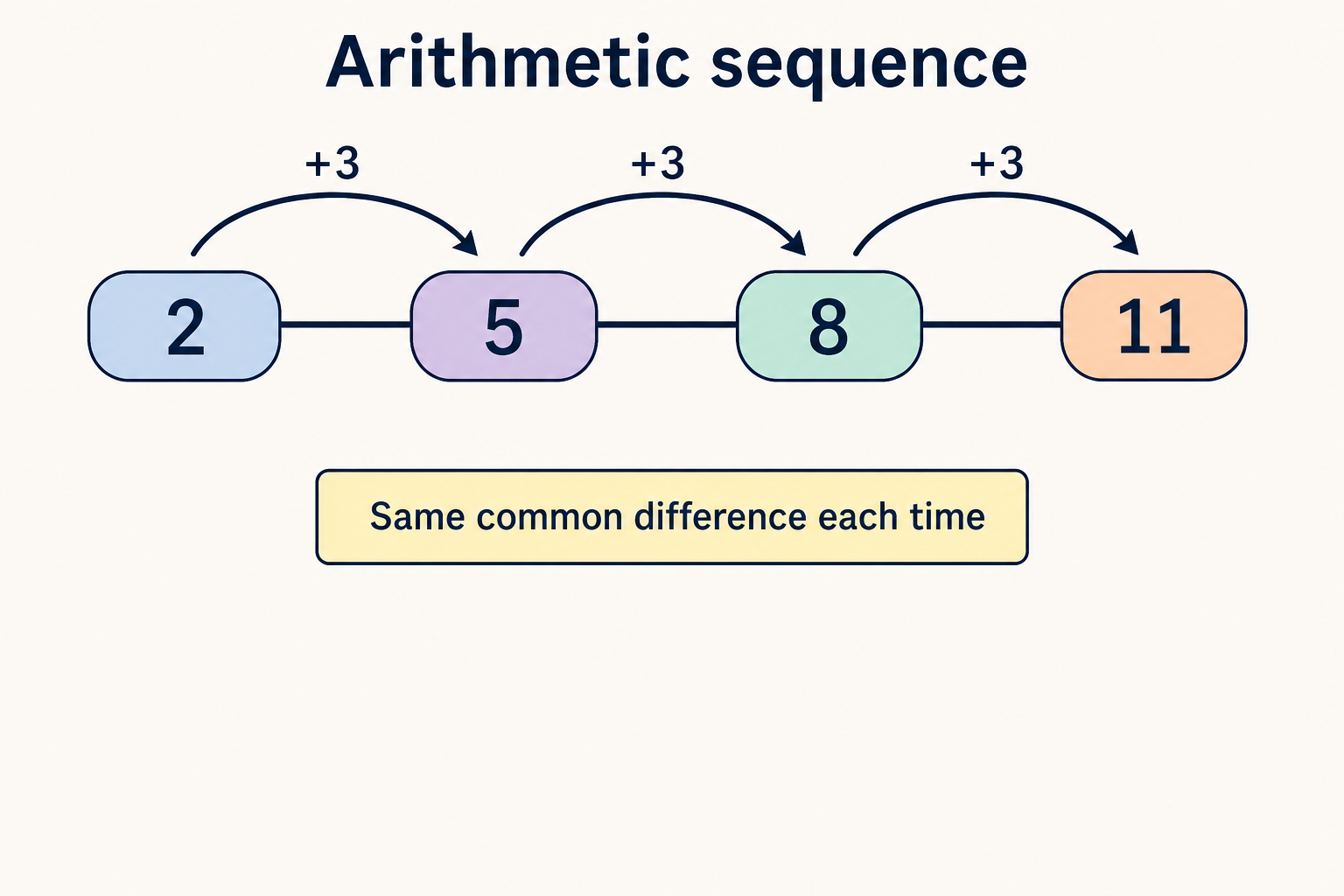 The common difference measures the equal step between consecutive terms. Here every step adds 3.
Key terms
- Sequence
- An ordered list of terms, usually written .
- Term
- One value in a sequence; is the value at position .
- Arithmetic sequence
- A sequence with the same difference between every pair of consecutive terms.
- Common difference
- The constant additive change .
- Recurrence relation
- A rule that defines each new term using an earlier term, such as .
Worked examples
Identify the common difference
Show that is arithmetic and state .
- 1Calculate consecutive differences: , , .
- 2Every checked difference is the same.
- 3The negative sign tells us that the sequence decreases by 5 each step.
Answer: The sequence is arithmetic with .
Generate terms from a recurrence relation
Given and , write the first five terms.
- 1Start with .
- 2Add 6 repeatedly: , , , .
Answer: .
Rules and formulas
Common difference
- the constant difference between consecutive terms
- the term at position n
- the term immediately after
Recursive definition
- the first term
- the common difference
The nth-term formula
Starting at , reaching requires equal jumps—not jumps. Each jump contributes , so the explicit formula is . This formula lets us find any term directly.
The formula is linear in . Expanding gives , so the common difference is the coefficient of . This connects arithmetic sequences to straight-line functions, while the constant term adjusts for the fact that sequence indexing begins at .
To test whether a number belongs to a sequence, set the nth-term formula equal to that number and solve for . It is a term only if the solution is a positive integer. A decimal or negative index does not represent a term in the usual IB sequence domain .
Key terms
- nth term
- A formula giving the value of the term at any positive integer position .
- Term index
- The positive integer identifying a term's position.
- Explicit formula
- A rule that calculates directly without generating all earlier terms.
Worked examples
Find a distant term
The sequence is . Find .
- 1Identify and .
- 2Use .
- 3Substitute : .
- 4Calculate .
Answer: .
Decide whether a value is a term
Is a term of ?
- 1Set .
- 2Then , so .
- 3Therefore , which is a positive integer.
Answer: Yes. .
Read an nth-term rule
For , state the first term and common difference.
- 1Substitute : .
- 2The coefficient of is , so each term decreases by 3.
- 3Check: , and .
Answer: and .
Rules and formulas
Arithmetic nth term
- the nth term
- the first term
- the positive integer term number
- the common difference
Finding the first term, difference or number of terms
The nth-term formula can be rearranged to find any missing quantity. If , and are known, then . If , the position of a known value is .
Two non-consecutive terms also determine an arithmetic sequence. From and , subtract the equations. The first term cancels, giving . Substitute back to find .
When finding a number of terms, the result for must be a positive integer. In an inequality such as ‘the first negative term’ or ‘at least a given total’, solve the boundary and then test the nearest permitted integers.
Key terms
- Non-consecutive terms
- Terms whose indices are separated by more than one position, such as and .
- Integer constraint
- The requirement that a term number must be a positive whole number.
Worked examples
Find the sequence from two terms
An arithmetic sequence has and . Find and .
- 1The index gap is , so there are seven equal jumps.
- 2Use .
- 3Now , so .
- 4Hence .
Answer: and .
Find a term number
In an arithmetic sequence, , , and . Find .
- 1Substitute into : .
- 2Then , so .
- 3Therefore .
Answer: is the 17th term.
Find the first negative term
Find the position and value of the first negative term of .
- 1Here and , so .
- 2Solve , giving .
- 3The smallest permitted integer is .
- 4Check , while is still positive.
Answer: The first negative term is .
Rules and formulas
Common difference from two terms
- the two known term positions
- the corresponding term values
Term number
- the required positive integer position
- the non-zero common difference
Arithmetic series and the sum of n terms
A sequence lists terms; a series adds them. If form an arithmetic sequence, then is the sum of its first terms.
Pair the first and last terms, then the second and second-last terms. Every pair has the same total . This produces . Replacing with gives the equivalent form .
Choose the form that matches the information given. Use when the first and last terms are known. Use when the first term and common difference are known.
A sum can be negative when sufficiently many terms are negative. The formula still works; do not replace negative terms with magnitudes. Keep the exact expression until the final step, particularly when solving a quadratic equation for .
Key terms
- Arithmetic series
- The sum of terms from an arithmetic sequence.
- The sum of the first terms.
- Finite series
- A sum with a specified final term or finite number of terms.
Worked examples
Sum when the difference is known
Find the sum of the first 40 terms of .
- 1Identify , , and .
- 2Find the last term: .
- 3Use .
- 4Calculate .
Answer: .
Find the number of terms from a sum
The sequence is . Given , find .
- 1Here and .
- 2Use .
- 3Simplify: , so .
- 4Factor or solve: .
- 5The valid positive integer solution is .
Answer: There are terms.
Use symmetry for an elegant result
In an arithmetic sequence, . Find .
- 1The indices 4 and 12 are equally spaced around 8, so .
- 2Hence .
- 3The 15 terms pair symmetrically around the middle term .
- 4Therefore their average is 32 and .
Answer: .
Rules and formulas
Arithmetic series using first and last terms
- sum of the first n terms
- first term
- last term included
Arithmetic series using the common difference
- number of terms being added
- common difference
Sigma notation for arithmetic sums
The Greek capital letter sigma, , means ‘add’. In , the lower value tells us where the index starts, the upper value tells us where it stops, and gives each term to add.
An arithmetic series can be written as . The index letter is a dummy variable: changing to does not change the sum, provided the limits and term expression remain consistent.
Always inspect the starting index. The expressions for and for generate the same terms. Mixing their limits causes an off-by-one error.
Key terms
- Sigma notation
- Compact notation for a sum of values generated by an indexed expression.
- Index
- The integer variable that changes from the lower limit to the upper limit.
- Summand
- The expression being added, such as .
- Limits
- The starting and ending index values shown below and above .
Worked examples
Expand and evaluate a sigma sum
Evaluate .
- 1At , the first term is .
- 2At , the last term is .
- 3The terms are arithmetic with .
- 4Use .
Answer: .
Write a series in sigma notation
Write using sigma notation.
- 1The first term is 12 and .
- 2Find the number of terms: , so .
- 3Use the general term with from 1 to 12.
Answer: .
Rules and formulas
Arithmetic series in sigma notation
- dummy index taking integer values from 1 to n
- the rth arithmetic term
Equivalent zero-based indexing
- dummy index taking integer values from 0 to n − 1
Real-world applications and word problems
Arithmetic sequences model constant additive change: the same amount is added or subtracted during each equal time interval or stage. Examples include rows of seats increasing by a fixed number, a weekly training distance increasing steadily, or an asset losing the same dollar amount each year.
Translate the context carefully. Identify what one term represents, what the first term is, the units of , and whether the question asks for one future value or a cumulative total . State the meaning of your answer in context and include units.
Watch the starting time. If a quantity is at time and falls by per hour, then . If you instead label the initial measurement , then . Both models are correct, but their indices mean different things.
Real data may be only approximately arithmetic. A model can still be useful, but an IB interpretation should mention that a constant-difference assumption may stop being realistic beyond the observed range.
Key terms
- Arithmetic model
- A model based on a constant additive change per equal interval.
- Initial value
- The quantity at the chosen starting point; check whether the index begins at 0 or 1.
- Extrapolation
- Using a model beyond the observed data range, where its assumptions may become less reliable.
Worked examples
Theatre seating
A theatre has 24 seats in the first row and 3 more seats in each successive row. Find the number of seats in row 18 and the total in the first 18 rows.
- 1Use , , and .
- 2Row 18 has seats.
- 3The total is .
Answer: Row 18 has 75 seats, and the first 18 rows contain 891 seats in total.
Training plan
A runner covers 12 km in week 1 and increases the weekly distance by 1.5 km for 10 weeks. Find the week-10 distance and total distance.
- 1Use , , and .
- 2 km.
- 3 km.
Answer: The runner covers 25.5 km in week 10 and 187.5 km over all 10 weeks.
Minimum time to reach a savings target
A student saves $35 in week 1 and increases the weekly amount by $8. What is the minimum number of weeks needed to save at least $1000?
- 1Use .
- 2Solve . A calculator gives a boundary between 12 and 13.
- 3Check permitted integers: and .
Answer: The student needs a minimum of 13 weeks.
Calculator methods and IB exam strategy
A calculator is useful for generating a term table, evaluating a large finite sum and solving an equation or inequality involving . It does not replace the mathematical model: write the sequence formula, substitute the known values, and then use technology for the numerical step.
For a term table, enter the nth-term expression as a function of an integer variable and view values beginning at . For a sum, use the calculator's summation template with correct lower and upper limits. For an unknown , graph both sides or use a numerical solver, then apply the positive-integer constraint.
On common IB-approved calculators, a table or spreadsheet can generate , while the catalog or calculation menu contains a sigma/sum command. Menu names vary by model, so practise on the calculator you will use in the examination.
Keep exact values during algebra and round only a contextual final answer when appropriate. Counts of people, rows or payments must be whole numbers. If technology gives for a minimum threshold, test and rather than reporting a decimal number of terms.
Key terms
- Table method
- Generating sequence values for integer inputs to inspect terms or locate a threshold.
- Numerical solver
- A calculator tool that approximates solutions of equations; its output must still satisfy the problem domain.
- Reasonableness check
- A comparison of the answer with the sequence's direction, scale, units and integer constraints.
Worked examples
Use technology to find a minimum n
A venue earns $150 in period 1, and earnings rise by $25 per period. Find the minimum for which total earnings exceed $10 000.
- 1Model the total: .
- 2Use a solver or graph to locate where .
- 3The boundary lies between 23 and 24, so test both integers.
- 4 and .
Answer: The minimum is 24 periods.
Check a sigma entry
Explain how to check a calculator entry for .
- 1Check the first generated term: at , it must be 7.
- 2Check the second term: at , it must be 9.
- 3Check the last term: at , it must be .
- 4Estimate the total as times the average , giving .
Answer: A correct calculator entry returns .
Practice questions with worked solutions
Attempt each question before opening the worked steps. The set moves from recognizing arithmetic structure to multi-step IB-style reasoning. Show formulas, substitutions and exact values before using a calculator.
After each solution, identify the decision that mattered most: finding , counting gaps, choosing or , handling sigma limits, or enforcing an integer constraint.
Worked examples
Practice 1 — difference and nth term
For , find , an expression for , and .
- 1.
- 2.
- 3.
Answer: , , and .
Practice 2 — two known terms
Given and , find , , and .
- 1.
- 2, so .
- 3.
Answer: , , and .
Practice 3 — first negative term
Find the first negative term of .
- 1.
- 2Solve , so .
- 3The first allowed integer is , and .
Answer: The first negative term is the 15th term, .
Practice 4 — membership test
Is a term of ?
- 1Use .
- 2Set , giving .
- 3This does not produce an integer value of .
Answer: No. is not a term of the sequence.
Practice 5 — finite arithmetic sum
Find the sum of the first 30 terms of .
- 1.
- 2.
Answer: .
Practice 6 — find n from a sum
For , find if .
- 1.
- 2Therefore .
- 3The discriminant is , so .
- 4Reject the negative root.
Answer: .
Practice 7 — sigma notation
Evaluate .
- 1The first term is and the last term is .
- 2There are 12 terms with common difference 3.
- 3.
Answer: The sum is .
Practice 8 — theatre application
A theatre has 20 seats in row 1 and two more seats in each successive row. How many seats are in the first 25 rows?
- 1, , and .
- 2.
- 3.
Answer: There are 1100 seats in the first 25 rows.
Practice 9 — minimum savings period
A student saves $35 in week 1 and $8 more each week. Find the minimum number of weeks needed for the total to reach at least $1000.
- 1.
- 2Solve and test nearby positive integers.
- 3, while .
Answer: The minimum is 13 weeks.
Practice 10 — advanced symmetry
An arithmetic sequence satisfies . Find .
- 1Positions 4 and 12 are symmetric about position 8, so .
- 2Thus .
- 3The average of the first 15 terms is their middle term .
- 4Therefore .
Answer: .
Topic summary
- An arithmetic sequence has constant additive change .
- Its recurrence form is , .
- The explicit term formula is ; remember the gaps.
- From two terms, , then substitute back to find .
- A target value belongs to the sequence only when solving for gives a positive integer.
- A sequence lists terms, while an arithmetic series adds them.
- Use when the first and last terms are known.
- Use when the first term and difference are known.
- Sigma notation represents the first arithmetic terms.
- In applications, identify whether the question asks for one term or a cumulative sum, and state units.
- Calculator solutions for term numbers must be checked against positive-integer and contextual constraints.
- For IB marks, show the model and substitution before calculator output, then interpret and check the answer.