The imaginary unit and Cartesian form
The real-number system cannot solve every polynomial equation. For example, would require a real number whose square is , and no such real number exists.
The imaginary unit is defined by . It is customary to write , but the defining relation is the safer algebraic rule.
A complex number in Cartesian form is , where . The real numbers are contained inside the complex numbers because .
Cartesian form is also called rectangular form. Keep the answer as one real term plus one imaginary term, with no power of above 1.
Key terms
- Imaginary unit
- The number i defined by .
- Complex number
- A number of the form a + bi, where a and b are real.
- Cartesian form
- The rectangular representation a + bi.
- Real number
- A complex number whose coefficient of i is zero.
- Pure imaginary number
- A complex number of the form bi with b non-zero.
Worked examples
Solve the equation that motivates i
Solve in the complex numbers.
- 1Rearrange to .
- 2Use , so .
- 3Include both square roots.
Answer: .
Classify complex numbers
Classify , , and .
- 1Write .
- 2Write .
- 3The third number has both a real and an imaginary component.
Answer: is real, is pure imaginary, and is non-real complex.
Write in Cartesian form
Simplify .
- 1Collect real terms: .
- 2Collect imaginary terms: .
Answer: .
Rules and formulas
Imaginary unit
Cartesian form
- real numbers
Set of complex numbers
Real and imaginary parts
For , the real part is and the imaginary part is . Both parts are real numbers.
The imaginary part is the coefficient , not the term . This distinction is frequently tested.
A complex number is real exactly when , and pure imaginary exactly when and .
The zero complex number is ; it is real but is not normally described as pure imaginary under the non-zero convention.
Key terms
- Real part
- The real coefficient in .
- Imaginary part
- The real coefficient in .
- Coefficient
- A numerical multiplier; b is the coefficient of i.
Worked examples
Read the two parts
For , find and .
- 1Match with .
- 2Here and .
Answer: and .
A negative imaginary coefficient
For , find the imaginary part.
- 1Rewrite as .
- 2Read the coefficient of .
Answer: , not .
Use parts to classify
Find real so that is real.
- 1A real complex number has imaginary part zero.
- 2Solve .
Answer: .
Rules and formulas
Real part
Imaginary part
Real-number condition
Equality, addition and subtraction
Two complex numbers are equal when their real parts are equal and their imaginary parts are equal. Thus implies and .
Add and subtract complex numbers componentwise. Real parts combine with real parts, and imaginary parts combine with imaginary parts.
When subtracting, distribute the negative sign across both components of the second complex number before collecting terms.
Equating components turns one complex equation into two simultaneous real equations, which is especially useful when unknown parameters are real.
Key terms
- Equality of complex numbers
- Equality of both corresponding Cartesian components.
- Componentwise operation
- An operation performed separately on real and imaginary parts.
Worked examples
Add two complex numbers
Calculate .
- 1Add real parts: .
- 2Add imaginary parts: .
Answer: .
Subtract carefully
Calculate .
- 1Distribute the subtraction: (3-2i-1-5i).
- 2Collect components.
Answer: (2-7i).
Equate components
Given , find real x and y.
- 1Equate real parts: .
- 2Equate imaginary parts: .
- 3Solve each real equation.
Answer: and .
Solve a linear complex equation
Solve .
- 1Subtract (2-3i) from both sides.
- 2Compute .
Answer: .
Rules and formulas
Complex equality
Addition
Subtraction
Powers of i
Successive powers of repeat every four exponents: . This follows because .
To simplify for an integer , divide by 4 and use the remainder. A remainder of 0, 1, 2, or 3 gives , respectively.
Negative powers are reciprocals. Since , the same four-cycle continues for every integer exponent.
When powers of occur inside a longer expression, reduce them before collecting real and imaginary parts.
Key terms
- Cycle
- A repeating pattern; the powers of i have period 4.
- Remainder modulo 4
- The remainder after division by 4, used to identify the corresponding power of i.
Worked examples
A large positive power
Simplify .
- 1Compute .
- 2Use the remainder 2: .
Answer: .
A negative power
Simplify .
- 1Since , the cycle gives .
- 2Check: .
Answer: .
Reduce a polynomial in i
Simplify .
- 1Use , , and .
- 2Substitute: .
Answer: .
Rules and formulas
Four-power cycle
Periodicity
- any integer
Inverse of i
Multiplying complex numbers
Multiply complex numbers using the distributive law exactly as for binomials, then replace by .
For , the real part is (ac-bd) and the imaginary part is .
A square such as contains a middle term . Missing this term is a common algebra error.
Products may become purely real or purely imaginary when one component cancels. Always finish by writing the result in Cartesian form.
Key terms
- Distributive law
- Multiplying each term in one bracket by each term in the other.
- Cartesian product
- A product simplified to one real part plus one imaginary part.
Worked examples
Multiply two complex numbers
Calculate .
- 1Expand: .
- 2Use , so .
- 3Collect components.
Answer: (11-10i).
Square a complex number
Expand .
- 1Use : .
- 2Replace by .
Answer: .
Find a parameter for a real product
Find real k so that is real.
- 1Expand to .
- 2A real result requires .
Answer: .
Rules and formulas
Complex multiplication
Complex square
Complex conjugates
The conjugate of is . Conjugation keeps the real part and reverses the sign of the imaginary part.
A complex number and its conjugate have the same modulus. On an Argand diagram, their points are reflections in the real axis.
Multiplying conjugates removes the imaginary part: . This non-negative real result is central to division and modulus calculations.
Conjugation respects addition and multiplication. If a polynomial has real coefficients, every non-real root occurs with its conjugate.
Key terms
- Complex conjugate
- The reflection a − bi of a + bi across the real axis.
- Conjugate pair
- Two numbers a + bi and a − bi.
- Real-coefficient polynomial
- A polynomial whose coefficients are all real; its non-real roots occur in conjugate pairs.
Worked examples
Find a conjugate
Find the conjugate of .
- 1Keep the real part .
- 2Reverse the sign of the imaginary part.
Answer: .
Multiply a conjugate pair
Calculate .
- 1Use the difference of squares: .
- 2Since , the result is .
Answer: .
Recover the components
If and , find z.
- 1Write .
- 2Then and .
- 3Solve and .
Answer: .
Rules and formulas
Conjugate
Sum with conjugate
Difference from conjugate
Conjugate product
Conjugate of a product
Dividing complex numbers
A quotient is in Cartesian form only when its denominator is real. To divide by , multiply numerator and denominator by the conjugate (c-di).
The denominator becomes , which is positive whenever .
After expanding the numerator, divide both its real and imaginary components by the real denominator.
Do not divide real parts and imaginary parts separately. Complex division follows ordinary fraction algebra with conjugates.
Key terms
- Rationalizing the denominator
- Using a conjugate to make a complex denominator real.
- Non-zero denominator
- Division requires , equivalently .
Worked examples
Divide in Cartesian form
Simplify .
- 1Multiply top and bottom by .
- 2The numerator is .
- 3The denominator is .
Answer: .
Reciprocal of a complex number
Write in Cartesian form.
- 1Multiply by .
- 2The denominator is .
Answer: .
Solve by division
Solve .
- 1Write .
- 2Multiply by .
- 3The numerator is (15-5i) and the denominator is 5.
Answer: .
Rules and formulas
Complex quotient
- non-zero divisor
Complex reciprocal
- non-zero complex number
Modulus and distance
The modulus of is . It is the Euclidean distance from the origin to the point () in the Argand plane.
A modulus is always a non-negative real number. Moreover, exactly when .
The distance between complex numbers and is . This is the usual distance formula expressed compactly.
Modulus behaves like length: , and for , . The triangle inequality states .
Key terms
- Modulus
- The non-negative distance of a complex number from the origin.
- Distance
- The length between two points; for complex numbers it is | − |.
- Triangle inequality
- The direct displacement cannot exceed the sum of two successive displacement lengths.
Worked examples
Find a modulus
Find .
- 1Use .
- 2Calculate .
Answer: .
Distance between two complex numbers
Find the distance between and .
- 1Compute .
- 2Find .
Answer: The distance is .
Use a modulus equation
Describe all satisfying .
- 1Square the modulus equation: .
- 2Interpret this in the Argand plane.
Answer: A circle centered at the origin with radius 4.
Rules and formulas
Modulus
Modulus squared
Distance
Product modulus
Triangle inequality
Argand diagrams
An Argand diagram represents by the point (), or by the position vector from the origin to that point. The horizontal axis is the real axis and the vertical axis is the imaginary axis.
Addition of complex numbers corresponds to vector addition. Subtraction is the displacement vector from to .
Conjugation reflects a point across the real axis. For example, and lie the same distance from the origin.
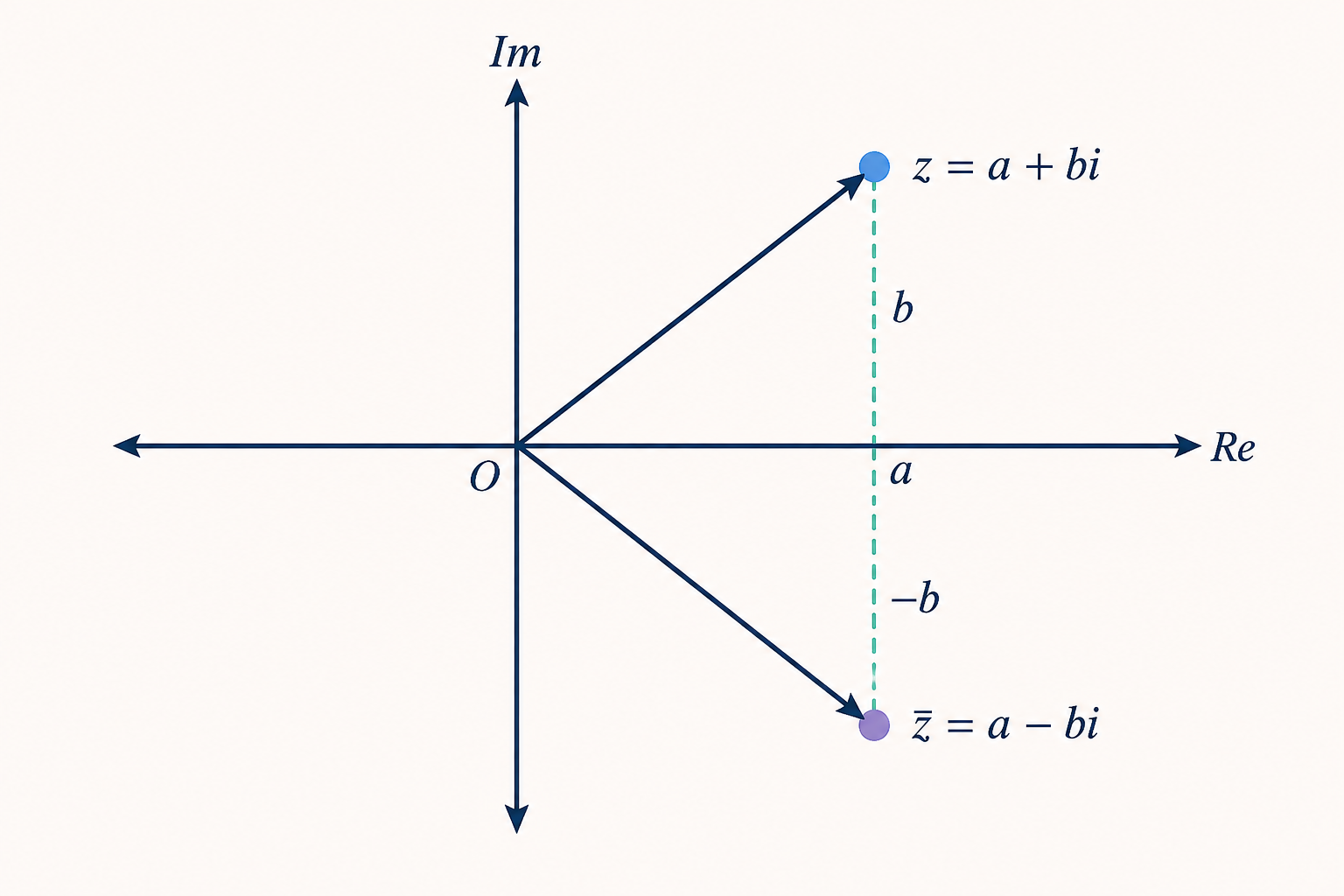 Conjugation reflects to across the real axis while preserving the modulus.
Label axes and scale clearly in an exam sketch. A correct algebraic value plotted with the real and imaginary coordinates reversed is still an incorrect Argand point.
Key terms
- Argand diagram
- A coordinate plane for complex numbers.
- Real axis
- The horizontal axis carrying the real part.
- Imaginary axis
- The vertical axis carrying the imaginary part.
- Position vector
- The directed line segment from the origin to the point representing z.
Worked examples
Plot a complex number
State the point representing .
- 1Read the real coordinate .
- 2Read the imaginary coordinate 5.
Answer: Plot .
Interpret conjugation geometrically
Describe the relationship between and (4-3i).
- 1Their real coordinates are both 4.
- 2Their imaginary coordinates are opposite.
Answer: They are reflections in the real axis and have equal modulus 5.
Translate a point
If , where is ?
- 1Add components to obtain .
- 2Interpret the addition as 3 units right and 1 unit down.
Answer: The new point is .
Rules and formulas
Argand coordinate
Conjugate reflection
Displacement
Solving equations with complex numbers
Linear equations in use the same inverse operations as real equations, followed by conjugate division if the coefficient is complex.
When an equation contains and , set , replace by (a-bi), and equate real and imaginary parts.
Quadratic equations may have non-real solutions. The quadratic formula remains valid, with for .
To find a Cartesian square root, write and equate components. Remember that a non-zero complex number has two square roots differing by sign.
Key terms
- Complex linear equation
- An equation in which the unknown complex number occurs to the first power.
- Non-real root
- A root with non-zero imaginary part.
- Cartesian square root
- A number a + bi whose square equals the given complex number.
Worked examples
Linear equation
Solve .
- 1Divide by (1-2i).
- 2Multiply by the conjugate .
- 3The numerator is and the denominator is 5.
Answer: .
Equation involving a conjugate
Solve and .
- 1Let .
- 2Then and .
Answer: .
Quadratic with complex roots
Solve .
- 1Use the quadratic formula.
- 2The discriminant is .
- 3Use .
Answer: .
Square roots in Cartesian form
Solve .
- 1Let , giving and .
- 2The pair satisfies both equations.
- 3Include the negative of this square root.
Answer: .
Rules and formulas
Square in Cartesian form
Quadratic formula
Conjugate roots and real polynomials
If a polynomial has real coefficients and is a non-real root, then (a-bi) is also a root. This is the conjugate-root theorem.
The factor pair associated with has real coefficients: .
Use the conjugate pair to construct the least-degree real polynomial with a specified non-real root. Additional real or conjugate roots contribute additional factors.
The theorem depends on the coefficients being real. A polynomial with complex coefficients does not have to contain conjugate pairs.
Key terms
- Conjugate-root theorem
- Non-real roots of real-coefficient polynomials occur in conjugate pairs.
- Real quadratic factor
- The factor (x − a)² + formed from roots a ± bi.
Worked examples
Build a real quadratic
Find a monic real quadratic with root .
- 1Include the conjugate root (3-2i).
- 2Multiply .
- 3Use the difference of squares.
Answer: .
Find a missing root
A real cubic has roots and . Find the third root.
- 1Real coefficients force non-real roots to occur in conjugate pairs.
Answer: The third root is (2-5i).
Construct a cubic
Find a monic real cubic with roots and .
- 1The conjugate pair gives .
- 2Multiply by (x-1).
Answer: .
Rules and formulas
Conjugate factor pair
Quadratic from conjugate roots
Mixed Cartesian-form problems
Advanced IB questions often combine several skills: component equations, conjugates, moduli, and polynomial structure. Translate each condition into its simplest Cartesian statement before calculating.
For , the relations , , and can turn a complex problem into familiar real algebra.
A condition such as describes a circle in the Argand plane centered at the point represented by , with radius . A condition describes the perpendicular bisector of the segment joining and .
Keep exact values such as radicals and fractions until the question requests an approximation.
Key terms
- Locus
- A set of points satisfying a stated geometric condition.
- Perpendicular bisector
- The line of points equidistant from two fixed points.
- Exact value
- A symbolic value without rounding error.
Worked examples
Determine z from real conditions
Given and , find z.
- 1Let . From , obtain .
- 2Then , so .
- 3Use both signs of b.
Answer: .
A circle not centered at the origin
Interpret .
- 1The fixed complex number (2-i) represents .
- 2The modulus is the distance from z to that point.
Answer: A circle centered at with radius 3.
An equidistance condition
Interpret .
- 1The points 1 and are and .
- 2Equal distances define their perpendicular bisector.
Answer: The locus is the line .
Rules and formulas
Circle locus
- center as a complex number
- positive radius
Equidistance locus
Calculator and IB exam strategy
In calculator-permitted work, select complex mode and rectangular output . Enter the imaginary unit using the calculator's dedicated key, not a letter variable.
A GDC can evaluate complex arithmetic, conjugates, moduli, and polynomial roots. Menu names vary, so practise the exact sequence on the approved model before the examination.
Use the calculator to verify arithmetic, not to replace required reasoning. For an exact question, show the conjugate multiplication, component equations, or factor construction that leads to the answer.
If the GDC returns decimals, decide whether an exact Cartesian value is expected. Convert recognizable decimals to fractions only when justified, and retain full internal precision until the final line.
A strong solution states restrictions, includes both roots where necessary, writes final answers in form, and checks the result by substitution or multiplication.
Key terms
- Complex mode
- A calculator setting that permits arithmetic involving i.
- Rectangular output
- Calculator output in Cartesian a + bi form.
- Verification
- An independent substitution or calculation that checks a result.
Worked examples
GDC arithmetic check
Use a GDC to check .
- 1Set complex mode and choose a+bi output.
- 2Enter the quotient with full parentheses.
- 3Compare the output with the exact algebraic result.
Answer: The GDC confirms .
GDC modulus
Check on a GDC.
- 1Use the absolute-value or complex modulus command.
- 2Enter the whole complex number in parentheses.
Answer: The output is 13.
GDC polynomial roots
Check the roots of .
- 1Use the polynomial solver in complex mode.
- 2Record both roots and keep exact values when the solver supports them.
- 3Substitute one root into the polynomial.
Answer: The roots are and (3-2i).
Rules and formulas
Universal arithmetic check
IB HL-style practice with worked solutions
Attempt each question before opening the worked steps. These problems progress from basic Cartesian fluency to multi-step HL reasoning.
For non-calculator practice, keep every value exact. For calculator practice, use the GDC only after setting up the mathematics clearly.
Key terms
- Method mark
- Credit earned for a valid mathematical method even if a later arithmetic error occurs.
- Accuracy mark
- Credit earned for a correct result following valid work.
Worked examples
Practice 1: identify components
For , state its real and imaginary parts.
- 1Match with .
- 2Read the two real coefficients.
Answer: and .
Practice 2: equality
Given , find real x and y.
- 1Equate real parts: .
- 2Equate imaginary parts: .
Answer: , .
Practice 3: add and subtract
Let and . Find and .
- 1Combine corresponding components for the sum.
- 2Distribute the subtraction across both parts of .
Answer: and .
Practice 4: multiplication
Calculate .
- 1Expand to .
- 2Use and collect terms.
Answer: (11-10i).
Practice 5: power of i
Simplify .
- 1Divide 2026 by 4; the remainder is 2.
- 2Therefore .
Answer: .
Practice 6: conjugate and modulus
For , find , , and .
- 1Reverse the imaginary sign for the conjugate.
- 2Use .
- 3Use .
Answer: , , and .
Practice 7: division
Write in Cartesian form.
- 1Multiply numerator and denominator by .
- 2Simplify the numerator to and denominator to 5.
Answer: .
Practice 8: Argand distance
Find the distance between and .
- 1Compute .
- 2Take the modulus.
Answer: The distance is .
Practice 9: linear complex equation
Solve .
- 1Write .
- 2Multiply top and bottom by .
- 3Simplify to Cartesian form.
Answer: .
Practice 10: conjugate roots
Solve .
- 1The discriminant is .
- 2Use .
- 3Apply the quadratic formula.
Answer: .
Practice 11: Cartesian square roots
Solve .
- 1Let , so and .
- 2A solution is .
- 3Include its negative.
Answer: .
Practice 12: combine conjugate conditions
Given and , find all possible z.
- 1Let . From , obtain .
- 2Then , so .
Answer: or .
Rules and formulas
Core Cartesian workflow
Topic summary and cheat sheet
Complex-number work becomes reliable when every expression is returned to Cartesian form, every component equation is stated explicitly, and every division uses a conjugate.
Use the summary below as a final checklist, then practise mixed questions without referring to it.
Key terms
- Cartesian fluency
- Moving accurately between algebra, components, conjugates, moduli, and Argand geometry.
Worked examples
One-line final check
What should be checked before submitting a complex-number answer?
- 1Confirm the form is .
- 2Reduce every power of i.
- 3Check signs, restrictions, and all required roots.
Answer: Finish with an exact Cartesian answer unless an approximation or another form is requested.
Rules and formulas
Imaginary unit
Cartesian form
Conjugate
Modulus
Division
Topic summary
- The imaginary unit is defined by .
- Every Cartesian complex number has the form with .
- For , and .
- The imaginary part is b, not bi.
- Two complex numbers are equal exactly when their real parts and imaginary parts are equal.
- Addition and subtraction are performed componentwise.
- The powers of i repeat every four exponents: .
- Reduce large integer powers of i using the exponent modulo 4.
- When multiplying, expand fully and replace by .
- The product formula is .
- The conjugate of is (a-bi).
- A number and its conjugate are reflections in the real axis.
- The product is real and non-negative.
- To divide complex numbers, multiply by the conjugate of the denominator.
- A complex denominator must be non-zero, so .
- The modulus is a non-negative real distance.
- The distance between and is .
- An Argand point for has coordinates ().
- Linear complex equations use ordinary inverse operations and conjugate division when needed.
- Equations containing z and its conjugate can be solved by setting .
- A non-zero complex number has two square roots that differ by sign.
- Non-real roots of a real-coefficient polynomial occur in conjugate pairs.
- Keep exact fractions and radicals unless an approximation is requested.
- Verify complex answers by substitution, squaring, or multiplying back.