Meaning of simultaneous and system equations
A system of linear equations is a collection of linear equations that must all be true for the same values of the unknowns. The words simultaneous equations emphasize that the equations are solved together, not independently.
A solution to a two-variable system is an ordered pair . A solution to a three-variable system is an ordered triple . Substitution into every original equation is the definitive check.
Each equation restricts the possible values. Solving the system means finding the intersection of all restrictions: one common point, no common point, or an entire family of common points.
Linear means every unknown has power one and variables are not multiplied together. Expressions such as xy, or make an equation nonlinear and require different methods.
Key terms
- System
- Two or more equations imposed on the same unknowns.
- Solution
- Values that satisfy every equation in the system simultaneously.
- Linear equation
- An equation in which each variable appears only to the first power and variables are not multiplied together.
- Ordered triple
- A three-variable solution written in the fixed order .
Worked examples
Verify a proposed solution
Does solve and ?
- 1First equation: .
- 2Second equation: .
- 3Both equations are true, so the pair is a simultaneous solution.
Answer: Yes, the solution is .
Recognize a nonlinear equation
Is the pair and a linear system?
- 1The first equation is linear.
- 2The product xy in the second equation makes that equation nonlinear.
Answer: No. The system contains a nonlinear equation.
Rules and formulas
General two-variable linear system
General three-variable linear equation
Solving systems with two unknowns by substitution
Substitution is efficient when one equation already isolates a variable, or when a variable has coefficient 1 or -1. Rearrange one equation, replace that variable in the other equation, then back-substitute.
Use parentheses around the substituted expression. This protects signs and ensures that every term is multiplied correctly.
If substitution produces a true identity such as , the equations are dependent and further interpretation is needed. If it produces a contradiction such as , the system is inconsistent.
Key terms
- Substitution
- Replacing a variable by an equal expression from another equation.
- Back-substitution
- Using a solved variable value in an earlier equation to obtain the remaining variable.
Worked examples
Direct substitution
Solve and .
- 1Substitute into .
- 2, so and .
- 3Back-substitute: .
- 4Check: .
Answer: .
Rearrange before substitution
Solve and .
- 1From , write .
- 2Substitute: .
- 3, so and .
Answer: .
Rules and formulas
Substitution pattern
Solving systems with two unknowns by elimination
Elimination combines equations so that one variable cancels. Multiply one or both equations by nonzero constants to create equal or opposite coefficients, then add or subtract the complete equations.
Write equations in aligned standard form before combining them. This reduces sign errors and makes omitted terms visible.
After finding one variable, substitute into an original equation. A final check is especially important when equations were multiplied or subtracted.
Key terms
- Elimination
- Combining equations to remove one unknown.
- Equivalent equation
- An equation with the same solution set, obtained by a valid reversible operation.
Worked examples
Opposite coefficients already present
Solve and .
- 1Add the equations: .
- 2Therefore .
- 3Substitute into : , so .
Answer: .
Create matching coefficients
Solve and .
- 1Multiply the first equation by 3: .
- 2Multiply the second equation by 2: .
- 3Add: , so .
- 4Substitute into to obtain .
Answer: .
Rules and formulas
Elimination combination
Systems with three unknowns
For a 3 by 3 system, eliminate the same variable from two different pairs of equations. This creates a 2 by 2 system in the remaining variables.
Label the equations and record each operation. A clear elimination chain earns method marks and makes the work auditable.
Once two variables are known, back-substitute to find the third, then verify the ordered triple in all three original equations.
Key terms
- 3 by 3 system
- A system of three linear equations in three unknowns.
- Triangular system
- A system arranged so the final equation has one unknown, the preceding equation has two, and so on.
Worked examples
Systematic elimination
Solve , and .
- 1Subtract the first equation from the second: .
- 2Subtract the first equation from the third: .
- 3From the first new equation, . From the second, .
- 4Substitute into to obtain , so .
- 5Then and . Check all three original equations.
Answer: .
Choose a convenient elimination order
Why might x be eliminated first when its coefficients are 1, 2 and -1?
- 1Small coefficients need little or no scaling.
- 2Combining the first equation with each other equation quickly produces a 2 by 2 system.
Answer: Eliminate x first to minimize arithmetic and sign risk.
Rules and formulas
Three-equation model
Matrix representation of a linear system
A linear system can be written compactly as , where is the coefficient matrix, is the column of unknowns and is the constants column.
The augmented matrix places the constants column beside the coefficients. The vertical divider is organizational; row operations act across the complete row, including the augmented entry.
Fix the variable order before building the matrix. A missing variable must be represented by a zero coefficient.
Key terms
- Coefficient matrix
- The rectangular array containing the coefficients of the unknowns.
- Augmented matrix
- The coefficient matrix with the constants column appended.
- Matrix equation
- The compact representation of a linear system.
Worked examples
Build a matrix equation
Represent and as .
- 1Use variable order x,y.
- 2Read each row of coefficients and its right-hand constant.
Answer:
Include a zero coefficient
Write and as an augmented matrix in x,y,z order.
- 1The first equation has coefficient 0 for y.
- 2The second equation has coefficient 0 for x.
Answer:
Rules and formulas
Matrix form
Augmented matrix
Two-variable coefficient matrix
Elementary row operations
Three reversible row operations preserve the solution set: interchange two rows, multiply a row by a nonzero constant, or add a multiple of one row to another row.
Row replacement is written as a single instruction, for example to -. Calculate every new entry from the old rows before moving to the next operation.
Multiplying by zero is forbidden because it destroys information and is not reversible.
Key terms
- Row interchange
- Swapping the positions of two equations.
- Row scaling
- Multiplying an entire row by a nonzero constant.
- Row replacement
- Adding a multiple of one row to another row.
- Pivot
- The leading nonzero entry used to eliminate entries below or above it.
Worked examples
Apply one row replacement
Apply to .
- 1Keep unchanged.
- 2Compute the new second row entry by entry: -2=.
Answer:
Choose a pivot row
If the first entry of row 1 is zero but row 2 has a nonzero first entry, what should be done?
- 1Interchange the two rows.
- 2Use the new leading entry as the first pivot.
Answer: Use .
Rules and formulas
Row interchange
Nonzero row scaling
Row replacement
Gaussian elimination and back-substitution
Gaussian elimination uses row operations to reach row-echelon form: pivots move to the right as rows descend, and entries below each pivot are zero.
Once the system is triangular, solve the last equation and back-substitute upward. Gauss-Jordan elimination continues until each pivot is the only nonzero entry in its column, producing reduced row-echelon form.
Exact fractions expose structure. Premature decimal rounding can turn a dependent row into an apparently nonzero row or distort a parameter condition.
Key terms
- Row-echelon form
- A stepped matrix with zero entries below each pivot.
- Reduced row-echelon form
- Row-echelon form in which each pivot is 1 and is the only nonzero entry in its column.
- Gaussian elimination
- Forward elimination to echelon form followed by back-substitution.
- Gauss-Jordan elimination
- Row reduction continued to reduced row-echelon form.
Worked examples
Gaussian elimination for a 3 by 3 system
Solve , and .
- 1Start with .
- 2Use and to get .
- 3Use to obtain , so .
- 4Back-substitute: gives , then gives .
Answer: .
Read a triangular system
Interpret .
- 1The last row gives , so .
- 2The second row gives , so .
- 3The first row gives , so .
Answer: .
Rules and formulas
Row-echelon structure
Back-substitution direction
Unique solution, no solution and infinitely many solutions
A unique solution occurs when every variable column contains a pivot. There are no free variables, so one ordered tuple satisfies the system.
No solution occurs when row reduction creates a contradiction row such as . The augmented column introduces a pivot that is absent from the coefficient matrix.
Infinitely many solutions occur when the system is consistent but at least one variable is free. A zero row indicates redundant information, not a contradiction.
Rank is the number of pivots. The system is consistent exactly when . If that common rank is smaller than the number of unknowns, free variables produce infinitely many solutions.
Key terms
- Rank
- The number of pivot positions in a matrix.
- Free variable
- A non-pivot variable allowed to vary over its domain.
- Contradiction row
- A row representing for nonzero c, proving the system inconsistent.
Worked examples
Classify three echelon forms
Classify systems ending in , (ii) with a free variable, and (iii) one pivot per variable. In (ii) and (iii), assume there is no contradictory row anywhere in the echelon form.
- 1Case is contradictory.
- 2Case is consistent but underdetermined.
- 3Case fixes every variable.
Answer: no solution; infinitely many solutions; one unique solution.
Communicate an infinite family
Solve and .
- 1The second equation is twice the first, so one equation is redundant.
- 2Let for any real t.
- 3Then .
Answer: .
Rules and formulas
Consistency criterion
Unique-solution rank condition
Infinite-solution rank condition
No-solution rank condition
Geometric interpretation of lines and planes
In two dimensions, each linear equation represents a line. Two nonparallel lines meet once, distinct parallel lines never meet, and coincident lines share every point.
In three dimensions, a linear equation represents a plane. Three planes may meet at one point, share a line or a plane, or have no common point. Pairwise intersections alone do not guarantee one point common to all three planes.
The algebraic and geometric classifications agree: unique means one common point, inconsistent means no common point, and dependent means a common family of points.
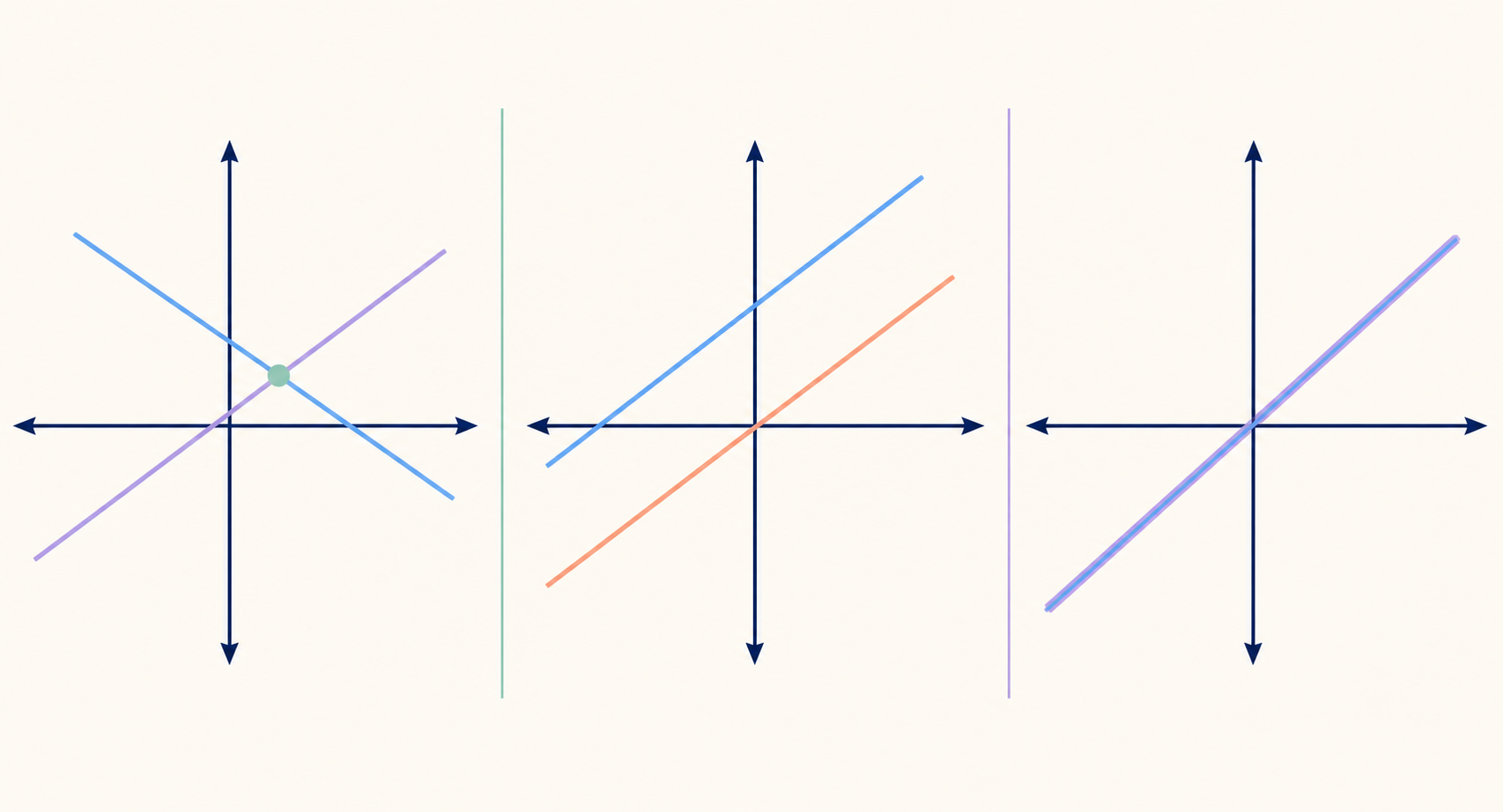 Intersecting, parallel and coincident lines correspond to one solution, no solution and infinitely many solutions.
Key terms
- Intersecting lines
- Nonparallel lines with exactly one common point.
- Parallel lines
- Distinct coplanar lines with equal gradient and no common point.
- Coincident lines
- Different equation forms representing the same line.
- Plane
- The three-dimensional graph of a linear equation in x, y and z.
Worked examples
Read a 2D system geometrically
Classify and .
- 1Both lines have gradient 2.
- 2Their y-intercepts differ, so they are distinct parallel lines.
Answer: The system has no solution.
Recognize coincident equations
Compare and .
- 1Every coefficient and the constant in the second equation is three times the first.
- 2The equations describe the same line.
Answer: The system has infinitely many solutions on .
Rules and formulas
Two-line determinant
Nonparallel-line condition
Consistency, independence and dependency
A consistent system has at least one solution. An inconsistent system has no solution.
Independent equations contribute distinct constraints. Dependent equations contain redundant information because one equation is a linear combination of others.
Dependency does not automatically mean infinitely many solutions. A larger system may contain one redundant equation while the remaining independent equations still determine a unique solution.
For a square 2 by 2 system, a nonzero determinant guarantees a unique solution. A zero determinant tells you only that the system is nonunique; compare constants or row-reduce to distinguish no solution from infinitely many solutions.
Key terms
- Consistent system
- A system with at least one solution.
- Inconsistent system
- A system with no solution.
- Independent equations
- Equations that supply nonredundant constraints.
- Dependent equations
- Equations for which at least one is a linear combination of the others.
Worked examples
Dependent pair
Classify and .
- 1Multiplying the second equation by -2 gives the first.
- 2The equations describe the same line.
Answer: The system is consistent and dependent, with infinitely many solutions.
Zero determinant needs another test
What can be concluded immediately when for a 2 by 2 system?
- 1The coefficient rows are dependent.
- 2The constants may preserve the same ratio or break it.
Answer: There is not a unique solution; row-reduce or compare ratios to decide between none and infinitely many.
Rules and formulas
Two-by-two determinant
Unique 2 by 2 system
Parameter-based systems
A parameter changes the coefficients or constants, so the solution type can change at special values. Identify the expression that controls a pivot or determinant, then split into cases.
Never divide by an expression involving a parameter until the zero case has been handled separately. Dividing by k-1 silently discards the case .
For a square system, determinant not equal to zero gives a unique solution. At determinant zero, inspect the augmented equations to decide whether the system is dependent or inconsistent.
Key terms
- Parameter
- A fixed but unspecified quantity whose value may change the behavior of a system.
- Case split
- Separate analysis for parameter values that make a controlling expression zero or nonzero.
Worked examples
A parameter controlling uniqueness
For and kx, classify and solve the system.
- 1Subtract the first equation from the second: .
- 2If , and .
- 3If , the equations become and , a contradiction.
Answer: .
Parameter in the augmented column
Classify and .
- 1The second coefficient row is twice the first.
- 2If , the full equation is twice the first and the system is dependent.
- 3If m is not 6, row reduction gives , a contradiction.
Answer: .
Rules and formulas
Parameter case trigger
Determinant case split
Applications and mathematical modeling
A modeling problem begins by defining unknowns with units. Translate each independent condition into a linear equation, solve, then interpret the tuple in the original context.
Check feasibility as well as algebra: counts may need to be nonnegative integers, masses and times should be nonnegative, and a monetary total should match the stated revenue.
If the equations are inconsistent, the data or assumptions cannot all hold simultaneously. If they are dependent, the information is insufficient for one unique answer.
Key terms
- Constraint
- A condition translated into an equation or inequality.
- Feasible solution
- A mathematical solution that also satisfies contextual restrictions.
- Model validation
- Checking the result against the original data, units and assumptions.
Worked examples
Ticket revenue model
A theater sells 120 tickets. Adult tickets cost 12 dollars and student tickets cost 7 dollars. Revenue is 1090 dollars. Find each number.
- 1Let a be adult tickets and s be student tickets.
- 2Write and .
- 3Use : .
- 4Then , so and .
- 5Check the revenue: .
Answer: 50 adult tickets and 70 student tickets.
Mixture model
How many liters of 20 percent and 50 percent solution make 30 liters of 40 percent solution?
- 1Let x and y be the respective volumes.
- 2Write and .
- 3Solving gives and .
- 4Both volumes are nonnegative and sum to 30.
Answer: 10 L of 20 percent solution and 20 L of 50 percent solution.
Rules and formulas
Two-category total
Weighted-total model
Calculator and GDC methods
A GDC may provide a simultaneous-equation solver, matrix inverse command, row-reduced echelon form command, or numerical solve feature. Enter the coefficients in a fixed variable order and include zeros for missing variables.
For a nonsingular square matrix, is valid. If A is singular, the inverse does not exist; use row reduction to distinguish no solution from infinitely many solutions.
GDC output must still be interpreted. A decimal tuple should be checked in the original equations, and parameter-based classification requires algebraic reasoning rather than sampling a few values.
On examinations, record the equations or augmented matrix and state the solution. Technology is a tool, not a replacement for mathematical communication.
Key terms
- Singular matrix
- A square matrix with determinant zero and no inverse.
- RREF command
- A calculator command that returns reduced row-echelon form.
- Residual
- The difference between a left-hand side evaluated at the proposed solution and its right-hand constant.
Worked examples
Use inverse-matrix mode safely
What should be checked before calculating A inverse times b?
- 1Confirm A is square.
- 2Confirm det is not zero.
- 3Enter b in the same equation order and variables in the same column order.
Answer: Use only when .
Interpret a calculator error
A GDC reports ‘singular matrix’. Does this prove there is no solution?
- 1A singular coefficient matrix proves only that a unique solution is impossible.
- 2Row-reduce the augmented matrix to test consistency.
Answer: No. The system may have no solution or infinitely many solutions.
Rules and formulas
Inverse-matrix solution
Residual vector
Common mistakes and how to prevent them
Sign errors often enter when subtracting equations. Put brackets around the full equation being subtracted or add a clearly written negative multiple instead.
A row operation must change every entry in the row, including the augmented constant. Applying it only to selected coefficients changes the system.
Do not confuse a zero row with a contradiction row, dependent equations with inconsistent equations, or a singular matrix with proof of no solution.
In parameter questions, dividing by an expression before treating its zero case loses a possible classification. In contextual problems, failing to interpret units or feasibility leaves the solution incomplete.
Premature decimal rounding can hide exact dependency. Keep exact values during elimination and check the final tuple in every original equation.
Worked examples
Spot an illegal row operation
A student uses . Why is this invalid?
- 1The original second equation is replaced by .
- 2The operation cannot be reversed and can destroy a necessary constraint. It is not an allowed elementary row operation.
Answer: Multiplying a row by zero does not in general preserve the solution set. A particular redundant row may be removed without changing solutions, but that does not make zero row-scaling a valid elementary operation.
Spot a lost parameter case
A student divides by k-2 without comment.
- 1The division assumes k is not 2.
- 2The case must be tested in the original system.
Answer: Split into and k not equal to 2 before dividing.
IB HL exam strategy and communication
Start by deciding whether substitution, elimination, matrices or technology is most efficient. For small exact systems, algebra usually communicates the structure best; for larger numerical systems, a GDC can reduce arithmetic.
Show enough structure for method marks: define variables, align equations, label row operations, identify parameter cases and state the final solution type.
If the system has infinitely many solutions, introduce free parameters and specify their domain. If it has no solution, show the contradiction. If it has one solution, verify the tuple.
For a contextual response, finish with a sentence containing units and a reasonableness check. For approximate GDC results, use the requested accuracy and avoid rounding intermediate values.
Worked examples
Select a method
Choose a method for and .
- 1One variable is already isolated.
- 2Substitution needs no preliminary scaling.
Answer: Use substitution.
State a complete classification
Row reduction ends with .
- 1There are pivots in x and y columns but not z.
- 2Let .
- 3Then and .
Answer: The system is consistent with infinitely many solutions: .
Rules and formulas
Solution verification
IB HL-style practice with worked solutions
Attempt each problem without the solution first. Use exact arithmetic unless an approximation is requested, and verify numerical solutions in the original equations.
The set progresses from two-variable techniques through row reduction, classification, parameters, modeling and three-variable reasoning.
Worked examples
Practice 1: substitution
Solve and .
- 1Substitute y into the second equation: .
- 2Thus and .
- 3Both equations check.
Answer: .
Practice 2: elimination
Solve and .
- 1Add the equations to get .
- 2Hence .
- 3Substitute to get .
Answer: .
Practice 3: exact fractional solution
Solve and .
- 1Use and .
- 2Add to obtain .
- 3Then and .
Answer: .
Practice 4: three unknowns
Solve , and .
- 1Subtract the second equation from the first: , so .
- 2Then .
- 3The third equation becomes , so .
- 4Hence , giving and .
Answer: .
Practice 5: Gaussian elimination
Solve , and .
- 1Use and .
- 2Then use to get .
- 3Back-substitution gives , and .
Answer: .
Practice 6: inconsistent system
Classify and .
- 1Subtract twice the first equation from the second.
- 2This gives , a contradiction.
Answer: The system is inconsistent and has no solution.
Practice 7: dependent system
Solve and .
- 1The second equation is twice the first.
- 2Let .
- 3Then .
Answer: .
Practice 8: parameter controlling uniqueness
Classify and kx for all real k.
- 1Subtract to get .
- 2For , and .
- 3For , the equations contradict each other.
Answer: .
Practice 9: parameter in the constants
Classify and .
- 1The coefficient rows are proportional.
- 2For , the whole second equation is twice the first.
- 3For m not equal to 6, elimination gives a contradiction.
Answer: .
Practice 10: ticket model
A theater sells 120 adult and student tickets for 1090 dollars. Adult tickets cost 12 dollars and student tickets 7 dollars. Find the numbers.
- 1Let and .
- 2Substitute to get .
- 3Thus and .
- 4The total and revenue both check.
Answer: 50 adult tickets and 70 student tickets.
Practice 11: interpret RREF
Interpret .
- 1The z column has no pivot, so let .
- 2The first row gives , so .
- 3The second gives , so .
Answer: .
Practice 12: a three-equation parameter system
Classify , and for all real .
- 1Subtract the first equation from the second: .
- 2Subtract the first from the third: .
- 3For , , and .
- 4For , the first two equations become and , a contradiction.
Answer: .
Topic summary and cheat sheet
A solution satisfies every equation simultaneously. Use substitution for an isolated variable, elimination for convenient matching coefficients, and Gaussian elimination for systematic matrix work.
One pivot per variable gives a unique solution. A contradiction row gives no solution. A consistent system with free variables has infinitely many solutions.
In two dimensions these cases correspond to intersecting, parallel and coincident lines. In three dimensions, interpret equations as planes and focus on their common intersection.
For parameters, split the zero and nonzero pivot or determinant cases before dividing. With a GDC, record the setup, interpret singular output and verify the result.
Rules and formulas
System form
Allowed row replacement
Consistency test
Unique solution test
Infinite solutions test
No solution test
Two-by-two determinant test
Inverse method condition
Topic summary
- A system requires the same values to satisfy every equation simultaneously.
- Solutions are ordered pairs for two variables and ordered triples for three variables.
- Substitution is efficient when a variable is already isolated or easy to isolate.
- Elimination combines equivalent equations to cancel an unknown.
- For three unknowns, eliminate the same variable twice to create a 2 by 2 system.
- The matrix equation separates coefficients, unknowns and constants.
- An augmented matrix must preserve a fixed variable order and include zero coefficients.
- Valid row operations are row interchange, nonzero scaling and row replacement.
- Gaussian elimination reaches echelon form; back-substitution then recovers the variables.
- Gauss-Jordan elimination continues to reduced row-echelon form.
- A pivot in every variable column gives a unique solution.
- A contradiction row with c nonzero proves there is no solution.
- A zero row indicates redundancy, not inconsistency.
- A consistent system with free variables has infinitely many solutions.
- Consistency requires .
- In two dimensions, unique, none and infinitely many correspond to intersecting, parallel and coincident lines.
- In three dimensions, linear equations represent planes and the solution is their common intersection.
- Consistent versus inconsistent and independent versus dependent describe different properties.
- A zero determinant rules out uniqueness but does not distinguish none from infinitely many solutions.
- Parameter systems require separate zero and nonzero cases before division.
- A singular GDC result means no unique solution; row reduction must determine the remaining classification.
- Exact arithmetic protects dependency and parameter structure from rounding errors.
- Contextual solutions must satisfy units, nonnegativity, integrality and other feasibility conditions.
- Finish by checking the solution in every original equation and stating the classification clearly.