Geometric sequence foundations
A geometric sequence is an ordered list in which each term is obtained by multiplying the previous term by the same constant. This multiplier is the common ratio . For consecutive non-zero terms, .
For , every term is multiplied by , so . For , every term is multiplied by , so the terms shrink. A negative ratio makes the signs alternate; for example, has .
Geometric change is multiplicative, while arithmetic change is additive. A quantity that increases by 5 each period is arithmetic. A quantity that increases by 5% each period is geometric because it is repeatedly multiplied by .
A geometric sequence can be defined recursively by giving its first term and multiplication rule: and . The symbol is often used for the first term, so .
Key terms
- Geometric sequence
- A sequence with a constant ratio between consecutive non-zero terms.
- Common ratio
- The constant multiplier in . When , it can be found as ; never divide by a zero term.
- Growth factor
- A ratio with magnitude greater than 1 that makes term magnitudes grow.
- Decay factor
- A positive ratio between 0 and 1 that makes terms shrink toward zero.
- Alternating sequence
- A sequence whose signs alternate, usually because .
Worked examples
Identify a positive fractional ratio
Show that is geometric and state .
- 1Calculate consecutive ratios: , , and .
- 2Every checked ratio is the same.
- 3Because the ratio is positive and less than 1, the terms decrease toward zero.
Answer: The sequence is geometric with .
Recognize an alternating geometric sequence
Find the common ratio of .
- 1Divide a later term by the previous term: .
- 2Check again: .
- 3The negative ratio explains the alternating signs.
Answer: .
Rules and formulas
Common ratio
- the constant ratio between consecutive terms
- a non-zero term
- the term immediately after
Recursive definition
- the first term
- the common ratio
The geometric nth-term formula
From to , the sequence is multiplied by exactly times. Therefore the explicit formula is . It finds a distant term without generating every previous term.
For a nonzero first term, If , term magnitudes grow. If , term magnitudes shrink toward zero. If , odd and even powers have different signs, so always keep the ratio inside parentheses when evaluating powers. If the first term is zero, the recurrence gives only zero terms for every finite ratio.
A geometric nth-term rule is exponential in , unlike the linear nth-term rule of an arithmetic sequence. This is why repeated percentage change can become much larger or smaller than constant additive change over many periods.
Key terms
- nth term
- An explicit formula giving the value at any positive integer position .
- Exponential change
- Change produced by repeatedly multiplying by the same factor.
- Term magnitude
- The absolute value , used to discuss growth when signs alternate.
Worked examples
Find a term in a growing sequence
The sequence is . Find .
- 1Identify , , and .
- 2Use .
- 3.
Answer: .
Find a term in a decaying sequence
For , find .
- 1Here and .
- 2.
- 3Since , divide 160 by 128.
Answer: .
Interpret a geometric rule
For , state , , and the long-term term behaviour.
- 1At , the exponent is zero, so .
- 2The repeated multiplier is .
- 3Because , the positive terms decrease toward zero.
Answer: , , and .
Rules and formulas
Geometric nth term
- the nth term
- the first term
- the common ratio
- the positive integer term position
Finding the first term, ratio or number of terms
For , rearrange as . If two terms are known and , division gives . When , terms after the first are zero and do not determine the first term.
Be careful when the index gap is even. If , both a positive and a negative real ratio may satisfy an even power. Extra information, such as another term or a statement that , may be needed to choose one.
For a positive ratio , logarithms can solve for a term number: , provided the ratio is positive. A term position must be a positive integer. For negative ratios, logarithms of are not real, so use sign and integer-power reasoning instead.
In threshold questions, solve the equality to locate the boundary, then test neighbouring integer positions in the original inequality. The direction of an inequality can change when dividing by a negative logarithm such as , so checking terms is essential.
Key terms
- Index gap
- The number of multiplication steps between and .
- Logarithmic solution
- Using logarithms to bring an unknown exponent down so it can be solved.
- Integer constraint
- The requirement that a sequence position be a positive whole number.
Worked examples
Find the first term
A geometric sequence has and . Find .
- 1Use .
- 2.
- 3Divide by 27.
Answer: .
Find the ratio from two terms
Given , , and , find and .
- 1There are multiplication steps, so .
- 2Because , .
- 3Now : .
Answer: and .
Find an exact term position
For , find when .
- 1Set .
- 2Divide by 5: .
- 3Therefore .
Answer: .
Find the first term below a threshold
For , find the first term below 20.
- 1Solve the boundary using logarithms or a table.
- 2This gives .
- 3Test integer positions: , while .
Answer: The first term below 20 is .
Rules and formulas
Ratio from two terms
- the two known term positions
- the corresponding non-zero term values
Term number for a positive ratio
- the required positive integer term position
- a positive common ratio other than 1
Finite geometric series and the sum of n terms
A geometric series is the sum of terms from a geometric sequence: . For , its finite sum is .
The equivalent form often feels more convenient when because the factors and are positive (the sign of still affects the sum). Both forms give exactly the same result when used consistently.
If , every term equals , so the special case is . The usual fraction would divide by zero and must not be used.
Finite geometric sums work for ratios larger than 1, between 0 and 1, and negative. With a negative ratio the terms alternate, so preserve signs rather than adding absolute values.
Key terms
- Geometric series
- A sum of consecutive terms from a geometric sequence.
- The sum of the first terms.
- Finite sum
- A series with a specified number of terms, valid for any real ratio when handled correctly.
Worked examples
Sum a growing geometric series
Find the sum of the first 8 terms of .
- 1Identify , , and .
- 2Use .
- 3.
Answer: .
Sum a decreasing finite series
Find .
- 1Here , , and .
- 2.
- 3, so .
Answer: .
Find the number of terms from a sum
For , find if .
- 1Use .
- 2Then , so .
- 3Since , .
Answer: There are terms.
Rules and formulas
Finite geometric sum
- sum of the first n terms
- first term
- common ratio
- number of terms included
Equivalent finite-sum form
Special case
Infinite geometric series and convergence
An infinite geometric series has no final term. For a nonzero first term it converges exactly when . Then , giving . If the first term is zero, every term and partial sum is zero for any finite ratio.
If and , the terms do not approach zero, so the series diverges and has no finite sum. The condition that terms approach zero is necessary for any infinite series to converge; for a geometric series, is also sufficient.
A negative ratio can still converge. For example, has . The partial sums alternate around their limiting value while moving closer to it.
The amount left after the first terms of a convergent geometric series is the remainder . It is also an infinite geometric tail whose first omitted term is .
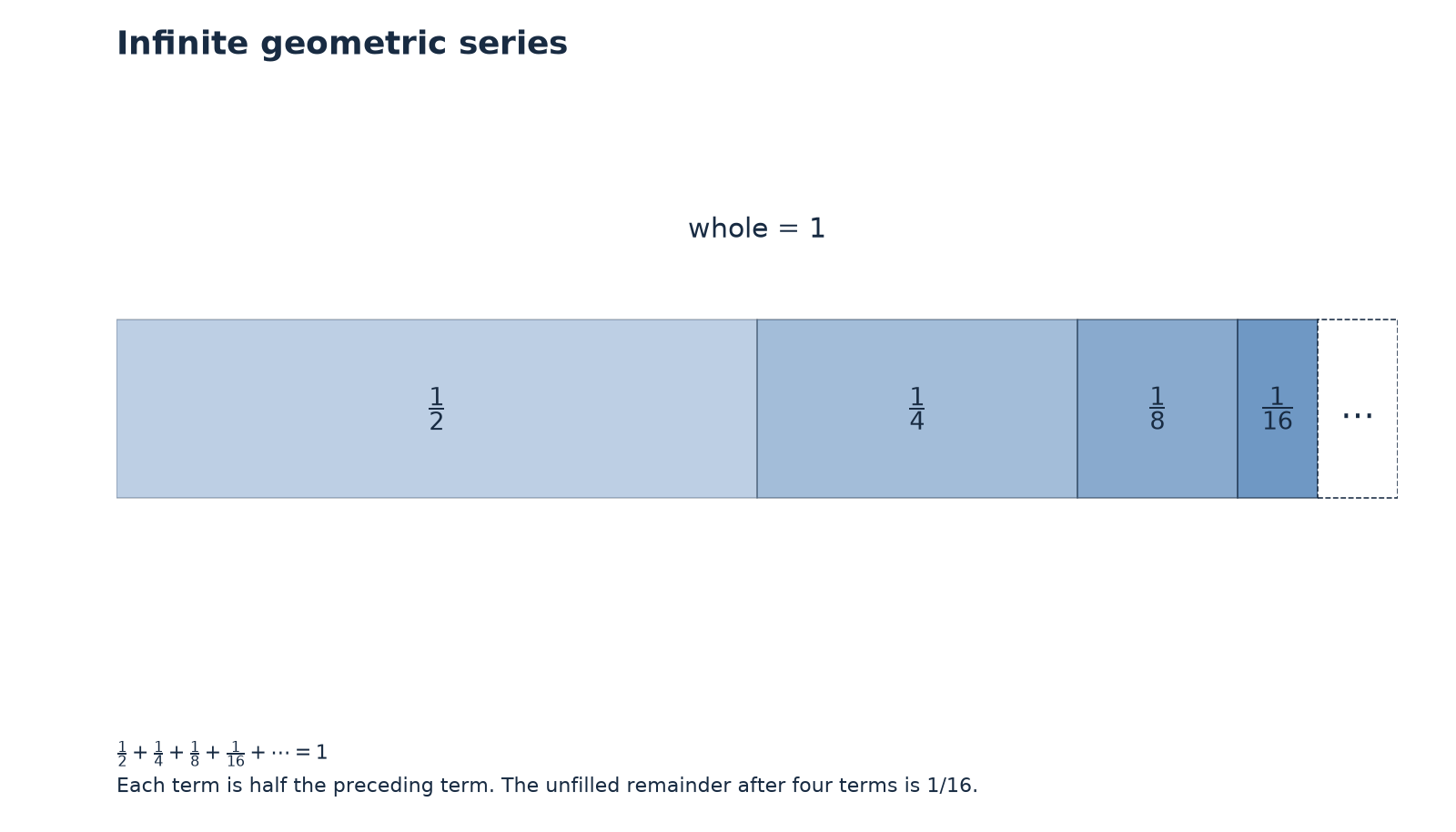 Each new region is half the previous one. Infinitely many shrinking additions fill the whole without the total exceeding 1.
Key terms
- Convergence
- Partial sums approach one finite limiting value.
- Divergence
- Partial sums do not approach a finite limit.
- Infinite sum
- The limit of partial sums when that limit exists.
- Remainder
- The convergent tail left after the first terms.
- Partial sum
- A finite sum used to approximate an infinite series.
Worked examples
Find a positive infinite sum
Find .
- 1Identify and .
- 2Because , the series converges.
- 3.
Answer: .
Find an alternating infinite sum
Find .
- 1The common ratio is .
- 2Since , the series converges.
- 3.
Answer: .
Recognize divergence
Does have an infinite sum?
- 1The common ratio is .
- 2Because , the terms do not approach zero.
Answer: The series diverges, so no finite infinite sum exists.
Find the remainder after n terms
For , find the amount remaining after the first 5 terms.
- 1Use with , , and .
- 2.
Answer: .
Rules and formulas
Infinite geometric sum
- finite limit of the partial sums
- first term
- common ratio with magnitude less than 1
Remainder after n terms
- sum of all terms after the first n terms
Sigma notation for geometric sums
A finite geometric series can be written as . Starting at produces the first term , and ending at produces exactly terms.
The equivalent one-based form is . The index letter is a dummy variable, but the limits and exponent must agree. An incorrect shift may change the included terms, their count, or both; check the first and last terms and calculate the count from the limits.
An infinite geometric series may be written . This notation does not guarantee convergence; the condition must still be checked before assigning the sum .
Key terms
- Summand
- The indexed expression being added, such as .
- Finite limits
- Starting and ending index values that produce a fixed number of terms.
- Infinite upper limit
- The symbol , meaning the partial sums continue without a final term.
Worked examples
Evaluate a finite sigma sum
Evaluate .
- 1The first term is 3, the ratio is 2, and indices 0 through 5 give 6 terms.
- 2Use .
- 3.
Answer: The sum is .
Write a finite series using sigma notation
Write the first 10 terms of in sigma notation.
- 1The first term is 7 and .
- 2Using a zero-based index, the term is .
- 3Ten terms require indices through .
Answer: .
Rules and formulas
Finite geometric series in sigma notation
- dummy index taking integer values from 0 to n − 1
Infinite geometric series in sigma notation
Real-world growth, decay and infinite-process applications
Geometric models describe repeated proportional change. An increase of uses growth factor ; a decrease of uses decay factor . Apply the factor once per stated time interval.
Check the time index. If is the amount now, then after periods . If the initial amount is labelled , then the same values follow . Confusing time 0 with term 1 creates an off-by-one power.
A model can produce one future amount, a finite accumulated total, or an infinite total. Decide whether the question asks for a term or a sum. Also judge whether extrapolating repeated percentage change indefinitely is realistic in context.
Bouncing-ball distance is a classic infinite-series model. The initial drop is counted once, while each rebound height is travelled upward and downward, so rebound distances are usually doubled.
Key terms
- Growth factor
- for an increase of per period.
- Decay factor
- for a decrease of per period.
- Repeated percentage change
- Applying the same percentage to the new amount each period, producing geometric—not linear—change.
- Extrapolation
- Using a model beyond observed data, where its assumptions may become less reliable.
Worked examples
Compound growth
An investment of $2000 grows by 4% per year. Find its value after 6 years.
- 1Convert 4% growth to the factor .
- 2Use time-zero indexing: .
- 3Evaluate with a calculator and round to the nearest cent.
Answer: The investment is worth approximately $2530.64.
Repeated depreciation
A vehicle is worth $32 000 and loses 18% of its value each year. Find its value after 5 years.
- 1The decay factor is .
- 2Use .
- 3Evaluate and round appropriately for currency.
Answer: The value is approximately $11 863.67.
Total distance travelled by a bouncing ball
A ball is dropped from 10 m and rebounds to 70% of the previous height each time. Find the total vertical distance travelled.
- 1The initial downward distance is 10 m and is counted once.
- 2The rebound heights form , with and .
- 3Their infinite sum is m.
- 4Each rebound height is travelled up and down, so total distance is .
Answer: The total distance is .
Rules and formulas
Repeated growth or decay
- initial quantity at time 0
- growth or decay factor per period
- number of completed periods
Calculator methods and IB exam strategy
Use a calculator table to generate terms, locate a threshold, or check alternating signs. Enter the nth-term rule with the correct starting index. For a finite series, use the summation template or the closed formula; calculate both ways occasionally to check your setup.
When the unknown is in an exponent, use logarithms, a numerical solver, a graph or a table. Keep full calculator precision during working and round only the final contextual result. Term numbers and counts must satisfy positive-integer constraints.
For positive growth or decay, the logarithmic boundary is efficient. For negative ratios, real logarithms cannot directly solve ; instead reason about parity and test integer powers.
Before accepting output, estimate the direction and scale. A positive quantity in a decay model should not increase; a convergent infinite sum should be larger than the first term when all terms are positive; and a finite sum should reflect the signs of its terms.
Key terms
- Table method
- Generating values at integer inputs to inspect a sequence or locate the first threshold crossing.
- Numerical solver
- Technology that approximates equation solutions, which must still be checked against the domain.
- Parity
- Whether an integer exponent is even or odd, important when the ratio is negative.
- Reasonableness check
- Checking sign, direction, scale, convergence, units and integer constraints.
Worked examples
Use logarithms and an integer check
A quantity starts at 30 000 and decreases by 12% each year. Find the first whole year when it is below 15 000.
- 1Model the amount after years as .
- 2Solve the boundary , giving .
- 3Test integers: , while .
Answer: The amount first falls below 15 000 after 6 years.
Check an infinite-sum calculator result
A calculator returns 40 for . Explain two checks.
- 1Confirm , so and an infinite sum exists.
- 2Apply .
- 3Since all terms are positive, the sum must exceed 10, and 40 is plausible.
Answer: The convergence condition and formula both confirm 40; its size is also reasonable.
Practice questions with worked solutions
Attempt each question before opening the worked steps. The set moves from recognizing common ratios to finite and infinite series, logarithmic thresholds and IB-style modelling.
After each solution, identify the key decision: ratio or difference, exponent, term or sum, finite or infinite, convergence condition, or integer threshold.
Worked examples
Practice 1 — ratio and next term
For , find and the next term.
- 1.
- 2Multiply the fourth term by : .
Answer: , and the next term is .
Practice 2 — nth term
For , find .
- 1 and .
- 2.
Answer: .
Practice 3 — find the first term
A geometric sequence has and . Find .
- 1.
- 2, so divide by 243.
Answer: .
Practice 4 — find the ratio and first term
Given , , and , find and .
- 1, so .
- 2Thus .
- 3, so .
Answer: and .
Practice 5 — find a term position
For , find when .
- 1, so .
- 2Since , .
Answer: .
Practice 6 — finite geometric sum
Find the sum of the first 9 terms of .
- 1Here , , and .
- 2.
Answer: .
Practice 7 — number of terms from a sum
For , find when .
- 1.
- 2Then .
Answer: .
Practice 8 — alternating infinite sum
Find .
- 1The ratio is , and .
- 2.
Answer: .
Practice 9 — finite sigma sum
Evaluate .
- 1Indices 0 through 6 give 7 terms.
- 2.
Answer: The exact sum is , or .
Practice 10 — bouncing-ball infinite series
A ball is dropped from 8 m and rebounds to 60% of each previous height. Find the total vertical distance travelled.
- 1Count the initial drop of 8 m once.
- 2The rebound heights are , with infinite sum m.
- 3Each rebound height is travelled upward and downward.
- 4Total distance .
Answer: The total vertical distance is .
Topic summary
- A geometric sequence has constant ratio between consecutive non-zero terms.
- Its recurrence form is , .
- The nth term is ; remember the multiplications.
- For a nonzero first term: A negative ratio alternates signs; controls whether term magnitudes grow or shrink. A zero first term stays zero.
- From two terms, use , remembering that an even power may allow two signs.
- For , .
- When , the finite sum is .
- With a nonzero first term, an infinite geometric series converges exactly when . A zero first term gives a zero series, which converges for every finite ratio.
- For a convergent series, and .
- Sigma notation contains exactly terms.
- Repeated percentage growth uses a factor above 1; repeated percentage decay uses a factor between 0 and 1.
- In applications, distinguish one term from a sum, define the time index, include units and judge whether indefinite extrapolation is realistic.
- Calculator boundaries must be checked against positive-integer and contextual constraints.
- For IB marks, show the model and convergence condition before calculator output, then interpret and check the result.