Fundamental counting principle
Counting problems ask how many valid outcomes are possible without listing every outcome. The key first step is to split the process into clear stages and decide whether the available cases happen together or as alternatives.
If a process has choices at stage 1, choices at stage 2, and so on, with every choice at one stage compatible with every choice at the next, then the total number of outcomes is . This is the fundamental counting principle, or product rule.
Use the sum rule for mutually exclusive alternatives. If one valid case produces outcomes and a different, non-overlapping case produces outcomes, the total is .
A tree diagram is a useful beginner check: each complete route from the start to an endpoint represents one outcome. Once the structure is understood, multiplication is faster than drawing every branch.
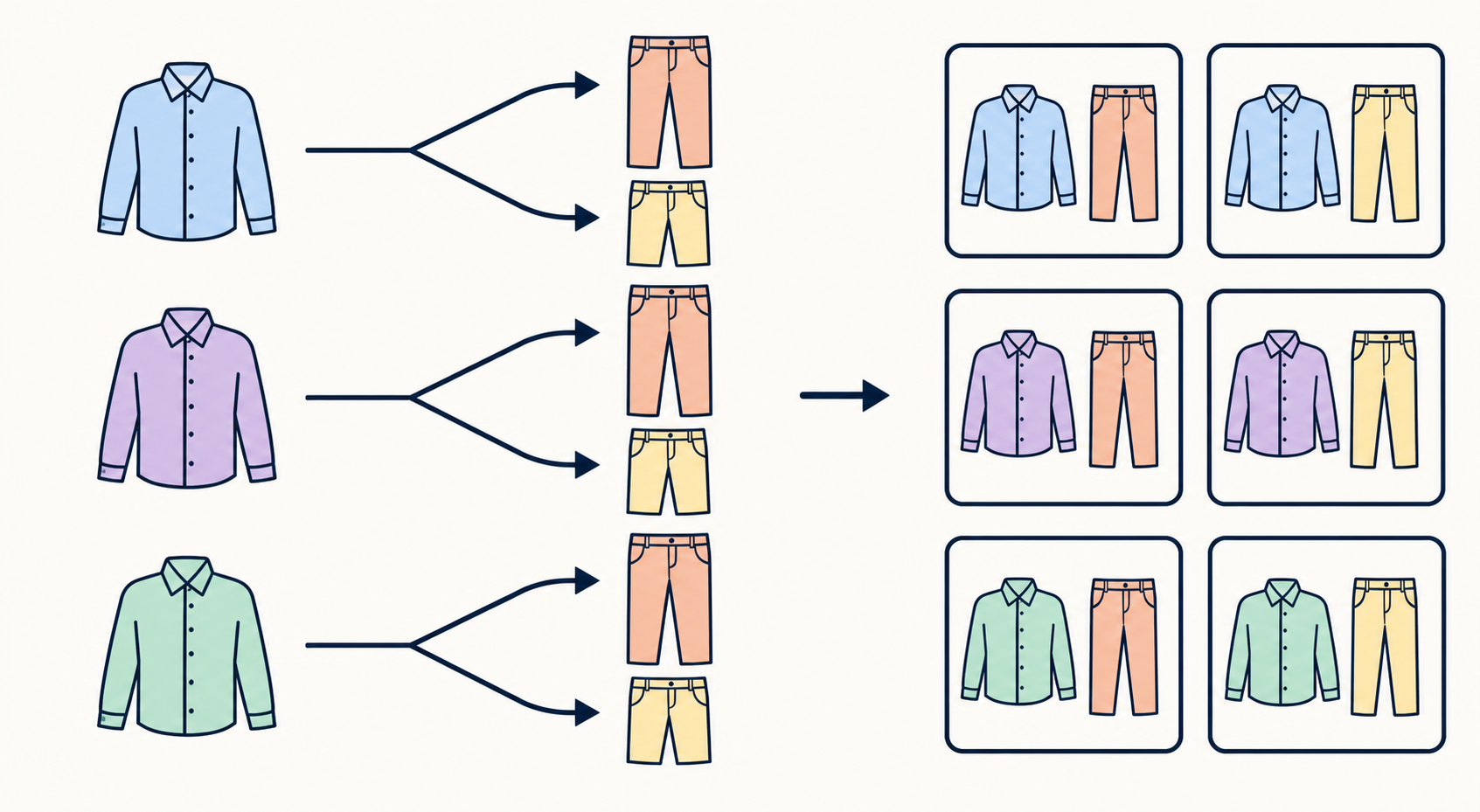 Three choices at the first stage and two at the second produce complete outcomes.
Key terms
- Outcome
- One complete possible result of a counting process.
- Stage
- One decision or step in a multi-step process.
- Product rule
- Multiply the number of choices at successive compatible stages.
- Sum rule
- Add the counts from mutually exclusive cases.
- Mutually exclusive cases
- Cases that cannot occur at the same time, so no outcome is counted twice.
Worked examples
Build an outfit
A student has 3 shirts and 2 pairs of trousers. How many different outfits contain one shirt and one pair of trousers?
- 1Choose a shirt in 3 ways.
- 2For each shirt, choose trousers in 2 ways.
- 3Apply the product rule: .
Answer: There are 6 different outfits.
Choose one transport type
There are 5 bus routes and 3 train routes from A to B. A traveler uses exactly one route. How many choices are available?
- 1The traveler chooses a bus route or a train route, not both.
- 2The two cases are mutually exclusive.
- 3Apply the sum rule: .
Answer: There are 8 route choices.
Code with independent stages
A code contains two letters followed by three digits. Repetition is allowed. How many codes exist?
- 1Each letter position has 26 choices.
- 2Each digit position has 10 choices.
- 3Multiply across the five stages: .
Answer: There are codes.
Rules and formulas
Fundamental counting principle
- total number of complete outcomes
- number of available choices at stage i
Sum rule for disjoint cases
- number of outcomes in mutually exclusive case i
Factorials
For a positive integer , the factorial is the product of all positive integers from down to 1. Factorials arise whenever distinct objects are placed into distinct positions.
By definition, . This convention makes permutation, combination, and binomial-coefficient formulas work correctly at their endpoints.
Factorials grow extremely quickly. Simplify ratios before evaluating: for example, , not two enormous calculator values.
Equations involving factorials often simplify by cancellation. Always state the integer restriction: factorial notation in this course normally requires .
Key terms
- Factorial
- The product , written .
- Endpoint convention
- The definition , needed for consistent counting formulas.
- Cancellation
- Removing common factorial factors before numerical evaluation.
Worked examples
Evaluate a factorial
Find .
- 1Write .
- 2Multiply carefully.
Answer: .
Simplify a factorial ratio
Simplify .
- 1Write .
- 2Cancel .
- 3Calculate .
Answer: .
Solve a factorial equation
Solve for a positive integer .
- 1Cancel to obtain .
- 2Solve , giving .
- 3Use the positive-integer restriction.
Answer: .
Rules and formulas
Factorial definition
- a positive integer
Zero factorial
Useful cancellation
- number of descending factors
Permutations: order matters
A permutation is an ordered arrangement. Changing the order creates a different outcome, so ABC and BAC are distinct permutations.
Arranging all distinct objects gives outcomes. Arranging objects selected from distinct objects gives .
The product rule explains the formula: there are n choices for the first position, n − 1 for the second, and so on until r positions are filled.
Use permutations for ranked places, assigned roles, ordered codes without repetition, or arrangements in a line.
Key terms
- Permutation
- An ordered selection or arrangement.
- Distinct objects
- Objects regarded as different from one another.
- Without replacement
- A selected object cannot be selected again, reducing the next stage count.
Worked examples
Award three ranked medals
Eight runners compete for gold, silver, and bronze. In how many ways can the medals be awarded?
- 1The positions are different, so order matters.
- 2Use .
Answer: There are 336 possible medal outcomes.
Arrange all objects
How many linear arrangements are possible for 7 different books?
- 1There are 7 choices for the first position, then 6, and so on.
- 2The total is .
Answer: There are 5040 arrangements.
Recognize an ordered role selection
A club of 12 students selects a president, vice-president, and treasurer. How many outcomes are possible?
- 1The roles are distinct, so changing the student assigned to a role changes the outcome.
- 2Use .
Answer: .
Rules and formulas
Arrange all distinct objects
- number of distinct objects
Permutations of r from n
- number of available distinct objects
- number of ordered positions filled
Combinations: order does not matter
A combination is an unordered selection. The group {A, B, C} is the same group as {C, A, B}, so different internal orders must not be counted again.
The number of ways to select objects from distinct objects is . Dividing by removes the orders of each selected group.
The symmetry identity reflects the equivalence of choosing the included objects or the excluded objects.
Use combinations for committees, teams, hands of cards, or any selection where the order of the chosen members has no meaning.
Key terms
- Combination
- An unordered selection.
- Selection
- A chosen subset of the available objects.
- Symmetry
- The identity .
Worked examples
Choose a committee
How many committees of 4 can be chosen from 12 students?
- 1The order of committee members does not matter.
- 2Use .
Answer: .
Select then assign roles
From 10 students, choose a team of 4 and then choose its captain. How many outcomes are possible?
- 1Choose the team in ways.
- 2For each team, choose its captain in 4 ways.
- 3Multiply the stages.
Answer: .
Use symmetry efficiently
Evaluate .
- 1Use .
- 2Calculate .
Answer: .
Rules and formulas
Combination formula
- number of available distinct objects
- number selected
Combination symmetry
Permutation-combination link
Restrictions and repeated objects
Restrictions change the sample space. Translate each condition before choosing a formula: ‘together’, ‘not together’, ‘at least’, ‘exactly’, ‘no repetition’, and ‘repetition allowed’ lead to different structures.
For objects that must stay together, treat the required group as one block, arrange the block with the remaining objects, then arrange the objects inside the block.
For objects that must not be together, the complement method is often efficient: count all arrangements and subtract those in which the forbidden objects form a block.
If positions contain groups of identical objects of sizes , the number of distinguishable arrangements is , where .
Do not confuse identical objects with repetition allowed. A length- code chosen from symbols with reuse allowed has outcomes; arranging a fixed multiset requires division by repeated factorials.
Key terms
- Block method
- Treating objects required to be together as one temporary object.
- Complement method
- Counting all outcomes and subtracting the forbidden outcomes.
- Repeated objects
- Identical objects whose interchange does not create a new arrangement.
- Repetition allowed
- A symbol may be selected again at a later stage.
- Case split
- Dividing a problem into mutually exclusive cases and adding their counts.
Worked examples
Two people must sit together
Seven distinct people stand in a line. In how many arrangements are A and B adjacent?
- 1Treat A and B as one block, giving 6 objects to arrange.
- 2Arrange the 6 objects in ways.
- 3Arrange A and B inside their block in 2 ways.
Answer: The number is .
Two people must not sit together
Seven distinct people stand in a line. In how many arrangements are A and B not adjacent?
- 1Count all arrangements: .
- 2Subtract the adjacent arrangements: .
- 3Calculate .
Answer: There are 3600 valid arrangements.
Arrange repeated letters
How many distinguishable arrangements are there of the letters in STATISTICS?
- 1There are 10 letters: S appears 3 times, T appears 3 times, and I appears 2 times.
- 2Start with and divide by .
Answer: .
At least three women
A committee of 5 is chosen from 8 women and 6 men. How many committees contain at least 3 women?
- 1Split into exactly 3, exactly 4, and exactly 5 women.
- 2Count .
- 3Add the mutually exclusive cases.
Answer: There are 1316 committees.
Rules and formulas
Arrangements with identical objects
- multiplicity of identical object type i
Sequences with repetition allowed
- number of available symbols
- number of positions
Complement count
Binomial coefficients and finite theorem review
The coefficient counts the ways to choose the positions that receive the second component when expanding . This connects combinations directly to algebra.
For , the finite binomial theorem is . It contains exactly terms.
The general term is . The index starts at , so the term containing is term number .
If the second component is negative, include its sign inside the power. This automatically produces the correct alternating sign pattern.
Key terms
- Binomial coefficient
- The combination number multiplying the term indexed by r.
- Finite expansion
- An expansion that terminates because the exponent is a non-negative integer.
- General term
- A formula that produces any chosen term without expanding everything.
Worked examples
Expand a finite binomial
Expand .
- 1Use coefficients 1, 4, 6, 4, 1.
- 2Use terms .
- 3Simplify each coefficient and retain the alternating signs.
Answer: .
Find a finite coefficient
Find the coefficient of in .
- 1The power occurs when .
- 2The coefficient is .
Answer: The coefficient is 280.
Use coefficient symmetry
Explain why the coefficients of and in are equal.
- 1The coefficients are and .
- 2Use .
Answer: Both coefficients are 28.
Rules and formulas
Finite binomial theorem
- a non-negative integer
Finite general term
- index beginning at 0
Pascal identity
The extended binomial theorem
The extended, or generalized, binomial theorem allows an exponent that is negative or non-integer. Instead of stopping, the expansion usually continues indefinitely.
For , , where and .
The first terms are . This form is often the fastest way to generate the required number of terms.
If is a non-negative integer, the factor makes all later coefficients vanish, so the generalized formula reduces to the familiar finite theorem.
Key terms
- Generalized coefficient
- , defined by a descending product even when is not a non-negative integer.
- Infinite series
- A sum with indefinitely many terms.
- Truncation
- Keeping only the first required terms of an infinite expansion.
- Convergence
- Approach of the partial sums to a finite value.
Worked examples
Generate generalized coefficients
Find , , , and .
- 1.
- 2.
- 3.
- 4.
Answer: The coefficients are .
Expand a square root
Write the first four terms of .
- 1Use the generalized coefficients for alpha = .
- 2Multiply each coefficient by the matching power of x.
Answer: , valid for .
See why an integer power terminates
Use the generalized coefficient to explain why has no term.
- 1The coefficient would be .
- 2The descending product contains a zero.
Answer: , so the expansion terminates after .
Rules and formulas
Generalized binomial coefficient
- real or rational exponent
- non-negative integer term index
Extended binomial theorem
- expansion variable inside the convergence interval
First four terms
Negative and fractional powers
Negative powers often generate recognizable infinite patterns. For example, , which is also an infinite geometric series.
For a positive integer , . This identity explains the alternating generalized coefficients before any substitution inside .
Fractional powers model roots. The expansion of can approximate when , and can approximate .
For , factor first: . The convergence condition becomes .
Key terms
- Negative exponent
- An exponent such as , representing a reciprocal power.
- Fractional exponent
- An exponent representing a root together with a power.
- Normalization
- Factoring a binomial into before using the extended theorem.
Worked examples
Negative integer power
Write the first four terms of .
- 1Use .
- 2The coefficients are for powers .
Answer: , valid for .
Substitute a linear term
Write the first four terms of .
- 1Use and substitute .
- 2Compute .
- 3Simplify each power of .
Answer: , valid for .
Factor before expanding
Find the first three terms of .
- 1Write .
- 2Use .
- 3Substitute and multiply by .
Answer: , valid for .
Rules and formulas
Negative upper coefficient
- positive integer
Normalized binomial
- non-zero constant factored from the binomial
Resulting validity condition
General term and specific coefficients
For the extended expansion , the general term is . It works for any non-negative integer , even though need not be an integer.
To find a coefficient, express u in terms of x, identify the value of r that produces the required power, and include every numerical factor from u raised to that power.
For a transformed expression , either normalize first or use .
When multiplying two series, a requested coefficient may receive contributions from several pairs of terms. List all exponent pairs that add to the required power before summing.
Key terms
- Coefficient extraction
- Finding the numerical multiplier of a specified power without writing unnecessary terms.
- Index matching
- Solving for the term index r that creates the required power of x.
- Contribution
- One product of terms that forms the requested power when series are multiplied.
Worked examples
Coefficient in a negative-power expansion
Find the coefficient of in .
- 1Use , , and .
- 2The coefficient is .
- 3Calculate .
Answer: The coefficient of x cubed is 32.
Coefficient after normalization
Find the coefficient of in .
- 1Normalize as .
- 2Use the coefficient .
- 3Compute .
Answer: The coefficient is .
Coefficient from a product
Find the coefficient of in .
- 1Use .
- 2The contributions are and .
- 3Add .
Answer: The coefficient is .
Rules and formulas
Extended general term
- non-negative integer index
General term after normalization
Validity, convergence and approximation
When is not a non-negative integer, the extended binomial series has the standard convergence condition . At or , endpoint behavior requires separate analysis and must not be assumed from the open interval.
After substituting , apply the condition to the complete inner expression: . For , this gives , hence .
A non-negative integer exponent produces a polynomial, so its finite expansion is valid for every real x; the convergence restriction is only relevant to the genuinely infinite expansion.
Truncating a convergent series gives an approximation. The closer the inner value is to zero, the more rapidly successive powers usually shrink. Report an approximate sign and appropriate accuracy.
A formula may define a real function on a wider domain than its expansion is valid. For example, the function may exist at a point where this particular power series does not converge.
Key terms
- Radius of convergence
- The distance from the expansion center within which the series converges; here the standard radius is 1 in the inner variable.
- Endpoint
- A boundary value excluded by the strict inequality and requiring a separate test.
- Partial sum
- The sum of the first finitely many terms of an infinite series.
- Approximation
- A numerical estimate obtained by truncating a convergent expansion.
Worked examples
Find an interval of validity
State the interval of validity for the extended expansion of .
- 1The inner variable is .
- 2Require : .
- 3Divide by 4 to obtain .
Answer: The interval is .
Approximate a square root
Use three non-constant terms of to approximate .
- 1Set .
- 2Use .
- 3Calculate .
Answer: .
Distinguish function domain from series validity
Does the series represent at ?
- 1The function value exists.
- 2The series requires , but .
Answer: No. The function exists at , but this series does not converge there.
Rules and formulas
Standard convergence condition
Substituted convergence condition
- complete expression replacing the standard inner variable
Truncated approximation
- highest retained power
Calculator and GDC methods
Scientific calculators and GDCs usually provide factorial, nPr, and nCr commands in a probability or mathematics menu. Enter n first, select the operation, then enter r.
Use technology to evaluate large exact counts, but write the model first. An unexplained calculator output does not show whether order matters or whether restrictions were applied correctly.
For generalized coefficients with negative or fractional , many nCr commands are unavailable. Evaluate the descending product , or define it as a sequence on the GDC.
A CAS may display a finite expansion or a truncated series, but you must still state the order term and validity condition. Verify signs and coefficients against the first-term pattern.
For approximations, keep full calculator precision through the retained sum and round only the final answer. Compare the size of the last retained term with the required accuracy.
Key terms
- nPr command
- Calculator command for ordered selections without replacement.
- nCr command
- Calculator command for unordered selections.
- CAS expansion
- Computer algebra output for an algebraic expansion or series.
- Order term
- A statement indicating the first omitted power or the continuation of a series.
Worked examples
Check a large combination
Evaluate on a GDC.
- 1Enter 30.
- 2Choose nCr and enter 8.
- 3Press enter, then retain the exact integer.
Answer: .
Generate a generalized coefficient
Use a calculator to evaluate .
- 1Enter .
- 2Use exact fraction mode if available.
- 3Check that four descending factors appear.
Answer: .
Numerical check without replacing proof
How should a GDC be used after deriving a restricted counting result?
- 1Enter the final expression exactly.
- 2Check it is a non-negative integer.
- 3Estimate whether its size is plausible from the unrestricted total.
Answer: Use the GDC to verify arithmetic, while keeping the case structure and restriction reasoning in the written solution.
Rules and formulas
Generalized coefficient recurrence
- current coefficient index
Plausibility bound for a restriction
IB HL problem-solving and exam strategy
Begin by classifying the problem: staged choices, ordered selection, unordered selection, repeated objects, restricted cases, finite binomial expansion, or infinite generalized expansion.
For counting, define what one outcome means. Then state whether order matters, whether replacement is allowed, and whether cases overlap. A correct formula applied to the wrong model earns little credit.
For an extended expansion, normalize the binomial, identify alpha and the complete inner variable u, write the general term, generate only the required powers, and state |u| < 1.
Use exact values during algebra. Fractions reveal coefficient structure and avoid rounding error. Convert to decimals only when an approximation or contextual answer is requested.
Finish with a reasonableness check: a count must be a non-negative integer no larger than the unrestricted total, and a truncated series should have decreasing term sizes near its center.
Key terms
- Model
- A mathematical representation of the choices, restrictions, or expansion structure.
- Unrestricted total
- The count before a restriction removes outcomes.
- Method mark
- Credit awarded for a valid mathematical process even if later arithmetic is incorrect.
- Reasonableness check
- A structural or numerical check that the result fits the problem.
Worked examples
Choose the correct counting tool
Match each situation to a method: a committee of 4; four ranked prizes; arrangements of LEVEL; six-digit codes with reuse.
- 1Committee: unordered selection.
- 2Prizes: ordered selection.
- 3LEVEL: repeated objects.
- 4Codes with reuse: product rule.
Answer: Use nCr; nPr; 5! divided by 2!2!; and 10 to the power 6, respectively.
Plan an extended expansion
Describe the method for expanding through .
- 1Factor: .
- 2Use and .
- 3Retain , 1, 2, multiply by one third, then state || < 1.
Answer: The expansion is , valid for .
Check a restricted count
A calculation gives 560 valid arrangements out of 420 unrestricted arrangements. What does this show?
- 1A restriction can only keep or remove outcomes.
- 2Therefore the valid count cannot exceed the unrestricted count.
Answer: The model or arithmetic is wrong; revisit overlapping cases, multiplication, or division by repeats.
Rules and formulas
Counting decision
Extended-expansion checklist
IB-style practice questions with worked solutions
Attempt each question before revealing the steps. The set moves from direct counting and notation to restrictions, generalized coefficients, convergence, and approximation.
In an examination, write the structural expression before using technology and state exact answers unless an approximation is requested.
Key terms
- Exact answer
- An integer, fraction, radical, or algebraic form with no rounding.
- Validity condition
- The inequality defining where an infinite expansion represents the function.
- Worked solution
- A sequence of justified steps leading to the answer.
Worked examples
1. Product rule with repetition
A password contains three letters followed by four digits. Repetition is allowed. How many passwords are possible?
- 1There are 26 choices for each letter and 10 for each digit.
- 2Use .
Answer: There are 175760000 passwords.
2. Sum rule
A journey uses exactly one of 4 bus routes or 3 train routes. How many route choices are possible?
- 1Bus and train are mutually exclusive alternatives.
- 2Add .
Answer: There are 7 choices.
3. Restricted permutation using a block
Eight distinct books are arranged on a shelf. Three particular books must remain together. How many arrangements are possible?
- 1Treat the three books as one block, leaving 6 objects.
- 2Arrange the objects in ways.
- 3Arrange the three books inside the block in ways.
- 4Multiply.
Answer: .
4. Combination
How many groups of 6 can be selected from 14 students?
- 1Order does not matter.
- 2Use .
Answer: .
5. Repeated letters
How many distinguishable arrangements are there of MISSISSIPPI?
- 1There are 11 letters.
- 2I appears 4 times, S appears 4 times, and P appears 2 times.
- 3Use .
Answer: There are 34650 arrangements.
6. Number with no repeated digits
How many six-digit numbers have no repeated digits?
- 1The first digit has 9 choices because it cannot be 0.
- 2The second digit has 9 remaining choices, including 0.
- 3The remaining positions have 8, 7, 6, and 5 choices.
Answer: .
7. Finite-binomial coefficient
Find the coefficient of in .
- 1Use the term with : .
- 2Calculate .
Answer: The coefficient is 60.
8. Fractional-power expansion
Find the first four terms of .
- 1Use .
- 2Substitute .
Answer: , valid for .
9. Negative-power expansion and validity
Expand through and state its validity.
- 1Use .
- 2Substitute .
- 3Require .
Answer: , valid for .
10. Generalized coefficient
Find the coefficient of in .
- 1Use : .
- 2Calculate .
- 3Multiply by .
Answer: The coefficient is .
11. Approximation
Use terms through in to approximate .
- 1Set .
- 2Use .
- 3Substitute without premature rounding.
Answer: .
12. Restricted committee
A committee of 4 is chosen from 7 women and 5 men. How many committees contain exactly 2 women?
- 1Choose 2 women in ways.
- 2Choose 2 men in ways.
- 3Multiply the independent selections.
Answer: .
Rules and formulas
Ordered selection
Unordered selection
Extended general term
Topic summary and cheat sheet
Counting starts with structure: multiply successive compatible stages, add mutually exclusive cases, and decide whether order matters.
Use for ordered selections and for unordered selections. Divide by repeated factorials only when objects are identical.
For a non-negative integer exponent, use the finite theorem. For negative or non-integer , normalize to , use generalized coefficients, and state .
A strong IB solution labels restrictions and cases, preserves exact arithmetic, shows the general term when extracting a coefficient, and checks that the result is reasonable.
Key terms
- Counting checklist
- AND or OR? Order or no order? Replacement or no replacement? Restrictions? Identical objects?
- Expansion checklist
- Normalize; identify alpha and u; choose r; simplify exactly; state |u| < 1.
- Final check
- A count is a non-negative integer; an infinite expansion includes its validity condition and continuation.
Worked examples
One-minute method choice
Which four questions should you ask before beginning a counting calculation?
- 1Does order matter?
- 2Is repetition or replacement allowed?
- 3Are there restrictions or identical objects?
- 4Are the cases successive or mutually exclusive alternatives?
Answer: Those decisions determine whether to use a product, sum, permutation, combination, repeated-object formula, block, complement, or case split.
One-minute extended-binomial method
What is the workflow for when is negative or non-integer? Assume and real .
- 1Factor to .
- 2Set .
- 3Use .
- 4State .
Answer: Retain only the required powers, include the outside factor, and keep exact coefficients.
Rules and formulas
Factorial
Permutation and combination
Repeated objects
Extended binomial theorem
Generalized coefficient
Topic summary
- Multiply the numbers of choices at successive compatible stages.
- Add counts only when cases are mutually exclusive and collectively cover the allowed outcomes.
- Use and remember .
- Use when order matters.
- Use when order does not matter.
- Separate group selection from later role assignment when both occur.
- Use blocks for objects required to stay together and complements for forbidden arrangements when efficient.
- For identical objects, divide by the factorial of each multiplicity.
- If repetition is allowed in each of positions from symbols, there are sequences.
- List all exact cases for ‘at least’ and ‘at most’ restrictions before adding.
- The finite theorem is .
- The finite general term is .
- For arbitrary , define .
- The extended theorem is .
- For a genuinely infinite extended expansion, state .
- Normalize as .
- When extracting a coefficient, include the full numerical factor raised to the chosen power.
- When multiplying series, add every pair of terms that contributes to the requested power.
- Use GDC nPr and nCr for evaluation, but show the mathematical model first.
- For negative or fractional upper coefficients, use the descending-product definition if calculator nCr is unavailable.
- Keep exact fractions through the expansion and round only a requested final approximation.
- A count must be a non-negative integer and cannot exceed its unrestricted total.
- An infinite expansion must show continuation and its validity condition.
- Near the expansion center, decreasing omitted terms provide a useful approximation check.