Meaning of an infinite geometric series
A geometric sequence lists terms obtained by repeatedly multiplying by a constant common ratio. A geometric series adds those terms. An infinite geometric series has no final term and takes the form .
We do not add infinitely many terms one at a time. Instead, we study the partial sums . If these finite sums approach one fixed number, the infinite series converges and that limiting number is called .
For example, has partial sums . Each partial sum is closer to 1, so the infinite series has sum 1 even though no finite partial sum equals 1.
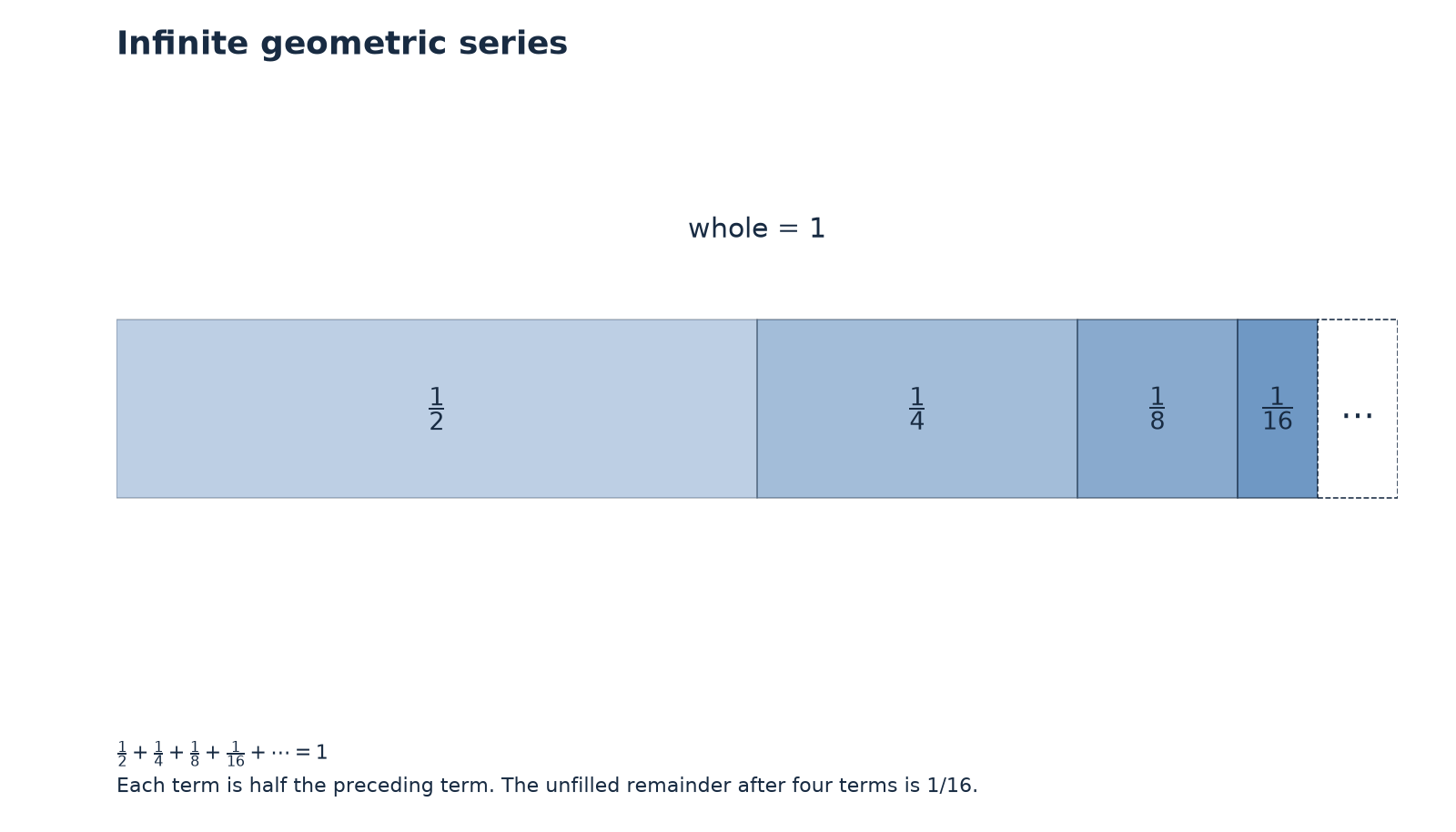 Each new region is half the previous one. Infinitely many shrinking additions approach the complete unit.
Key terms
- Infinite geometric series
- An endless sum whose consecutive terms have a constant ratio.
- Partial sum
- The finite sum of the first terms.
- Limit
- The value approached by the partial sums as increases without bound.
- Sum to infinity
- The limiting value when the partial sums converge.
Worked examples
Sequence or series?
Classify and .
- 1Commas indicate an ordered list of terms, so the first expression is a sequence.
- 2Plus signs indicate addition, so the second expression is a series.
- 3Both are geometric because each new term is obtained by multiplying by .
Answer: The first is an infinite geometric sequence; the second is an infinite geometric series.
Build partial sums
Find the first four partial sums of .
- 1.
- 2.
- 3.
- 4.
Answer: ; they approach 1.
Write the general term
For , write the th term and the first -term sum.
- 1The first term is and the ratio is .
- 2The th term is .
- 3The partial sum is .
Answer: and .
Rules and formulas
Infinite geometric series
- the first term
- the common ratio
Partial sum notation
First term, common ratio, and geometric structure
The first term is . For consecutive non-zero terms, calculate the common ratio using later term divided by earlier term: . Check more than one pair when deciding whether a displayed series is geometric.
A positive ratio keeps the signs the same. A negative ratio makes signs alternate. The magnitude tells us whether the term sizes shrink, stay constant, or grow.
The general term is . A necessary condition for any infinite series to converge is ; for a non-zero geometric series, this happens exactly when .
Key terms
- First term
- The initial term of the geometric series.
- Common ratio
- The constant multiplier between consecutive non-zero terms.
- Alternating series
- A series whose term signs alternate, usually because .
- Term test
- If the terms do not approach zero, the infinite series cannot converge.
Worked examples
Find a positive ratio
Find and for .
- 1The first term is .
- 2Divide consecutive terms: and .
Answer: and .
Find a negative ratio
Find and for .
- 1The first term is .
- 2, and .
- 3The negative ratio explains the alternating signs.
Answer: and .
Find an unknown term
A geometric series has and . Find its sixth term.
- 1Use .
- 2.
Answer: .
Rules and formulas
Common ratio
Geometric term
Convergence and the condition |r| < 1
A non-zero infinite geometric series converges exactly when , equivalently . Repeated multiplication then makes , so the terms shrink toward zero and the partial sums settle at a finite limit.
If , term magnitudes grow. If , the same non-zero term is added forever. If , the partial sums oscillate between two values. In every case , a non-zero geometric series diverges.
A negative ratio does not automatically cause divergence. If , term signs alternate but their magnitudes shrink, so the partial sums oscillate ever closer to one limit.
The zero series is a trivial exception that sums to zero. IB questions normally use a non-zero first term, for which is the complete convergence test.
Key terms
- Convergent
- The sequence of partial sums approaches a finite limit.
- Divergent
- The partial sums do not approach one finite value.
- Magnitude
- Absolute value; measures the size of the repeated multiplier without its sign.
- Oscillation
- Movement back and forth between values, as occurs with negative ratios.
Worked examples
Classify several ratios
Decide whether geometric series with converge.
- 1Calculate each magnitude.
- 2, so it converges.
- 3, so it converges.
- 4 and , so those series diverge.
Answer: The first two converge; the last two diverge.
Alternating convergence
Does converge?
- 1The common ratio is .
- 2.
- 3Alternating signs do not prevent convergence because the magnitudes shrink.
Answer: Yes, the series converges.
Use the term test
Explain why diverges.
- 1The common ratio is .
- 2The terms grow rather than approach zero.
- 3A series whose terms do not approach zero cannot converge.
Answer: It diverges because and .
Rules and formulas
Geometric convergence condition
Vanishing powers
Deriving and finding the sum to infinity
For , the finite geometric sum is . If , then , so the limit is .
The finite formula can be derived algebraically. Write , multiply by , and subtract the aligned equations. All middle terms cancel, leaving .
A positive ratio gives partial sums that move toward the limit from one side when . A negative ratio often makes the partial sums alternate above and below the limit.
Key terms
- Finite geometric sum
- , the sum of the first terms when .
- Limiting sum
- The value obtained when the finite partial sums approach a limit as .
- Cancellation
- The disappearance of matching middle terms when is subtracted from .
Worked examples
Positive sum to infinity
Find .
- 1 and .
- 2Since , the series converges.
- 3.
Answer: .
Alternating sum to infinity
Find .
- 1 and .
- 2Since , use the infinite-sum formula.
- 3.
Answer: .
Exact fractional sum
Find .
- 1The ratio is , which satisfies .
- 2.
Answer: .
Rules and formulas
Finite geometric sum
Sum to infinity
- the limiting sum
- the first term
- the common ratio with magnitude less than 1
Finding unknown terms, the first term, or the common ratio
For , the equation gives . If , it also gives . Check that a calculated ratio satisfies . The zero series does not determine a unique ratio from its first term and sum.
A known term adds the equation . Use it together with the sum equation, then check all algebraic candidates because polynomial equations can produce more than one ratio.
When the displayed terms contain an unknown, form the ratio between consecutive terms. A true geometric series must use the same ratio throughout.
Key terms
- Simultaneous conditions
- Two equations, such as a term formula and an infinite-sum formula, used together to find unknown parameters.
- Candidate ratio
- A possible solution for that must be checked against the original series and .
- Rearrangement
- Algebraically isolating a required variable without changing the equality.
Worked examples
Find the first term
A convergent geometric series has and . Find .
- 1Use .
- 2.
Answer: .
Find the common ratio
A convergent geometric series has first term 14 and sum 20. Find .
- 1Use .
- 2.
- 3Check .
Answer: .
Use the second term and the sum
A convergent geometric series has second term 6 and sum 24. Find and .
- 1The conditions are and .
- 2Substitute into : .
- 3This simplifies to , so .
- 4Then .
Answer: and .
Unknown inside the terms
The convergent series has sum . Find .
- 1The common ratio is .
- 2Use .
- 3Cross-multiply: , so .
- 4Then , which satisfies convergence.
Answer: .
Rules and formulas
First term from the sum
Ratio from first term and sum
Term condition
Convergent versus divergent series and remainders
A convergent series has a finite sum and can be approximated by a large partial sum. The difference between the exact limiting sum and is the remainder .
For a convergent geometric series, the first omitted term after is . The remaining tail is itself a geometric series, so .
A divergent series has no finite . Writing a numerical value from when is an invalid application of the formula, not a strange sum.
Key terms
- Remainder
- , the infinite tail after the first terms.
- First omitted term
- The term immediately after the final term included in .
- Approximation error
- The size of the difference between a partial sum and the limiting sum.
Worked examples
Find a remainder
For , find the sum remaining after the first four terms.
- 1Here , , and the first omitted term is .
- 2Use .
- 3Simplify exactly or evaluate with full precision.
Answer: .
Explain divergence at
Explain why diverges.
- 1Here , so each partial sum adds another 4.
- 2, which grows without bound.
- 3The denominator in would be zero, confirming the formula is unavailable.
Answer: The series diverges.
Explain oscillation at
Describe the partial sums of .
- 1The partial sums are .
- 2They do not approach one value.
- 3Because , the series fails the convergence condition.
Answer: The series diverges by oscillation.
Rules and formulas
Remainder after n terms
Approximation relation
Applications and word problems
Infinite geometric series model repeated contributions that become smaller by a constant factor. The model is appropriate only when the repetition can continue conceptually and the ratio has magnitude less than 1.
For a bouncing ball, count the initial drop once. Each rebound height is then travelled twice—upward and downward—so the distance model is .
Recurring decimals are infinite geometric series because each repeated digit block shifts by a fixed power of 10. Repeated-dose models work similarly when a constant fraction remains before each new dose.
Key terms
- Rebound factor
- The constant fraction of the previous height reached after each bounce.
- Recurring decimal
- A decimal with a digit block that repeats forever.
- Steady-state amount
- The limiting total approached after many repeated additions and proportional reductions.
Worked examples
Bouncing-ball distance
A ball is dropped from 10 m and rebounds to 60% of each previous height. Find its total vertical distance.
- 1The initial drop contributes 10 m.
- 2The rebound heights form , with sum .
- 3Each rebound height is travelled once up and once down.
- 4Total distance .
Answer: .
Recurring decimal
Write as a fraction.
- 1Write .
- 2Here and .
- 3.
- 4Simplify the fraction.
Answer: .
Repeated medicine dose
A patient receives 80 mg each day. Immediately before the next dose, 25% of the previous amount remains. Find the long-term amount immediately after a dose.
- 1The contributions present just after many doses are .
- 2The ratio is .
- 3.
Answer: The amount approaches .
Rules and formulas
Bouncing-ball distance
Repeated fixed contribution
- amount immediately after addition n in the recurrence A_(n+1)=r +d
- fixed addition after each retention step; just before the next addition the limiting amount is
Two-digit recurring decimal
- the recurring two-digit block, not the product of a and b
Calculator/GDC methods and exam strategy
A GDC has no special infinity term to enter. Use the exact formula after checking , or calculate partial sums for increasing values of to observe the limiting behaviour.
A finite table of illustrates numerical behaviour but does not prove convergence. Prove when . For and , compare consecutive odd and even indices, such as , to see partial sums alternate around the limit.
When an unknown ratio produces a nonlinear equation, use a numerical solver or graph intersection. Restrict the search to , record the equation entered, and verify each reported root in the original conditions.
Keep exact fractions through the algebra. If the context requires a decimal, use full GDC precision and round only the final answer.
Key terms
- Numerical solver
- A GDC tool that approximates roots of an equation over a specified interval.
- Graph intersection
- A point where two plotted expressions have equal values.
- Convergence table
- A table of partial sums for increasing used to observe approach toward a limit.
- Guard digits
- Extra calculator precision retained before final rounding.
Worked examples
Investigate partial sums
Use partial sums to investigate .
- 1Here and .
- 2Enter .
- 3A GDC gives , , and .
- 4Compare with .
Answer: The partial sums approach .
Use a solver for an unknown ratio
A series has , , and converges. Find .
- 1Use : .
- 2Solve with exact reasoning or a GDC.
- 3The real solution is , which satisfies .
Answer: .
Check an apparently valid formula result
A student enters and claims . Explain the error.
- 1The ratio is .
- 2Although the calculator can evaluate the algebraic fraction, .
- 3The terms grow and the partial sums do not approach 2.
Answer: The series diverges; the sum-to-infinity formula was used outside its domain.
Rules and formulas
Partial-sum calculator entry
Solver interval
IB-style practice with worked solutions
Attempt each problem before opening its worked solution. The set moves from identifying convergence to solving unknowns and building applied models.
In every sum-to-infinity question, make the convergence condition visible. Exact values are preferred unless the question requests a decimal or contextual rounding.
Key terms
- Exact answer
- A fraction or symbolic value without premature decimal approximation.
- Model validation
- Checking that the common ratio and counting assumptions match the stated context.
- Candidate check
- Testing a calculated ratio or variable in both the original conditions and .
Worked examples
Practice 1 — convergence
Does a non-zero geometric series with converge?
- 1.
Answer: Yes, it converges.
Practice 2 — boundary ratio
Does a non-zero geometric series with converge?
- 1, not less than 1.
- 2Its partial sums oscillate rather than approach one limit.
Answer: No, it diverges.
Practice 3 — positive infinite sum
Find .
- 1, , and .
- 2.
Answer: .
Practice 4 — alternating infinite sum
Find .
- 1, , and .
- 2.
Answer: .
Practice 5 — first term
A convergent geometric series has sum 40 and ratio 0.2. Find its first term.
- 1.
Answer: .
Practice 6 — common ratio
A convergent geometric series has first term 9 and sum 12. Find .
- 1.
- 2Check that the result has magnitude less than 1.
Answer: .
Practice 7 — unknown term
A geometric series has and . Find .
- 1.
Answer: .
Practice 8 — algebraic series
The convergent series has sum . Find .
- 1The ratio is .
- 2Solve .
- 3This gives , hence .
Answer: .
Practice 9 — recurring decimal
Write as a fraction.
- 1.
- 2Sum: .
- 3Simplify.
Answer: .
Practice 10 — bouncing ball
A ball is dropped from 12 m and rebounds to half its previous height. Find the total distance travelled.
- 1Rebound heights sum to m.
- 2Count the initial 12 m once and each rebound height twice.
- 3.
Answer: .
Practice 11 — remainder
For , find the sum after the first four terms that has not yet been included.
- 1Use with .
- 2.
Answer: .
Practice 12 — divergent claim
Explain why has no sum to infinity.
- 1The common ratio is .
- 2, and the terms do not approach zero.
- 3Therefore the partial sums grow without bound.
Answer: The series diverges.
Rules and formulas
Convergence and sum
Term and remainder
Topic summary
- An infinite geometric series has the form .
- Its partial sums determine whether a finite limiting sum exists.
- For a non-zero geometric series, convergence occurs exactly when .
- A negative ratio can converge when ; the partial sums then alternate toward the limit.
- For a nonzero first term, makes the geometric series diverge; do not assign it a sum with the convergent-series formula. The zero series instead sums to zero for every finite ratio.
- For , .
- For , . If , also ; a zero sum with zero first term does not identify the ratio.
- The th term is .
- The remainder after terms is .
- In bouncing-ball models, count the initial drop once and every rebound height twice.
- A GDC can inspect partial sums or solve unknowns, but it cannot replace the convergence check.
- Keep exact values until the final step and state units, accuracy, and contextual meaning.