Meaning of mathematical proof
A mathematical proof is a finite chain of valid logical deductions that establishes a statement from accepted definitions, axioms, or previously proved results. A proof explains why a result must be true, not merely why it appears true in several examples.
A theorem usually has hypotheses and a conclusion. In an implication , P is the hypothesis and Q is the conclusion. The proof may assume P and must justify Q.
A universal statement claims that a property holds for every object in a stated domain. An existential statement claims that at least one object satisfies a property. The quantifiers and domain are part of the statement and cannot be ignored.
Numerical checks can suggest a conjecture or reveal an error, but checking any finite list does not prove a claim about infinitely many cases.
Key terms
- Proof
- A logically valid argument establishing that a mathematical statement must be true.
- Theorem
- A statement established by proof.
- Hypothesis
- An assumption supplied by a theorem or implication.
- Conclusion
- The result that must follow from the hypotheses.
- Conjecture
- A plausible statement not yet proved.
Worked examples
Evidence is not proof
A student checks for , 2, 3, 4, 5. Has the statement been proved for every positive integer?
- 1Only five cases were checked.
- 2The claim concerns infinitely many positive integers.
Answer: No. The checks are evidence; a general argument such as induction is required.
Identify hypothesis and conclusion
In the statement ‘if n is divisible by 4, then n is even’, identify the two parts.
- 1The phrase after ‘if’ is the hypothesis.
- 2The phrase after ‘then’ is the conclusion.
Answer: Hypothesis: . Conclusion: .
A valid existential proof
Prove that there exists an even prime.
- 1An existential statement needs one valid witness.
- 2Choose 2 and verify that it is even and prime.
Answer: The witness 2 proves the statement.
Rules and formulas
Implication
Universal statement
Existential statement
Choosing the appropriate proof method
Choose a proof method by reading the logical structure rather than by copying a familiar template. Induction is designed for a chain of integer-indexed cases. Contradiction is useful when the negation creates strong algebraic or logical consequences. A counterexample disproves a universal claim.
Direct proof is often best when definitions immediately transform the hypothesis into the conclusion. Do not use induction simply because the statement contains n; many integer statements have shorter direct proofs.
To prove by contradiction, assume P and . To disprove , find one with .
Before writing, identify the domain, quantifier, hypotheses, exact conclusion, and any restrictions such as .
Key terms
- Direct proof
- A proof that derives the conclusion directly from the hypotheses.
- Induction
- A proof method connecting a verified starting case to every later integer case.
- Contradiction
- A proof that assumes the negation and derives an impossibility.
- Counterexample
- One valid domain value that makes a universal claim false.
Worked examples
Choose induction
Which method naturally proves for every positive integer n?
- 1The statement is indexed by consecutive positive integers.
- 2The formula for k can help build the formula for k + 1.
Answer: Mathematical induction is natural.
Choose contradiction
Which method naturally proves that is irrational?
- 1Assuming rationality gives a lowest-terms fraction.
- 2Parity then forces numerator and denominator both even, contradicting lowest terms.
Answer: Proof by contradiction is natural.
Choose a counterexample
How should the claim ‘every prime is odd’ be handled?
- 1The claim is universal.
- 2Search for one prime that is not odd.
Answer: The counterexample 2 disproves the claim.
Rules and formulas
Contradiction form for an implication
Disproving a universal claim
Mathematical induction: the complete logical chain
Suppose () is a statement for every integer . Mathematical induction has two logical obligations: prove , then prove for an arbitrary integer .
The first obligation is the base case. The second contains the inductive hypothesis and inductive step. Together they establish () for all integers from onward.
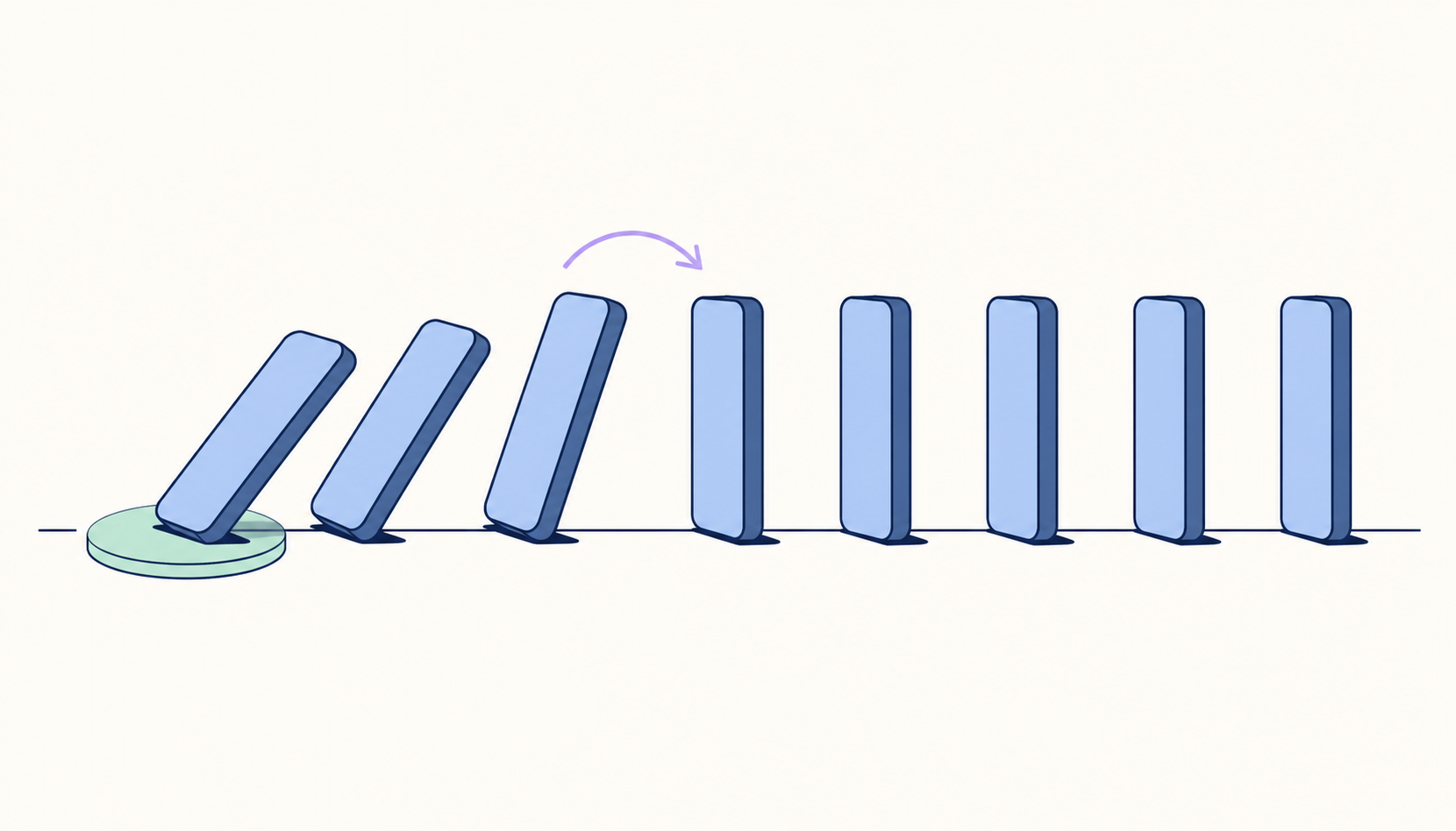 A complete induction proof needs both the verified first case and a valid implication from each case to the next.
The domino analogy separates the logic: placing or knocking the first domino corresponds to the base case; proving each falling domino knocks the next corresponds to the implication . Either part alone is insufficient.
Induction does not assume the statement for every n. It assumes one arbitrary case temporarily in order to prove the next case.
Key terms
- Induction proposition
- The statement to be proved for all integers in a specified range.
- Base case
- Verification of the first required integer .
- Inductive hypothesis
- The temporary assumption that holds for an arbitrary eligible k.
- Inductive step
- The proof that implies .
Worked examples
Identify
For the claim , state .
- 1Include both the indexed sum and the proposed result.
- 2State the integer domain.
Answer: for .
Identify the starting index
For a claim stated for every integer , which base case is required?
- 1Use the first integer in the stated range.
Answer: Verify , not .
Explain the two failures
Why does checking without proving ⇒ not establish every case?
- 1The base starts the chain.
- 2No rule has been proved to reach later cases.
Answer: Both the base case and the inductive implication are necessary.
Rules and formulas
Induction principle
The base case
The base case substitutes the first required integer into the original statement and verifies both sides or the required property.
Write the base case explicitly. For an identity, calculate the left-hand side and right-hand side separately. For divisibility, show the required integer multiple.
If the statement starts at , checking leaves a gap. If it starts at , checking does not start the required chain at its stated first case.
Some statements require more than one base case when the inductive step jumps by more than one index or depends on several previous terms.
Key terms
- Starting index
- The smallest integer covered by the theorem.
- Verification
- A calculation or argument confirming the proposition at .
Worked examples
Base case for a sum
Verify the base case for , .
- 1At , the left side is 1.
- 2The right side is .
Answer: is true.
Base case for divisibility
Verify the base case for , .
- 1At , .
- 2Seven is divisible by 7.
Answer: is true.
A non-standard start
Verify the base case for , .
- 1At , .
- 2Also, , so .
Answer: is true.
Rules and formulas
Base-case instruction
The inductive hypothesis
In the inductive hypothesis, let k be an arbitrary integer with and assume is true. Write the complete statement , not only the phrase ‘assume true for k’.
The hypothesis is temporary and local to the inductive step. It is not the result being proved, because the conclusion concerns all n after the step and base case are combined.
Do not assume . That is exactly what the inductive step must establish.
The hypothesis must be used. If the calculation of never depends on , the central link has probably not been proved.
Key terms
- Arbitrary k
- A general integer in the required range, not a chosen example.
- Temporary assumption
- A statement permitted within the implication proof and discharged afterward.
Worked examples
Write a sum hypothesis
State the inductive hypothesis for .
- 1Replace n by k on both sides.
Answer: Assume for an arbitrary .
Write a divisibility hypothesis
State the hypothesis for .
- 1Write divisibility as an integer multiple if it will be used algebraically.
Answer: Assume for some integer m.
Write a recurrence hypothesis
For , , state the hypothesis for the claim .
- 1Replace n by k in the claimed explicit formula.
Answer: Assume for an arbitrary .
Rules and formulas
Inductive hypothesis
Divisibility hypothesis
The inductive step and conclusion
The inductive step starts from the left-hand side or defining expression for , separates the new contribution, and uses the inductive hypothesis to reach the required right-hand side or property.
For a sum, write the sum to k + 1 as the sum to k plus the new term. For a recurrence, use the recurrence to express in terms of . For divisibility, rearrange the next expression so that the assumed divisible part appears.
End the step with the exact statement , then discharge the temporary assumption and state the induction conclusion for every integer in the domain.
Avoid circular reasoning: do not begin by assuming the formula for k + 1 or manipulate the desired equation as though it were already true.
Key terms
- New term
- The additional term appearing when a sum grows from k to k + 1.
- Discharge
- Completing an implication so the temporary hypothesis is no longer assumed globally.
- Induction conclusion
- The final statement that holds for every integer n in the required range.
Worked examples
Complete a sum step
Assuming , prove the k + 1 case.
- 1Write .
- 2Use the hypothesis to obtain .
- 3Factor and simplify to .
Answer: This is .
Complete a recurrence step
Assume and . Prove the next formula.
- 1Substitute the hypothesis: .
- 2Simplify to .
Answer: Therefore holds.
Write the conclusion
How should a complete induction proof finish?
- 1Refer to both the verified base and proved implication.
- 2Restate the domain.
Answer: Therefore, by mathematical induction, holds for every integer .
Rules and formulas
Sum extension
Inductive implication
Induction proofs involving sums
For a finite-sum identity, define precisely with correct sigma limits. In the inductive step, isolate the term produced when the upper limit changes from k to k + 1.
Substitute the inductive hypothesis for the entire sum to k. Then simplify until the result has exactly the claimed form with n replaced by k + 1.
Factorization is often the decisive final step. Write enough algebra to show how the target expression appears.
The same structure works for arithmetic, geometric, polynomial, and telescoping sums when the new term is identified correctly.
Key terms
- Finite sum
- A sum with a specified lower and upper index.
- Sigma notation
- Compact notation for indexed addition.
- Target form
- The claimed formula after replacing n by k + 1.
Worked examples
Sum of odd integers
Prove for .
- 1Base: at , both sides equal 1.
- 2Assume .
- 3Then the next sum is .
Answer: The identity holds for every positive integer n by induction.
Geometric sum
Prove for .
- 1Base: gives .
- 2Assume the formula for k.
- 3Add and simplify: .
Answer: The formula holds for every integer .
A polynomial summand
Prove .
- 1Verify : both sides equal 2.
- 2Assume the formula for k.
- 3Add , factor , and obtain .
Answer: The identity holds for all positive integers n.
Rules and formulas
Natural-number sum
Odd-number sum
Finite geometric sum
- real or complex ratio with q not equal to 1
Induction proofs involving divisibility
A divisibility statement means for some integer m. This representation makes the inductive hypothesis usable.
In the next case, rewrite using plus or times an additional expression. The hypothesis supplies one multiple of d; show the remaining part is also a multiple of d.
Conclude by explicitly identifying an integer multiplier. It is not enough to say that an expression ‘looks divisible’.
Modular arithmetic can guide the rearrangement, but the induction proof must still contain its base, hypothesis, step, and conclusion when induction is requested.
Key terms
- Divisibility
- divides when for some integer .
- Integer multiplier
- The integer showing that an expression is an exact multiple of the divisor.
- Congruence
- A modular statement describing equal remainders.
Worked examples
Power divisibility
Prove for .
- 1Base: .
- 2Assume .
- 3Then .
- 4Since is an integer, the next case is divisible by 7.
Answer: The result holds for all positive integers n.
Another power pattern
Prove for .
- 1Base: .
- 2Assume .
- 3Then .
Answer: The result holds for every positive integer n.
Choose a useful rearrangement
Why is useful?
- 1It exposes the expression in the inductive hypothesis.
- 2The extra term 7 is also divisible by 7.
Answer: Both parts are known multiples of 7.
Rules and formulas
Divisibility definition
Useful power rearrangement
Induction proofs involving sequences and recurrences
To prove an explicit formula for a recursively defined sequence, verify the formula at the initial index, assume it at index k, and substitute it into the recurrence for .
The recurrence is the bridge from k to k + 1. Without using it, the inductive step does not connect the sequence terms.
If a recurrence depends on two previous terms, strong induction or two initial cases may be required. The scope of the inductive hypothesis must match the recurrence.
After simplifying , compare it with the claimed explicit formula after replacing n by k + 1.
Key terms
- Recursive sequence
- A sequence whose later terms are defined using earlier terms.
- Explicit formula
- A formula giving directly as a function of n.
- Strong induction
- An induction form that assumes all relevant earlier cases up to k.
Worked examples
Linear recurrence
Given , , prove .
- 1Base: .
- 2Assume .
- 3Then .
Answer: The formula holds for every .
Arithmetic recurrence
Given , , prove .
- 1Base: .
- 2Assume .
- 3Then .
Answer: The formula holds for every .
Recognize a two-term dependency
A recurrence uses . Why may one base case be insufficient?
- 1The next term depends on two previous terms.
- 2The induction needs both starting values and access to both earlier formulas.
Answer: Verify two initial cases and use an appropriately strengthened hypothesis.
Rules and formulas
One-step recurrence proof
Strong induction hypothesis
Induction proofs involving inequalities
Induction can prove inequalities when the k + 1 expression can be bounded using the hypothesis. Every multiplication or division must respect sign conditions.
State the valid starting index carefully. Many exponential-versus-polynomial inequalities fail for small n and become true only after a threshold.
The inductive step often requires an additional simple inequality valid in the range, such as . State it rather than hiding it.
A strict inequality must remain strict; do not silently replace it by equality during algebra.
Key terms
- Inductive inequality
- An inequality whose next case is derived using the assumed current case.
- Threshold
- The first integer from which an inequality remains true.
Worked examples
Basic exponential inequality
Prove for .
- 1Base: .
- 2Assume .
- 3Then .
- 4Since for , holds.
Answer: The inequality holds for every integer .
Check a threshold
Why can the claim not start at ?
- 1At , both sides equal 4.
- 2The strict inequality fails at the proposed base.
Answer: A valid theorem needs a later starting index, such as .
Preserve direction
If the hypothesis is , when can both sides be multiplied by c without reversing the inequality?
- 1The sign of c determines the direction.
Answer: The direction is preserved when ; it reverses when .
Rules and formulas
Example inequality chain
Proof by contradiction: logical structure
To prove a statement S by contradiction, assume its negation . Use valid deductions until an impossibility appears, then conclude that the assumption was false and S must be true.
A contradiction may be a direct impossibility such as , a statement and its negation, a violation of a definition, or a conflict with an established hypothesis such as ‘the fraction is in lowest terms’.
For an implication , assume P and . Do not discard the original hypothesis P.
The contradiction must depend on the negated assumption. An unrelated false statement does not prove the desired conclusion.
Key terms
- Negation
- The logical statement that S is false.
- Contradiction
- An impossible conclusion, often written ⊥.
- Lowest terms
- A fraction whose numerator and denominator have greatest common divisor 1.
Worked examples
Negate an implication correctly
To prove ‘if is even, then n is even’ by contradiction, what should be assumed?
- 1Keep the hypothesis that is even.
- 2Negate the conclusion that n is even.
Answer: Assume is even and n is odd.
Recognize a contradiction
A proof assumes and later proves both and are even. What is contradicted?
- 1If both are even, they share factor 2.
- 2That conflicts with greatest common divisor 1.
Answer: The lowest-terms assumption is contradicted.
Finish the logic
After deriving a contradiction from , what may be concluded?
- 1The negated assumption cannot be true.
- 2Therefore S is true.
Answer: Conclude S, explicitly citing contradiction.
Rules and formulas
Contradiction schema
Implication by contradiction
Worked proofs by contradiction
Classic contradiction proofs are valuable because their structure is reusable: assume the opposite, translate it into precise algebra, derive incompatible consequences, and state the conclusion.
In irrationality proofs, write a rational number as a lowest-terms fraction. Without that condition, proving numerator and denominator share a factor is not a contradiction.
In parity proofs, use definitions: an even integer is , and an odd integer is for some integer m.
In existence arguments such as infinitely many primes, construct a new object that cannot fit the supposedly complete list.
Key terms
- Irrational
- A real number that cannot be expressed as a ratio of integers with non-zero denominator.
- Parity
- The property of an integer being even or odd.
- Constructive contradiction
- A contradiction produced by building an object excluded by the assumption.
Worked examples
Irrationality of square root 2
Prove is irrational.
- 1Assume in lowest terms, with integers a, b and .
- 2Then , so and hence a are even; write .
- 3Substitute to get , so b is even.
- 4Then a and b share factor 2, contradicting lowest terms.
Answer: Therefore is irrational.
Even square implies even integer
Prove that if is even, then n is even.
- 1Assume is even but n is odd.
- 2Write .
- 3Then , which is odd.
- 4This contradicts the hypothesis that is even.
Answer: Therefore n is even.
Infinitely many primes
Prove that there are infinitely many primes.
- 1Assume there are finitely many primes .
- 2Form .
- 3No listed prime divides N, because division leaves remainder 1.
- 4But every integer has a prime divisor, producing a prime not on the complete list.
Answer: The finite-list assumption is contradictory, so infinitely many primes exist.
Rules and formulas
Even integer
Odd integer
Euclid construction
Disproving universal statements with counterexamples
A counterexample is one object in the stated domain for which a universal claim fails. Since ‘for every’ allows no exceptions, one valid exception disproves the whole statement.
A counterexample must satisfy every hypothesis while violating the conclusion. An object outside the domain or one that fails the hypothesis proves nothing about the claim.
Counterexamples disprove universal claims; they do not prove a different universal statement. Likewise, several supporting examples do not prove the original claim.
To disprove an implication , find a case where P is true and Q is false. Cases with false P are not counterexamples.
Key terms
- Counterexample
- A valid domain case that makes a universal statement false.
- Universal claim
- A statement asserting a property for every member of a domain.
- Converse
- The implication Q ⇒ P formed by reversing P ⇒ Q.
Worked examples
Prime counterexample
Disprove ‘every prime number is odd’.
- 1Choose 2.
- 2Verify that 2 is prime and not odd.
Answer: The counterexample 2 disproves the claim.
Polynomial counterexample
Disprove ‘ is prime for every non-negative integer n’.
- 1Choose , which is in the domain.
- 2Calculate .
- 3This value is composite.
Answer: is a counterexample.
Counterexample to a product claim
Disprove ‘if ab is even, then a and b are both even’ for integers a and b.
- 1Choose and .
- 2Then is even, so the hypothesis is true.
- 3But is not even, so the conclusion is false.
Answer: is a counterexample.
An invalid attempted counterexample
Can disprove ‘if n is divisible by 4, then n is even’?
- 1At , the hypothesis ‘divisible by 4’ is false.
- 2A counterexample to an implication needs a true hypothesis.
Answer: No. is not a counterexample.
Rules and formulas
Counterexample to implication
Universal negation
Common mistakes and IB HL exam strategy
A complete induction proof needs a defined , correct base case, arbitrary k, explicit hypothesis, valid step using that hypothesis, and final conclusion. Omitting any link weakens the proof.
A contradiction proof must assume the exact negation and derive an impossibility that depends on it. A counterexample must belong to the domain and satisfy the original hypotheses.
Do not use phrases such as ‘obviously’ to hide a necessary algebraic or logical step. Concision is valuable only when every implication remains justified.
Keep notation consistent: distinguish n, the arbitrary k, and the next index k + 1. State integer conditions and divisibility multipliers explicitly.
After finishing, audit the proof: Did every line follow from a definition, hypothesis, previous line, or cited theorem? Did the final sentence answer the exact quantified claim?
Key terms
- Circular reasoning
- Using the desired conclusion as an assumption in its own proof.
- Logical gap
- An unsupported transition between two claims.
- Proof audit
- Checking each inference, condition and conclusion after writing.
Worked examples
Spot a circular induction step
A student begins the step with the formula for and simplifies it to itself. What is wrong?
- 1The target was assumed rather than derived.
- 2The inductive hypothesis did no work.
Answer: The argument is circular and does not prove ⇒ .
Spot a missing conclusion
A proof verifies and ⇒ , then stops. What should be added?
- 1Combine both established components using the induction principle.
Answer: State that holds for all integers in the specified range by mathematical induction.
Spot an invalid disproof
A student gives five cases where a universal claim is true and says it is proved. What is wrong? Assume the five cases do not exhaust the stated domain.
- 1A non-exhaustive set of supporting cases leaves untested values.
- 2A proof covering every allowed case is still required. Exhaustive verification is valid on a finite domain.
Answer: The argument provides evidence, not proof.
Rules and formulas
Induction checklist
Contradiction checklist
IB HL-style practice with complete solutions
Attempt each proof before opening the solution. The set includes sums, divisibility, sequences, inequalities, contradiction and counterexample arguments.
When reviewing, check the logical structure as carefully as the algebra. A correct final formula does not repair a missing hypothesis or incomplete root of the argument.
Key terms
- Complete solution
- A proof containing every required logical stage and justified calculation.
- Proof method mark
- Credit for selecting and correctly structuring an appropriate proof method.
Worked examples
Practice 1: natural-number sum
Prove by induction that for .
- 1Base: gives .
- 2Assume .
- 3Then .
- 4This is , so the result follows by induction.
Answer: The formula holds for every positive integer n.
Practice 2: odd-number sum
Prove for .
- 1Base: at , both sides equal 1.
- 2Assume the sum to k equals .
- 3Add the next odd number: .
- 4Conclude by induction.
Answer: The identity holds for every positive integer n.
Practice 3: geometric sum
Prove for .
- 1Base: gives .
- 2Assume the formula for k.
- 3Add : .
- 4Conclude by induction.
Answer: The formula holds for every integer .
Practice 4: divisibility
Prove for every positive integer n.
- 1Base: .
- 2Assume for some integer m.
- 3Then .
- 4Since is an integer, the next case holds.
Answer: The divisibility statement follows by induction.
Practice 5: recurrence
Given and , prove .
- 1Base: .
- 2Assume .
- 3Then .
- 4Conclude by induction.
Answer: The explicit formula holds for every .
Practice 6: inequality
Prove for every integer .
- 1Base: .
- 2Assume .
- 3Then .
- 4Since , .
Answer: The inequality follows by induction.
Practice 7: irrationality
Prove by contradiction that is irrational.
- 1Assume in lowest terms.
- 2Then , so a is even; write .
- 3Substitution gives , so b is even.
- 4Both are even, contradicting lowest terms.
Answer: Therefore is irrational.
Practice 8: parity contradiction
Prove that if is even, then n is even.
- 1Assume is even and n is odd.
- 2Write .
- 3Then , which is odd.
- 4This contradicts the even-square hypothesis.
Answer: Therefore n is even.
Practice 9: infinitely many primes
Prove by contradiction that there are infinitely many primes.
- 1Assume the complete finite list is .
- 2Form .
- 3No listed prime divides N, but must have a prime divisor.
- 4That divisor is a prime outside the supposedly complete list.
Answer: Therefore there are infinitely many primes.
Practice 10: prime counterexample
Disprove ‘every prime number is odd’.
- 1Choose 2.
- 2Verify that 2 is prime.
- 3Verify that 2 is even, not odd.
Answer: The counterexample 2 disproves the claim.
Practice 11: polynomial counterexample
Disprove ‘ is prime for every non-negative integer n’.
- 1Choose .
- 2Calculate .
- 3This is composite.
Answer: is a valid counterexample.
Practice 12: implication counterexample
Disprove ‘if ab is even, then integers a and b are both even’.
- 1Choose and .
- 2Then is even, so the hypothesis holds.
- 3But b is odd, so the conclusion fails.
Answer: is a valid counterexample.
Rules and formulas
Proof workflow
Topic summary and cheat sheet
Rigorous proof depends on matching a method to the statement's logic. Induction proves an integer chain, contradiction rejects an impossible negation, and a counterexample destroys a universal claim with one genuine exception.
Use the checklist below to audit structure, domain, hypotheses, deductions and conclusion before submitting an IB HL proof.
Key terms
- Proof fluency
- Selecting a valid method and communicating every logical dependency clearly.
Worked examples
Final proof audit
What should be checked before submitting a proof?
- 1The exact domain and statement are identified.
- 2Every assumption is permitted and every deduction justified.
- 3The chosen method is complete.
- 4The final sentence states the requested conclusion.
Answer: A proof is complete only when its logic and algebra both withstand the audit.
Rules and formulas
Induction structure
Contradiction structure
Counterexample structure
Topic summary
- A proof establishes why a statement must be true using valid deductions.
- Checking finitely many cases does not prove a universal statement.
- Always identify the domain, hypotheses, conclusion and quantifiers.
- Use induction for a chain of integer-indexed statements.
- Define the induction proposition precisely.
- Verify the first required case .
- Assume for an arbitrary eligible integer k.
- Use the inductive hypothesis to prove .
- Do not assume or reason circularly.
- Finish by invoking mathematical induction over the stated domain.
- For sums, separate the k + 1 sum into the k sum and its new term.
- For divisibility, express the hypothesis as an integer multiple.
- For recurrences, use the recurrence to connect and .
- For inequalities, justify every sign and threshold condition.
- A contradiction proof assumes the exact negation of the desired statement.
- For an implication by contradiction, assume the hypothesis and negate the conclusion.
- The contradiction must depend on the negated assumption.
- Irrationality proofs using fractions require a lowest-terms assumption.
- A counterexample disproves a universal statement with one valid exception.
- A counterexample to must make P true and Q false.
- An example outside the domain or failing the hypothesis is not a counterexample.
- One witness can prove an existential claim, but examples cannot prove a universal claim.
- Use explicit logical signposts so every proof stage is visible.
- Audit every inference and restate the exact conclusion before submitting.