Scientific notation foundations
Scientific notation, also called standard form, writes a non-zero number as . The coefficient contains the significant digits, while the integer exponent records the number's scale. In normalized form, . For positive quantities this is often written .
A power of ten is a place-value shortcut. Multiplying a nonzero coefficient by a positive power of ten increases its magnitude: . Multiplying by a negative power of ten decreases its magnitude: . The exponent does not mean that the coefficient itself is positive; for example, is valid because lies between 1 and 10.
The number zero is normally written simply as , because it cannot be normalized with a non-zero coefficient. Scientific notation is most useful when ordinary notation would contain many zeros or when the order of magnitude matters.
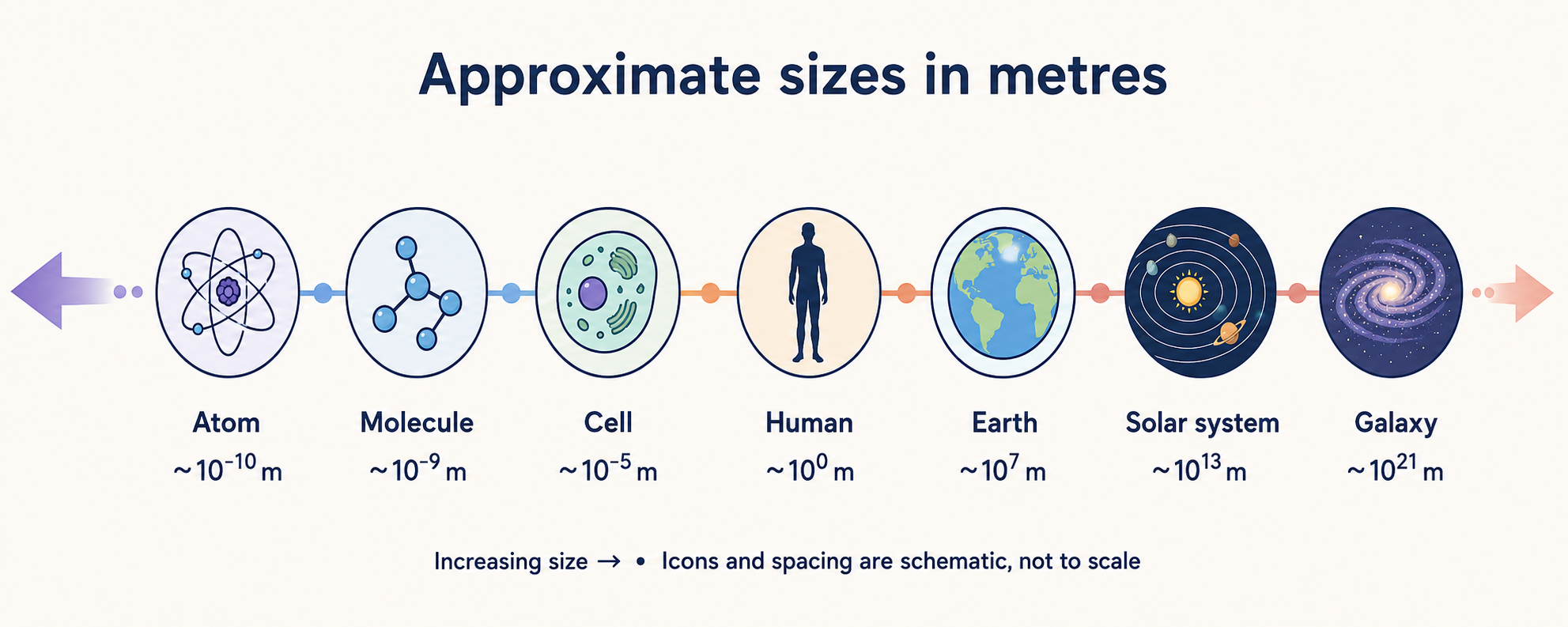 Scientific notation gives us one compact number language for scales from atoms to galaxies. Moving one power-of-ten step multiplies or divides a value by 10.
Key terms
- Scientific notation
- A representation of the form , where and .
- Coefficient
- The number in . It carries the significant digits and must be normalized.
- Exponent
- The integer that tells us how many powers of ten scale the coefficient.
- Order of magnitude
- The power of ten that describes the approximate scale of a quantity. In IB work, justify how you choose the nearest power when the distinction matters.
- Normalized form
- Scientific notation in which the coefficient has exactly one non-zero digit before the decimal point.
- E-notation
- Calculator notation such as , meaning .
Worked examples
Recognize valid scientific notation
Decide which of , , and is normalized scientific notation.
- 1The coefficient must satisfy .
- 2The coefficients and are outside this range.
- 3Only is at least 1 and less than 10.
- 4All three expressions have the same value, but only one is normalized.
Answer: is the normalized scientific-notation form.
Understand a negative exponent
Explain why is smaller than 1.
- 1Use .
- 2Therefore .
- 3Dividing by moves the decimal point four places left.
Answer: , which is smaller than 1.
Rules and formulas
Normalized scientific notation
- the original non-zero number
- the normalized coefficient containing the significant digits
- the integer exponent or power of ten
Converting between ordinary and scientific notation
To convert an ordinary non-zero number to scientific notation, move the decimal point until one non-zero digit remains before it. Count the moves. If the original number is large, the exponent is positive; if the original number lies between 0 and 1, the exponent is negative.
A reliable sign check is to ask what the power of ten must do. In , the power must enlarge , so the exponent is positive. In , it must shrink , so the exponent is negative.
To convert back to ordinary notation, reverse the process. A positive exponent moves the decimal point right; a negative exponent moves it left. Add placeholder zeros only when necessary, and keep any leading minus sign unchanged.
Key terms
- Decimal movement
- The number of places between the original decimal point and the normalized coefficient's decimal point.
- Placeholder zero
- A zero inserted to preserve place value when the decimal point moves beyond the existing digits.
Worked examples
Convert a large number
Write in scientific notation.
- 1Place the decimal after the first non-zero digit: .
- 2The decimal moved six places left from the end of .
- 3A large number needs a positive exponent.
Answer: .
Convert a small number
Write in scientific notation.
- 1Move the decimal to obtain the normalized coefficient .
- 2The decimal moved five places right.
- 3Because the original value is between 0 and 1, the exponent is negative.
Answer: .
Convert back to ordinary notation
Write and in ordinary notation.
- 1For , move the decimal seven places right: .
- 2For , move the decimal four places left: .
Answer: and .
Multiplication, division and powers
Scientific notation separates each calculation into a coefficient part and a power-of-ten part. Multiply or divide the coefficients normally, apply the exponent laws to the powers of ten, and normalize only after those steps.
When a scientific-notation expression is raised to a power, the power applies to both the coefficient and the power of ten. Parentheses matter: .
If the calculated coefficient is at least 10, move its decimal left and increase the exponent. If it is between 0 and 1, move its decimal right and decrease the exponent. This normalization step preserves the value.
Key terms
- Product law
- When powers with the same base are multiplied, add their exponents: .
- Quotient law
- When powers with the same base are divided, subtract their exponents: .
- Power law
- When a power is raised to another power, multiply the exponents: .
Worked examples
Multiply quantities
Calculate .
- 1Multiply coefficients: .
- 2Add exponents: .
- 3Combine: .
- 4Normalize by moving the decimal one place left and increasing the exponent by 1.
Answer: .
Divide quantities
Calculate .
- 1Divide coefficients: .
- 2Subtract exponents: .
- 3The coefficient is already normalized.
Answer: .
Raise a quantity to a power
Calculate .
- 1Raise the coefficient: .
- 2Multiply exponents: .
- 3Combine: .
- 4Normalize: .
Answer: .
Rules and formulas
Multiplication rule
Division rule
Power rule
Addition and subtraction
Addition and subtraction are different from multiplication and division: the powers of ten must match before the coefficients can be combined. This is the same place-value principle that prevents us from directly adding metres to kilometres without converting units.
Choose one exponent, rewrite every term using that common power of ten, then add or subtract the coefficients. Finally normalize and round only if the question requests it.
When two close values are subtracted, many leading significant digits may cancel. Keep extra digits during the calculation because early rounding can create a large relative error in the small difference.
Key terms
- Common exponent
- A single shared power of ten used to align place value before addition or subtraction.
- Cancellation
- Loss of leading digits when two nearly equal numbers are subtracted; it makes guard digits especially important.
Worked examples
Add with different exponents
Calculate .
- 1Rewrite the second term with exponent 6: .
- 2Add coefficients: .
- 3Keep the common power .
Answer: .
Subtract with negative exponents
Calculate .
- 1Rewrite .
- 2Subtract coefficients: .
- 3Keep the common exponent .
Answer: .
Handle cancellation carefully
Calculate .
- 1The exponents already match.
- 2Subtract coefficients: .
- 3Write , then normalize by moving the decimal two places right and decreasing the exponent by 2.
Answer: .
Rules and formulas
Addition with a common exponent
Subtraction with a common exponent
Significant figures and rounding
Significant figures describe precision. Start counting at the first non-zero digit. Zeros between non-zero digits are significant, and trailing zeros to the right of a decimal point are significant. Leading zeros only locate the decimal point and are not significant.
To round to significant figures, keep the first significant digits and inspect the next digit. If it is 5 or more, increase the last kept digit by 1; otherwise leave it unchanged. Replace discarded place-value digits with zeros when ordinary notation requires them.
Scientific notation makes precision explicit. The coefficient has three significant figures, whereas has two. Do not delete a trailing zero when it communicates requested accuracy.
For multiplication and division, a final answer is often reported to the same number of significant figures as the least precise given measurement, unless the question specifies an accuracy. For addition and subtraction, decimal-place precision may be the more meaningful guide. In IB questions, follow the stated instruction first.
Key terms
- Significant figure
- A digit that contributes to the stated precision of a number, beginning with the first non-zero digit.
- Leading zero
- A zero before the first non-zero digit; it locates the decimal point but is not significant.
- Trailing zero
- A zero after the final non-zero digit. It is significant when written to the right of a decimal point or explicitly shown in scientific notation.
- Guard digits
- Extra calculator digits retained during working so that intermediate rounding does not distort the final answer.
Worked examples
Count significant figures
State the number of significant figures in .
- 1Ignore the leading zeros before 4.
- 2Count , the zero between 4 and 7, , and the final zero after the decimal point.
Answer: has 4 significant figures.
Round through a chain of nines
Round to 3 significant figures.
- 1The first three significant digits are .
- 2The next digit is 6, so round the 9 up.
- 3Rounding at this place produces , so the trailing zero must be shown.
Answer: to 3 significant figures.
Carry precision in scientific notation
Round to 3 significant figures.
- 1Keep and inspect the next digit, 5.
- 2Round the hundredths digit up: becomes .
- 3Retain both trailing zeros to show three significant figures.
Answer: to 3 significant figures.
Calculator methods, estimation and reasonableness
On most scientific calculators and GDCs, use the , , or key to enter a power of ten. To enter , type , press the exponent-entry key, then type . Use the dedicated negative-sign key for a negative exponent if your calculator distinguishes it from subtraction.
Calculator output such as means . Do not multiply by another . Set the display to scientific mode only when useful; the value is unchanged when the display mode changes.
Use parentheses around an entire numerator, denominator or powered scientific-notation factor. Store intermediate values or keep the full display instead of copying rounded decimals into later steps.
Estimate before or after calculating. Round coefficients to one convenient significant digit and apply the exponent rules mentally. Your estimate should identify the sign, approximate coefficient and order of magnitude. A calculator answer many powers of ten away from the estimate usually signals an entry or exponent error.
Key terms
- Scientific display mode
- A calculator setting that displays results in E-notation; it changes presentation, not value.
- Sanity check
- A quick estimate or reverse calculation used to decide whether a detailed answer is plausible.
- Stored value
- A full-precision calculator result kept in memory for use in a later step.
Worked examples
Enter and interpret E-notation
Evaluate and give the answer to 3 significant figures.
- 1Enter as one calculation.
- 2The display gives approximately .
- 3Interpret this as , not as a second instruction to multiply.
- 4Round the coefficient to 3 significant figures.
Answer: (3 s.f.).
Check an answer by estimation
Estimate before using a calculator.
- 1Round coefficients conveniently: , , and .
- 2Estimate the coefficient: .
- 3Combine exponents: .
- 4Expect a result near .
Answer: The estimate is ; the exact calculator result is , so it is reasonable.
Rules and formulas
Calculator E-notation
IB exam methods and mixed applications
IB questions often embed scientific notation inside geometry, probability, physics, finance or modelling. Translate the context into an expression first, substitute values with units, calculate without premature rounding, then interpret the result in the requested form.
A strong written solution normally contains: the formula or expression used; substitution in consistent units; an intermediate line showing exponent arithmetic when relevant; a normalized answer; the required accuracy; and a contextual unit or sentence.
For a multi-part question, store earlier results at full precision. If a later part says 'hence', use the stated earlier value appropriately but avoid retyping a heavily rounded version when the calculator can retain more digits.
Key terms
- Exact value
- A value not rounded, such as a fraction or a complete terminating decimal obtained from exact data.
- Approximate equality
- The symbol shows that a value has been rounded or estimated.
- Units
- The measurement label attached to a result. Powers on units must follow the operation, for example area in .
Worked examples
IB-style distance calculation
A signal travels at for . Find the distance travelled, in scientific notation, to 3 significant figures.
- 1Use .
- 2Substitute: .
- 3Calculate the coefficient: . The exponent remains 8.
- 4The coefficient is normalized and already has 3 significant figures.
Answer: (3 s.f.).
IB-style area and unit reasoning
A rectangular sensor has length and width . Find its area to 2 significant figures.
- 1Use .
- 2Multiply coefficients: .
- 3Add exponents: , giving .
- 4Normalize: .
- 5Round to 2 significant figures and square the metre unit.
Answer: (2 s.f.).
Advanced composite expression
Evaluate .
- 1Square the second factor: .
- 2Multiply the numerator: .
- 3Divide by : .
- 4Simplify and normalize.
Answer: .
Practice questions with worked solutions
Try each question before opening the worked reasoning mentally. The set progresses from direct conversions to IB-style multi-step calculations. In an exam, write enough method to earn marks even if the final arithmetic goes wrong.
Worked examples
Practice 1 — small-number conversion
Write in scientific notation.
- 1Move the decimal to make .
- 2The decimal moves seven places right, so the exponent is .
Answer: .
Practice 2 — ordinary notation
Write in ordinary notation.
- 1A positive exponent 5 moves the decimal five places right.
- 2Insert a placeholder zero where required.
Answer: .
Practice 3 — multiplication
Calculate .
- 1Multiply coefficients: .
- 2Add exponents: .
- 3Normalize .
Answer: .
Practice 4 — division
Calculate .
- 1Divide coefficients: .
- 2Subtract exponents: .
Answer: when the given precision is retained.
Practice 5 — addition and rounding
Calculate , giving the result to 3 significant figures.
- 1Rewrite .
- 2Add: .
- 3Round the coefficient to 3 significant figures.
Answer: (3 s.f.).
Practice 6 — a power
Calculate .
- 1Cube the coefficient: .
- 2Multiply the exponent: .
- 3Normalize .
Answer: .
Practice 7 — significant figures
Round to 3 significant figures.
- 1The first three significant digits are .
- 2The next digit is 5, so round the 8 upward.
- 3The rounded coefficient is .
Answer: (3 s.f.).
Practice 8 — contextual total mass
One bacterium has mass . Find the total mass of bacteria, giving the answer to 2 significant figures.
- 1Multiply mass per bacterium by the number of bacteria.
- 2Multiply coefficients: .
- 3Add exponents: .
- 4The coefficient is normalized and has 2 significant figures.
Answer: (2 s.f.).
Practice 9 — advanced mixed operation
Evaluate .
- 1Align the numerator: .
- 2Add: .
- 3Divide coefficients: .
- 4Subtract exponents: .
Answer: .
Practice 10 — reasonableness and error detection
A student enters and reports . Explain why this is unreasonable and find the correct result.
- 1Dividing by a very small positive number should make larger, not smaller.
- 2Divide coefficients: .
- 3Subtract exponents: , giving .
- 4Normalize by moving the decimal one place right and decreasing the exponent by 1.
Answer: . The student's exponent handling was incorrect.
Topic summary
- Normalized scientific notation is , where and .
- Large ordinary numbers usually produce positive exponents; numbers between 0 and 1 produce negative exponents.
- For multiplication, multiply coefficients and add exponents; for division, divide coefficients and subtract exponents.
- For powers, raise the coefficient and multiply the power-of-ten exponent by the outside power.
- For addition or subtraction, rewrite every term using a common exponent before combining coefficients.
- Count significant figures from the first non-zero digit; preserve trailing zeros when they communicate required precision.
- Use E-notation as a compact display of , and do not apply the power of ten a second time.
- Keep guard digits during working and round once at the end to the requested accuracy.
- Estimate the order of magnitude to detect calculator-entry and exponent errors.
- In IB solutions, show the mathematical expression, normalize the result, state accuracy and include units.