Complex conjugates and conjugate pairs
For , the complex conjugate is . Conjugation reflects the point representing z across the real axis while preserving its modulus.
The product of a number and its conjugate is real: . Their sum is , and their difference is .
In polar form, if , then . The modulus stays r and the argument changes sign.
These algebraic and geometric facts explain why conjugate pairs combine to produce polynomial factors with real coefficients.
Key terms
- Complex conjugate
- The number a − bi obtained by reversing the sign of the imaginary part of a + bi.
- Conjugate pair
- The two numbers a + bi and a − bi.
- Reflection
- The geometric transformation across the real axis induced by conjugation.
Worked examples
Cartesian conjugate
For , find and .
- 1Reverse the imaginary sign to obtain the conjugate.
- 2Use .
Answer: and .
Polar conjugate
Write the conjugate of in polar form.
- 1Keep the modulus 5.
- 2Negate the argument.
Answer: .
Recover a conjugate pair
A conjugate pair has sum 6 and product 13. Find the pair.
- 1Write the numbers as .
- 2Their sum gives , so .
- 3Their product gives , so .
Answer: The pair is and (3-2i).
Rules and formulas
Complex conjugate
Conjugate product
Conjugate in polar form
The conjugate-root theorem
If a polynomial () has real coefficients and is a non-real root, then (a-bi) is also a root. This is the conjugate-root theorem.
The reason is that conjugation commutes with addition and multiplication. For real coefficients, . If , then .
Non-real roots therefore occur in pairs when the coefficients are real. A real polynomial of odd degree must still have at least one real root because the remaining non-real roots pair off.
The theorem does not apply automatically to polynomials with non-real coefficients.
Key terms
- Conjugate-root theorem
- Non-real roots of a real-coefficient polynomial occur in conjugate pairs.
- Real-coefficient polynomial
- A polynomial all of whose coefficients are real numbers.
- Root
- A value satisfying .
Worked examples
Find a missing conjugate root
A polynomial with real coefficients has root (2-5i). State another root.
- 1Reverse the sign of the imaginary part.
Answer: is also a root.
Use degree information
A real cubic has roots and . Find the third root.
- 1The non-real root requires its conjugate.
- 2A cubic has three roots counting multiplicity.
Answer: The third root is (3-i).
Check when the theorem does not apply
Does a polynomial with coefficient have to contain conjugate root pairs?
- 1Inspect the coefficient condition.
- 2At least one coefficient is non-real.
Answer: No. Conjugate pairing is guaranteed only for real coefficients.
Rules and formulas
Conjugation of a real polynomial
Conjugate-root implication
Building real polynomial factors from conjugate roots
The conjugate roots produce the real quadratic factor .
Expanded, this factor is . Its discriminant is when , confirming that its roots are non-real.
To construct a real polynomial from known roots, include every required conjugate, write one factor per root, combine conjugate factors first, then expand only if requested.
Multiplicity is preserved: if is a repeated root of multiplicity m in a real polynomial, (a-bi) has the same multiplicity.
Key terms
- Linear factor
- The factor x − α corresponding to root α.
- Real quadratic factor
- The factor (x − a)² + generated by roots a ± bi.
- Multiplicity
- The number of times a root and its factor are repeated.
Worked examples
Quadratic from a conjugate pair
Find the monic quadratic with roots .
- 1Write .
- 2Use .
- 3Expand.
Answer: .
Quartic from two non-real roots
Find the monic real polynomial whose roots include and , with no additional roots.
- 1Include (2-i) and (-1-2i).
- 2Form .
- 3Expand the real quadratics.
Answer: .
Repeated conjugate roots
A real polynomial has as a double root. What factor must divide it?
- 1The conjugate (1-3i) is also a double root.
- 2Combine both repeated factors.
Answer: must divide the polynomial.
Rules and formulas
Conjugate factor pair
Expanded real quadratic
Repeated conjugate factor
De Moivre's theorem
De Moivre's theorem states that for an integer n, raising a polar complex number to the nth power raises its modulus to n and multiplies its argument by n.
For , . In full trigonometric form, .
For positive integers, the result follows by repeated polar multiplication. For negative integers it also holds when , using reciprocals.
The theorem turns a long Cartesian expansion into two simple operations, but the original number must first be converted to polar form accurately.
Key terms
- De Moivre's theorem
- The integer-power rule for a complex number in polar form.
- Integer exponent
- A positive, zero, or negative whole-number power.
- Argument multiplication
- The rule that the direction of zⁿ is n times an argument of z, modulo 2π.
Worked examples
Unit-modulus power
Simplify .
- 1Keep modulus 1.
- 2Multiply the argument by 5.
Answer: .
Power with non-unit modulus
Calculate .
- 1Raise the modulus: .
- 2Multiply the argument: .
- 3Subtract if a simpler coterminal angle is desired.
Answer: .
Negative integer power
Simplify .
- 1Raise the modulus: .
- 2Multiply the argument by : .
Answer: .
Rules and formulas
De Moivre's theorem
- integer exponent
Unit-modulus form
Exponential equivalent
Finding powers of complex numbers
To calculate a large power, convert the base to polar form, apply De Moivre's theorem, normalize the angle if useful, and convert back to Cartesian form only if requested.
Exact standard angles make the final conversion exact. Keep radical moduli such as symbolic before raising them to a power.
A reasonableness check is immediate: . If the computed Cartesian result has a different modulus, revisit the arithmetic.
When the multiplied argument completes whole turns, the power may become real even if the original number is non-real.
Key terms
- Power workflow
- Convert, apply De Moivre, normalize, then convert only if required.
- Coterminal normalization
- Adding or subtracting 2π without changing a direction.
Worked examples
A high power of 1 + i
Calculate .
- 1Write .
- 2Apply De Moivre: .
- 3Use and .
Answer: .
A fifth power
Calculate in Cartesian form.
- 1Write .
- 2Raise to obtain .
- 3Normalize to and convert.
Answer: .
Power and modulus check
Find .
- 1First find .
- 2Use .
Answer: .
Rules and formulas
Power modulus
Power argument
Using De Moivre to derive multiple-angle identities
De Moivre's theorem can generate trigonometric identities by expanding algebraically and comparing real and imaginary parts with .
The real parts must be equal, and the imaginary parts must be equal. This produces exact formulas for and .
For , expansion gives the triple-angle identities. Equivalent forms can be obtained using or .
Show the comparison step explicitly; a final identity without the complex expansion may omit the central reasoning.
Key terms
- Multiple-angle identity
- A trigonometric identity connecting nθ with powers of sin θ and cos θ.
- Compare components
- Equating the real parts and imaginary parts of equal complex numbers.
Worked examples
Derive cos 3θ
Use De Moivre to express in terms of .
- 1Expand .
- 2The real part is .
- 3Replace by .
Answer: .
Derive sin 3θ
Use De Moivre to express in terms of .
- 1The imaginary part of the cubic expansion is .
- 2Replace by .
Answer: .
Evaluate an exact cosine
Use with to relate and .
- 1Substitute .
- 2Use .
Answer: .
Rules and formulas
Triple-angle cosine
Triple-angle sine
Finding nth roots of a complex number
To solve , write with , and write . De Moivre gives .
Equating moduli gives . Equating directions requires , so .
Exactly n distinct roots are obtained by using . Other integer values of k repeat these roots.
The roots all have the same modulus and successive arguments differ by .
Key terms
- Nth root
- A complex number z satisfying zⁿ = w.
- Root index k
- The integer selecting one of the n distinct angular solutions.
- Angular spacing
- The constant difference 2π/n between consecutive root arguments.
Worked examples
Derive cube-root angles
If , state the three root arguments. Assume .
- 1Use .
- 2Substitute .
Answer: , , and .
Why only n values of k?
Explain why repeats the root.
- 1Compare the arguments for and .
- 2Their difference is .
Answer: They are coterminal and represent the same root.
Root modulus
Find the modulus of every fifth root of a complex number of modulus 32.
- 1Use .
- 2Calculate .
Answer: Every root has modulus 2.
Rules and formulas
Nth-root formula
Root modulus
Root angular spacing
Calculating and checking complex roots
Use the nth-root formula systematically: express the target in polar form, find the root modulus, create the n arguments, and convert roots to Cartesian form only if required.
A complete answer should list all distinct roots. Order them by increasing argument or by increasing k so omissions are easy to detect.
Check one root by raising it to the nth power. Check the whole set geometrically: equal modulus and equal angular spacing are required.
When the target is a negative real number, use argument under the principal convention before generating all roots.
Key terms
- Complete root set
- All n distinct values satisfying zⁿ = w.
- Root verification
- Raising a proposed root to the nth power and checking that it returns w.
Worked examples
Cube roots of 8
Find all solutions of .
- 1Write .
- 2The root modulus is 2.
- 3Use arguments .
Answer: .
Fourth roots of −16
Find all solutions of in polar form.
- 1Write .
- 2The root modulus is 2.
- 3Use for .
Answer: , , , .
Cube roots of 8i
Solve in Cartesian form.
- 1Write .
- 2The root modulus is 2.
- 3The root arguments are .
- 4Convert each to Cartesian form.
Answer: .
Rules and formulas
Root angles
Root check
Geometric arrangement of nth roots
The n roots of a non-zero complex number lie on the circle centered at the origin with radius . Their arguments are equally spaced by .
Joining consecutive roots forms a regular n-gon. Rotating one root by reaches the next root.
Changing the argument θ of the target rotates the entire regular polygon by , while changing the modulus R changes only its radius to .
The sum of all n roots is zero for , because the symmetric position vectors cancel. This also follows from the coefficient of in .
Key terms
- Regular n-gon
- A polygon with n equal sides and n equal angles formed by equally spaced roots.
- Rotational symmetry
- Invariance of the root set under rotation by 2π/n.
- Vector cancellation
- The symmetric root position vectors add to zero.
Worked examples
Geometry of fourth roots
Describe the Argand arrangement of the fourth roots of .
- 1Every root has modulus 2.
- 2Successive arguments differ by .
Answer: The roots are the vertices of a square centered at the origin on the circle .
Geometry of fifth roots
A complex number has modulus 243. Describe the arrangement of its fifth roots.
- 1Each root has modulus .
- 2The angular spacing is .
Answer: They form a regular pentagon centered at the origin on .
Sum of a root set
Find the sum of all solutions of .
- 1The six roots form a regular hexagon centered at the origin.
- 2Opposite vectors cancel.
Answer: The sum is 0.
Rules and formulas
Root circle
Consecutive-root rotation
Root sum
Roots of unity
The nth roots of unity solve . Since , the distinct roots are for .
All roots of unity have modulus 1 and form a regular n-gon on the unit circle. The root always occurs at angle 0.
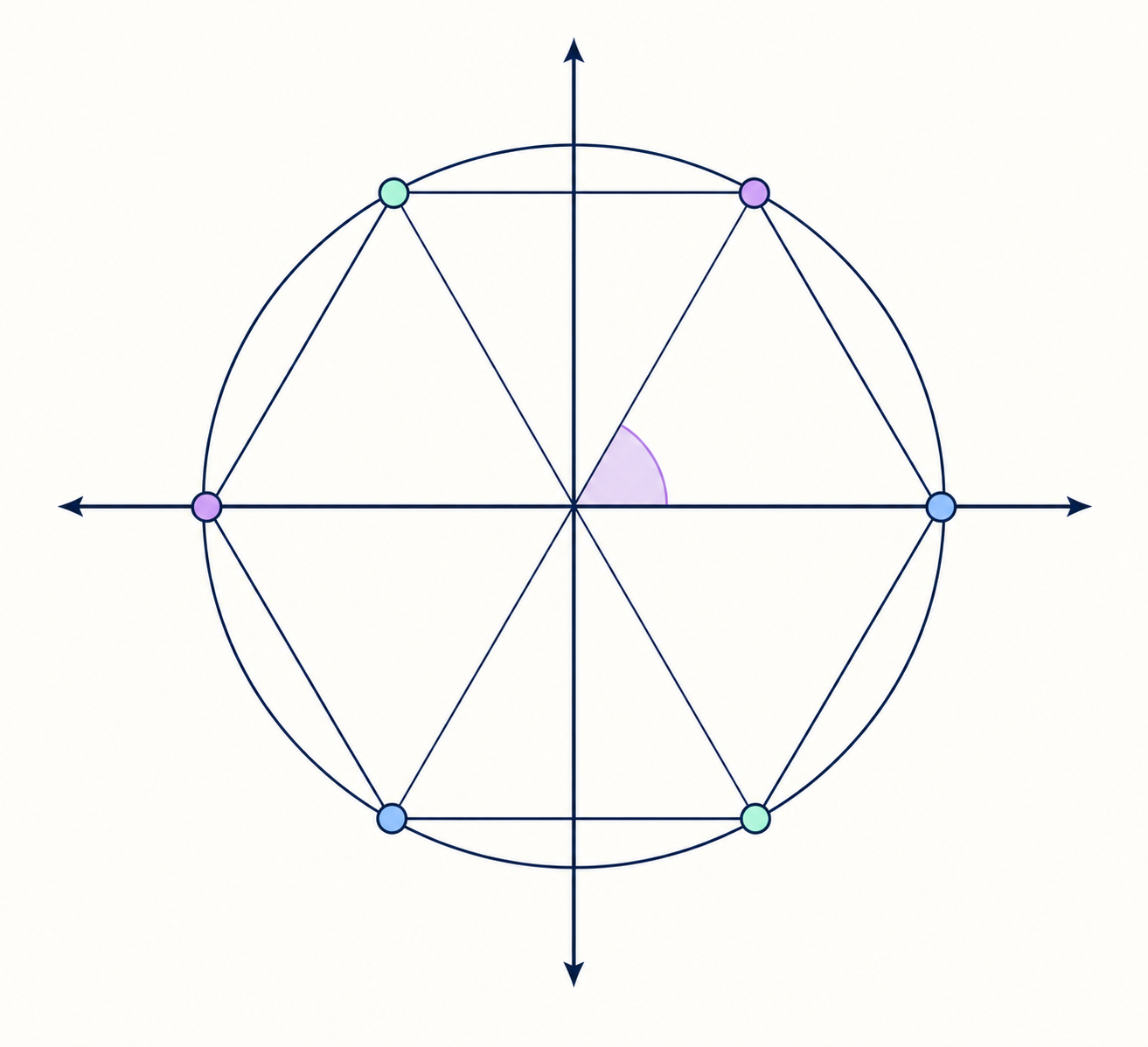 The sixth roots lie on the unit circle with angular separation , forming a regular hexagon.
The visual shows the sixth roots of unity: six points on one circle, separated by , forming a regular hexagon.
A primitive nth root of unity generates every nth root by repeated powers. The root is primitive exactly when k and n are coprime.
Key terms
- Root of unity
- A complex number satisfying zⁿ = 1.
- Primitive root of unity
- An nth root whose powers generate all nth roots of unity.
- Coprime
- Two integers whose greatest common divisor is 1.
- Unit circle
- The circle |z| = 1 in the Argand plane.
Worked examples
Fourth roots of unity
Find all fourth roots of unity.
- 1Use angles for .
- 2Convert the four standard directions to Cartesian form.
Answer: .
Cube roots of unity
Let . State the cube roots of unity and a useful sum.
- 1The roots are , , and .
- 2Their symmetric vector sum is zero.
Answer: The roots are , and .
Identify primitive sixth roots
Which sixth roots are primitive?
- 1Require .
- 2Among , only 1 and 5 are coprime to 6.
Answer: The primitive roots are and .
Rules and formulas
Nth roots of unity
Root-of-unity equation
Primitive-root condition
Sum of nth roots of unity
Solving polynomial equations using complex roots
Polynomial equations can be solved by combining factorization, conjugate pairing, and nth-root methods. First identify the algebraic structure before choosing a technique.
For , use the nth-root formula directly. For a real polynomial with one known non-real root, add its conjugate and divide by the resulting real quadratic factor.
After reducing the polynomial degree, solve the remaining real or complex factor by familiar methods. Count roots with multiplicity to confirm completeness.
The fundamental theorem of algebra guarantees exactly n complex roots counting multiplicity for a degree-n polynomial.
Key terms
- Fundamental theorem of algebra
- A degree-n polynomial has n complex roots counting multiplicity.
- Polynomial reduction
- Dividing by known factors to obtain a lower-degree equation.
- Completeness check
- Comparing the listed root count with the polynomial degree.
Worked examples
Solve a pure-power equation
Solve .
- 1Write .
- 2The root modulus is .
- 3Use arguments for .
Answer: , .
Use a known conjugate pair
A monic real quartic has roots , 3, and . Find its fourth root and polynomial.
- 1The fourth root is (1-2i).
- 2The conjugate pair gives .
- 3Multiply by .
Answer: The polynomial is .
Factor using cube roots of unity
Factor over the complex numbers.
- 1The roots of are , , and .
- 2Write one linear factor for each root.
Answer: .
Rules and formulas
Factor theorem
Root-count rule
Mixed De Moivre and root problems
Advanced questions may combine a power, a root condition, and a polynomial requirement. Keep the modulus and argument work separate until the final form is requested.
When an equation can be rearranged to , use the complete root family rather than taking only a principal real-style root.
Symmetry can simplify expressions involving roots of unity. For example, for the non-real cube roots of unity.
Use exact polar values first; convert to Cartesian form only for factorization, addition, or a requested final answer.
Key terms
- Root family
- The indexed set of all n distinct solutions of zⁿ = w.
- Symmetry identity
- An algebraic relation arising from the regular geometric arrangement of roots.
Worked examples
Solve a shifted pure-power equation
Solve .
- 1Let .
- 2The cube roots of are , , and .
- 3Add 1 to each w value.
Answer: .
Use a cube-root identity
If and , simplify .
- 1Factor .
- 2Since , divide by .
Answer: .
Power followed by a root condition
Find all z satisfying .
- 1The root modulus is 2.
- 2Use arguments .
- 3Use .
Answer: , .
Rules and formulas
Shifted power substitution
Root-family completeness
Calculator/GDC methods and verification
Use complex mode and radian angle mode. A GDC can evaluate powers, convert between Cartesian and polar form, and numerically solve many polynomial equations.
For nth roots, a calculator may display only one principal root. The mathematical formula with is still required to generate the complete set.
When a polynomial solver returns decimals, identify exact conjugate structure where possible. Values such as may represent , but claim an exact value only when algebra supports it.
Use the GDC to verify each proposed root by evaluating the original expression. Small numerical residues such as are rounding effects, not additional roots.
For an Argand sketch, plot all roots and check equal radii and angular gaps. The visual check complements the numerical check.
Key terms
- Principal root output
- A calculator's single default root, which is not the full nth-root set.
- Numerical residual
- A small non-zero calculator result caused by floating-point rounding.
- Exact recognition
- Identifying a decimal as an exact radical or standard-angle value using algebraic evidence.
Worked examples
Check a high power
Use a GDC to verify .
- 1Enter in complex mode.
- 2Compare with the exact De Moivre result.
Answer: The display confirms 16.
Generate roots systematically
Use a GDC to check the four roots of .
- 1Generate all four angles with the formula, not a single fourth-root key.
- 2Enter each root to the fourth power.
- 3Confirm each output is approximately .
Answer: All four roots pass the check.
Check a polynomial factor
Verify numerically that is a root of .
- 1Substitute into the polynomial in complex mode.
- 2Evaluate the result.
Answer: The result is 0, within calculator precision.
Rules and formulas
Numerical root check
Geometric root check
Common mistakes and IB HL exam strategy
The most frequent errors are forgetting a conjugate root, applying the conjugate-root theorem without real coefficients, using instead of , dividing only the principal argument by n, or listing fewer than n roots.
For powers, show the polar conversion and both De Moivre operations. For roots, show the target polar form, the common root modulus, the indexed angle formula, and the complete k range.
For polynomial construction, pair conjugates before expanding and count the degree. For an Argand answer, state the radius, angular separation, and regular polygon.
Normalize arguments only when the question requests a principal interval; coterminal root angles are mathematically valid but should be presented consistently.
Key terms
- Method communication
- Writing enough structure for the examiner to follow and award method marks.
- Root-count check
- Confirming that exactly n roots, counting multiplicity, have been found.
Worked examples
Diagnose an incomplete root answer
A student solves and gives only . What is missing?
- 1A fourth-degree equation has four complex roots counting multiplicity.
- 2Use angles for .
Answer: The full set is .
Diagnose a De Moivre error
A student writes . Correct it.
- 1Cube the modulus instead of multiplying it by 3.
Answer: .
Diagnose an invalid conjugate claim
A student says every polynomial containing root also contains root (-i). Is this always true?
- 1The conjugate-root theorem needs real coefficients.
- 2A complex-coefficient polynomial can have i without −i.
Answer: No. Real coefficients guarantee that a nonreal root occurs with its conjugate, but this is not guaranteed for general complex coefficients. For example, has root but not . Some complex-coefficient polynomials, such as , still have both.
Rules and formulas
Power checklist
Root checklist
IB HL-style practice with worked solutions
Attempt each problem before reading the steps. The questions progress from conjugate-root fundamentals to powers, complete root families, roots of unity and mixed polynomial reasoning.
Use exact values and radian arguments unless a question explicitly requests a decimal approximation.
Key terms
- Exact root set
- Every distinct solution expressed without premature decimal rounding.
- Structured solution
- A solution that states the theorem, formula, index range and verification clearly.
Worked examples
Practice 1: conjugate root
A real polynomial has root (4-3i). State the required partner root and quadratic factor.
- 1Use the conjugate-root theorem to obtain .
- 2Form .
Answer: The partner is , and the factor is .
Practice 2: construct a real quartic
Find the monic real polynomial with roots and .
- 1Form .
- 2Form .
- 3Multiply the quadratics.
Answer: .
Practice 3: De Moivre power
Calculate in Cartesian form.
- 1Raise the modulus to obtain 16.
- 2Multiply the angle to obtain .
- 3Normalize to and convert.
Answer: .
Practice 4: high Cartesian power
Evaluate .
- 1Write .
- 2Apply De Moivre to get .
Answer: .
Practice 5: negative power
Simplify .
- 1Use modulus .
- 2Use argument .
Answer: .
Practice 6: cube roots
Solve in Cartesian form.
- 1Write .
- 2Use root modulus 2 and arguments .
- 3Convert all three roots.
Answer: .
Practice 7: fourth roots
Find all fourth roots of in polar form.
- 1Write .
- 2Use modulus 2 and arguments for .
Answer: .
Practice 8: roots of unity
Find the sixth roots of unity and state their geometric arrangement.
- 1Use , .
- 2Their common modulus is 1 and separation is .
Answer: They are , , forming a regular hexagon on the unit circle.
Practice 9: primitive roots
Identify the primitive eighth roots of unity.
- 1Require .
- 2Use .
Answer: .
Practice 10: shifted root equation
Solve .
- 1Let .
- 2Use the three cube roots .
- 3Add 1 to each root.
Answer: .
Practice 11: factor over the complex numbers
Factor completely over .
- 1Find the cube roots of 8: .
- 2Write one factor per root.
Answer: .
Practice 12: derive a triple-angle identity
Use De Moivre's theorem to derive a formula for in terms of .
- 1Expand .
- 2Equate the real part to .
- 3Replace by .
Answer: .
Rules and formulas
Complete workflow
Topic summary and cheat sheet
Conjugate pairing connects non-real roots to real polynomial factors. De Moivre's theorem then makes powers and complete root families systematic in polar form.
A strong final check combines algebraic substitution, root count, common modulus, equal angular spacing and the polynomial's coefficient conditions.
Key terms
- De Moivre fluency
- Choosing and applying conjugate, power, root and geometric ideas accurately.
Worked examples
Final checklist
What should be checked before submitting a De Moivre or roots answer?
- 1The theorem's conditions are satisfied.
- 2The modulus operation is correct.
- 3All n roots are listed with to n − 1.
- 4Arguments and geometry are consistent.
- 5Substitution verifies the result.
Answer: Submit an exact, complete, and clearly indexed answer.
Rules and formulas
Conjugate-root factor
De Moivre's theorem
Nth roots
Roots of unity
Topic summary
- The conjugate of is (a-bi).
- Conjugation reflects a complex point in the real axis and preserves modulus.
- Non-real roots of a polynomial with real coefficients occur in conjugate pairs.
- The conjugate-root theorem is not guaranteed for non-real polynomial coefficients.
- Roots generate the real quadratic factor .
- Repeated non-real roots have conjugates with the same multiplicity in a real polynomial.
- De Moivre's theorem is for integer n.
- For a power, raise the modulus and multiply the argument.
- Negative powers require a non-zero complex base.
- The modulus check for powers is .
- De Moivre can derive multiple-angle identities by comparing real and imaginary parts.
- To solve , use modulus .
- The root arguments are .
- Use to obtain exactly n distinct roots.
- Consecutive nth roots are separated by .
- The nth roots form a regular n-gon centered at the origin.
- The sum of a complete non-trivial nth-root set is zero.
- The nth roots of unity are .
- Every root of unity lies on the unit circle, and 1 is always included.
- A root is primitive when .
- A degree-n polynomial has n complex roots counting multiplicity.
- Pair conjugate factors before expanding a real polynomial.
- A GDC principal-root output does not replace the full indexed root family.
- Verify results by substitution, root count, modulus and equal angular spacing.