Approximation, exact values and accuracy
An exact value has no rounding uncertainty. Counts such as students and defined conversions such as are exact. A measured or rounded value is an approximation: it is close to the true value but does not identify it precisely.
The symbols communicate this difference. Write between equal values, but use when a decimal has been rounded. For example, to three decimal places. Writing incorrectly claims exact equality.
The degree of accuracy is the place value or precision used to report an answer. Greater accuracy is not automatically better. A population forecast of people suggests unrealistic precision; people to three significant figures may be more meaningful.
Approximation is a decision about communication as well as calculation. The available data, reliability of the model, purpose of the result, units and consequences of error should determine how many digits are reported.
Key terms
- Exact value
- A value known without rounding or measurement uncertainty.
- Approximation
- A value close to, but not necessarily equal to, the exact or accepted value.
- Degree of accuracy
- The precision to which a value is reported, such as 2 decimal places or 3 significant figures.
- Measurement
- A numerical estimate of a physical quantity obtained using an instrument or procedure.
- Guard digits
- Extra calculator digits retained during working and removed only when the final answer is reported.
Worked examples
Recognize exact and approximate data
Classify each value: 24 books on a shelf; a mass recorded as 3.8 kg; and the conversion .
- 1A count of 24 objects is exact if every object was counted.
- 2The recorded mass is a measurement rounded to the instrument's precision, so it is approximate.
- 3The time conversion is defined, so it is exact.
Answer: 24 books and are exact; 3.8 kg is approximate.
Report sensible accuracy
A model predicts visitors next month. Give a sensible reported value.
- 1Visitor numbers are whole-number counts, but a forecast itself is uncertain.
- 2Rounding to three significant figures gives .
- 3State that the result is a model estimate rather than an exact count.
Answer: A sensible report is approximately visitors, subject to the model's assumptions.
Rounding to decimal places
Decimal places are counted to the right of the decimal point. To round to decimal places, keep digits after the decimal point, inspect the next digit, and round the final kept digit up when that next digit is or more.
The rounding unit for decimal places is . Thus 1 decimal place uses units of , 2 decimal places uses , and 3 decimal places uses .
Trailing zeros can communicate precision. The values and are numerically equal, but signals reporting to two decimal places. In measurement contexts, that extra zero is meaningful.
For negative values, round the magnitude using the same rule and then restore the sign. For example, to two decimal places. The rounded value is farther from zero because the third decimal digit is .
Key terms
- Decimal place
- A position to the right of the decimal point: tenths, hundredths, thousandths, and so on.
- Rounding digit
- The final digit kept in the rounded value.
- Rounding unit
- The place-value step between consecutive values at a stated accuracy.
Worked examples
Round a positive decimal
Round to 2 decimal places.
- 1Keep the hundredths digit: .
- 2Inspect the next digit, .
- 3Because , increase the hundredths digit from to .
Answer: to 2 decimal places.
Round through a carry
Round to 3 decimal places.
- 1Keep and inspect the next digit, .
- 2Because , the final kept digit does not increase.
Answer: to 3 decimal places.
Round a negative measurement
Round to 3 decimal places.
- 1Use the magnitude . Keep and inspect .
- 2Round the thousandths digit up: .
- 3Restore the negative sign.
Answer: to 3 decimal places.
Rules and formulas
Rounding unit for decimal places
- number of decimal places
- rounding unit
Rounding to significant figures
Significant figures are counted from the first non-zero digit. Leading zeros only locate the decimal point and are not significant. Zeros between non-zero digits are significant, and trailing zeros after a decimal point are significant.
For , the significant digits are , so the number has four significant figures. In , trailing zeros can be ambiguous unless the accuracy is stated; scientific notation removes the ambiguity.
Scientific notation makes significant figures visible: has three significant figures, while has five.
To round to a stated number of significant figures, find the first non-zero digit, count the required number of digits, inspect the next digit, and replace later place values with zeros when necessary.
Key terms
- Significant figure
- A digit contributing to the stated precision, counted from the first non-zero digit.
- Leading zero
- A zero before the first non-zero digit; it is not significant.
- Trailing zero
- A zero after the final non-zero digit; its significance depends on the notation and stated accuracy.
- Scientific notation
- The form a × with 1 ≤ |a| < 10, useful for showing significant figures clearly.
Worked examples
Round a large value
Round to 3 significant figures.
- 1The first three significant digits are .
- 2The next digit is , so stays unchanged.
- 3Replace the remaining place values with zeros.
Answer: to 3 significant figures.
Round a small value
Round to 2 significant figures.
- 1Ignore leading zeros; the first two significant digits are and .
- 2The next digit is , so rounds to .
- 3Write the result as to preserve two significant figures.
Answer: to 2 significant figures.
Use scientific notation to show accuracy
Express to 2 and to 4 significant figures.
- 1For 2 significant figures, write .
- 2For 4 significant figures, write .
Answer: (2 s.f.) and (4 s.f.).
Choosing suitable accuracy and estimating
Estimation replaces values with nearby, easy numbers to predict the scale of an answer. It is not a substitute for the final calculation when accuracy is required; it is a check that can reveal entry errors, incorrect units or an impossible model result.
For a quick estimate, round each factor to one significant figure or a convenient compatible number. For example, . A calculator answer of would therefore be unreasonable.
Context supplies further checks: a length and a probability cannot be negative; a probability cannot exceed 1; a count of people should normally be a whole number; and a price may need the nearest cent.
The most appropriate accuracy depends on the purpose. Medicine and engineering may demand fine tolerances; a weather forecast or long-term economic projection may justify fewer digits because model uncertainty dominates.
Key terms
- Estimate
- A deliberately simplified approximate calculation used to judge size or plausibility.
- Order of magnitude
- The scale of a quantity, commonly described by a nearby power of ten.
- Reasonableness check
- A comparison with an estimate, units, constraints or context to decide whether a result is plausible.
- False precision
- Reporting more digits than the data and model justify.
Worked examples
Estimate before calculating
Estimate .
- 1Choose convenient values: , , and .
- 2Calculate .
Answer: The result should be close to .
Choose an application-appropriate answer
A calculation gives buses for a school trip. How should it be reported?
- 1A fraction of a bus cannot transport the remaining students.
- 2Ordinary rounding to 6 would leave some students without transport.
- 3Round upward because the context requires sufficient capacity.
Answer: The school needs 7 buses.
Upper and lower bounds and error intervals
A reported rounded value represents every original value that would round to it. If is rounded to the nearest unit , the maximum displacement from is half a unit, . Therefore the lower bound is and the upper bound is .
The standard error interval is . The lower endpoint is included because it rounds up to . Under the usual “5 rounds up” convention, the upper endpoint is excluded because it rounds to the next reported value.
The lower bound is the smallest possible value and the upper bound is the boundary the value cannot reach. In ordinary language one may say “the upper bound is ,” while the inequality correctly shows .
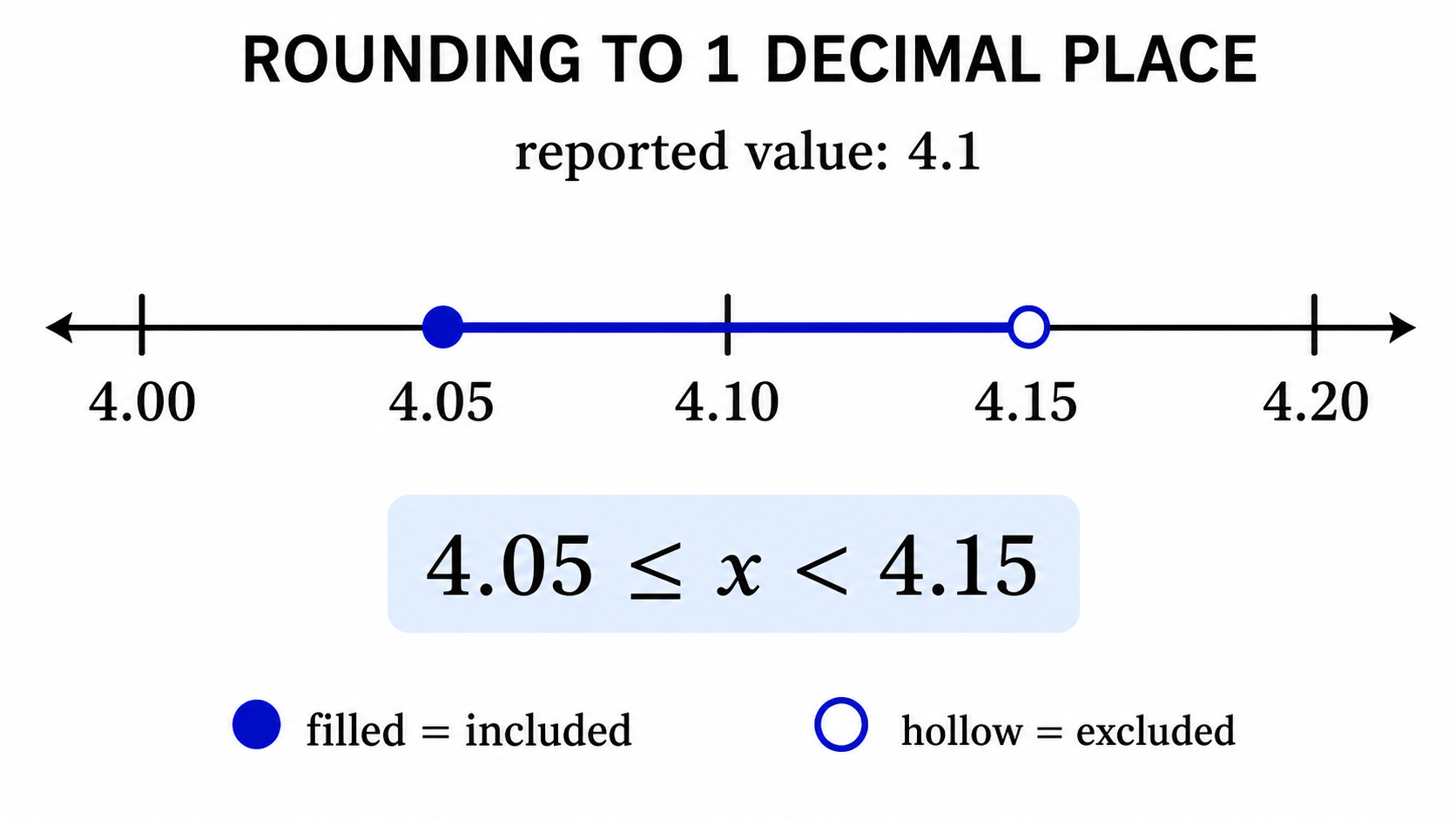 A value reported as 4.1 to 1 decimal place represents the half-open interval .
For significant figures, first identify the place value of the final significant digit. That place value is the rounding unit. A value of 7300 to two significant figures is rounded to the nearest 100, so the half-unit is 50.
Key terms
- Lower bound
- The smallest value included in the set of possible original values.
- Upper bound
- The excluded boundary at the top of the set of possible original values.
- Error interval
- An inequality describing all values that round to the reported value.
- Half-open interval
- An interval containing one endpoint but not the other, such as [4.05, 4.15).
Worked examples
Bounds from decimal places
A length is correct to 1 decimal place. Find its error interval.
- 1The rounding unit is .
- 2Half the unit is .
- 3Calculate and .
- 4Include the lower endpoint and exclude the upper endpoint.
Answer: .
Bounds from significant figures
A distance is reported as to 2 significant figures. Find its bounds.
- 1The second significant digit is in the thousands place, so .
- 2The half-unit is .
- 3Subtract and add .
Answer: .
Reverse a rounding statement
State all numbers that round to to 1 decimal place. Use round-to-nearest with halfway cases rounded away from zero.
- 1The unit is , so the half-unit is .
- 2The midpoint boundaries are and . Under the stated convention, rounds to , while rounds to .
- 3The lower boundary is excluded and the upper boundary is included.
Answer: . Different tie conventions can change endpoint inclusion.
Rules and formulas
General rounding error interval
- reported rounded value
- rounding unit
- possible exact value
Lower and upper bounds
Interval notation
Using bounds in calculations
When a formula uses rounded measurements, the result also has a range. To find worst-case bounds, choose input endpoints that make the output as small or as large as possible. For positive quantities, sums and products grow when their inputs grow.
For positive and , the product satisfies . For a quotient with a positive denominator, the smallest quotient uses the smallest numerator and largest denominator; the largest uses the largest numerator and smallest denominator.
Subtraction requires crossed endpoints: is smallest at and largest at . Do not simply combine both lower bounds.
These endpoint rules assume the relevant quantities remain positive and the formula is monotonic over the interval. If intervals cross zero or the formula changes direction, inspect the situation more carefully.
Key terms
- Worst-case bound
- The smallest or largest possible output consistent with all input intervals.
- Monotonic
- Changing in only one direction over an interval, so endpoint values determine extrema.
- Propagated uncertainty
- Uncertainty in a calculated output caused by uncertainty in its inputs.
Worked examples
Area of a rounded rectangle
A rectangle has width to the nearest and length to the nearest centimetre. Find bounds for its area.
- 1Width: .
- 2Length: .
- 3Both are positive, so .
- 4The upper boundary is .
Answer: .
Bounds for average speed
A journey is to the nearest kilometre and takes to the nearest . Find bounds for average speed.
- 1Distance: . Time: .
- 2The infimum is , but is excluded, so it is not attained.
- 3The supremum is , but is excluded, so it is not attained.
Answer: in . The boundary values are approximately and ; rounded numbers are labels, not exact sharp bounds.
Bounds for a difference
Two masses are reported as and , each to the nearest . Bound the difference .
- 1 and .
- 2Minimum: .
- 3Upper boundary: .
Answer: ; with exact endpoint status tracked, the extreme boundaries are not both attainable.
Rules and formulas
Sum bounds
Difference bounds
Product bounds for positive values
Quotient bounds for positive values
Absolute, relative and percentage error
When an exact or accepted reference value is known, the absolute error is the magnitude of the difference: . It uses the same units as the measured quantity.
The relative error compares the absolute error with the size of the exact value: , provided the exact value is not zero. Relative error has no units.
The percentage error is the relative error expressed as a percentage: . It makes errors in differently sized quantities easier to compare.
An error is not automatically a mistake. Measurement error can arise from instrument precision, calibration, environmental conditions, sampling, model assumptions and rounding. State the reference value and source of uncertainty when interpreting the result.
Key terms
- Absolute error
- The non-negative difference in the original units between an approximate value and a reference value.
- Relative error
- Absolute error divided by the magnitude of the non-zero reference value.
- Percentage error
- Relative error multiplied by 100%.
- Accepted value
- A reference value treated as correct for comparison, even though it may itself have uncertainty.
- Accuracy
- How close a measured or calculated result is to a true or accepted value.
- Precision
- How finely a value is recorded or how closely repeated measurements agree; it does not guarantee accuracy.
Worked examples
Calculate three forms of error
Use as an approximation to . Find the absolute, relative and percentage error.
- 1Absolute error: .
- 2Relative error: .
- 3Percentage error: .
Answer: Absolute error , relative error , and percentage error .
Compare errors fairly
Measurement A is too high when the true length is . Measurement B is too high when the true length is . Which is relatively more accurate?
- 1For A, percentage error is .
- 2For B, percentage error is .
- 3Although B has a larger absolute error, it has the smaller relative error.
Answer: Measurement B is relatively more accurate because its percentage error is 1%, compared with 5% for A.
Interpret the sign separately
A forecast is units but the actual value is . Find the percentage error and state whether the forecast is high or low.
- 1Absolute error: .
- 2Percentage error: .
- 3The absolute-value formula removes sign, so describe direction in words.
Answer: The percentage error is 2.5%, and the forecast is an overestimate.
Rules and formulas
Absolute error
Relative error
Percentage error
Maximum error from rounded measurements
If the exact value is unknown but a measurement was rounded to unit , its maximum possible absolute rounding error is . This is a bound on the uncertainty, not the actual error.
A maximum percentage error for the measured quantity can be estimated by comparing the half-unit with an appropriate reference. Some problems instead ask for the maximum percentage error in a calculated quantity such as area; then evaluate the formula at its input bounds and compare the output with the value calculated from the reported measurement.
For nonlinear formulas, equal input changes need not cause equal output changes. Squaring a radius makes the upper-area deviation slightly different from the lower-area deviation, so calculate both or reason which is larger.
Key terms
- Maximum absolute rounding error
- Half the rounding unit; the greatest possible distance from a reported rounded value.
- Maximum percentage error
- The largest possible output error, expressed relative to the stated or accepted output.
- Nonlinear formula
- A formula in which the output does not change at a constant rate with an input, such as A = .
Worked examples
Maximum error in a length
A cable is recorded as to the nearest . State the maximum possible absolute rounding error.
- 1The rounding unit is .
- 2Half the unit is .
Answer: The maximum possible absolute rounding error is .
IB-style maximum area error
The radius of a circle is measured as to 1 decimal place. Find the maximum percentage error in the area calculated as . Define percentage error using the true area as the denominator.
- 1Radius bounds: .
- 2If is the calculated area and the true area, percentage error is .
- 3At the included lower radius, the error is .
- 4At the excluded upper boundary, the error approaches , which is smaller.
- 5Dividing instead by the nominal calculated area measures a different quantity: nominal-relative uncertainty. Its upper supremum is 4.0400%, not the true-reference percentage error.
Answer: The maximum true-reference percentage error is approximately 4.12%, attained at the included lower measurement bound.
Maximum error in a volume
A cylinder has radius to the nearest and height to the nearest centimetre. Bound .
- 1 and .
- 2All quantities are positive and increases with both inputs.
- 3.
- 4.
Answer: Approximately .
Rules and formulas
Maximum absolute rounding error
Maximum output percentage error
Effects of rounding in calculations
Every time an intermediate result is rounded, information is discarded. Later multiplication, division or repeated iteration can magnify the resulting difference. Keep the full calculator value or several guard digits and round once, at the end.
For example, is recurring. Using in gives , while using the stored value gives exactly . The early rounding creates a final error of .
Adding many individually rounded values may accumulate error. A total made from original readings is normally more reliable than a total made from separately rounded display values.
Technology reduces arithmetic effort but does not decide appropriate accuracy. Calculator displays are finite approximations, and copying too few digits between steps can still cause avoidable error.
Key terms
- Premature rounding
- Rounding an intermediate value before the calculation is complete.
- Accumulated error
- The combined effect of multiple approximations or rounded steps.
- Stored value
- The calculator's internal value, usually retaining more digits than are displayed or copied.
Worked examples
Compare early and final rounding
Evaluate using , then using the stored fraction.
- 1Early rounding gives .
- 2The stored fraction gives .
- 3The difference is about , even though looked close to .
Answer: Use the stored fraction and report to 3 significant figures.
Repeated rounded readings
Ten components are each displayed as to the nearest . Bound their total mass.
- 1Each mass satisfies .
- 2Add ten lower bounds: .
- 3Add ten upper boundaries: .
Answer: , so the displayed total can hide up to of rounding uncertainty.
Measurement and real-world applications
A measurement is affected by instrument resolution, technique and conditions. A ruler marked in millimetres, a digital scale displaying 0.01 g and a weather sensor each support different precision. Repeated digits on a screen do not guarantee that the instrument is accurate.
In construction, manufacturing and medicine, a tolerance specifies an acceptable range rather than a single target. Bounds help decide whether every possible value meets a safety or quality requirement.
Currency normally uses the smallest available unit for final transactions, but exchange rates and tax calculations should retain guard digits before the final monetary rounding. Repeated rounding across thousands of transactions may have a material effect.
Statistical and scientific claims should state data quality and uncertainty. Selective rounding can mislead: reporting only favourable precision, hiding a wide interval, or presenting a model output with excessive digits can exaggerate confidence.
Key terms
- Resolution
- The smallest change an instrument can display or distinguish.
- Tolerance
- The permitted difference from a target or the acceptable interval for a quantity.
- Calibration
- Checking or adjusting an instrument against a known standard.
- Uncertainty
- The range or degree of doubt associated with a measured or modeled value.
Worked examples
Check a manufacturing tolerance
A shaft is accepted when . A display reads to the nearest . Can acceptance be guaranteed from the display alone?
- 1The display implies .
- 2Every possible value in this interval lies within the stated inclusive tolerance.
- 3The upper display boundary is excluded, while the tolerance includes it anyway.
Answer: Yes, acceptance is guaranteed from this correctly rounded display interval.
Currency conversion
Convert USD 875 at a rate of AED per USD, then add a 1.8% fee. Give the final charge to the nearest fils.
- 1Convert without rounding: .
- 2Apply the fee to the unrounded amount: .
- 3Round only the final currency amount to 2 decimal places.
Answer: AED 3271.28.
Evaluate a claimed precision
A weather model based on uncertain inputs predicts next month's rainfall as 41.738264 mm. Comment on the report.
- 1The many decimals describe calculator output, not necessarily real predictive accuracy.
- 2The result should match the resolution of observations and uncertainty of the forecast model.
- 3A rounded value plus an uncertainty interval would communicate more honestly.
Answer: The report shows false precision; use a justified rounded value and, where available, a prediction interval.
Rules and formulas
Symmetric tolerance
- target value
- allowed deviation
Calculator and GDC methods
A scientific calculator or GDC can round, store values, evaluate endpoint expressions and compare results, but the written method must identify the relevant bounds or error formula. Technology output without a setup is not a complete mathematical explanation.
Use full display precision during working. Parenthesize numerators and denominators in percentage-error calculations, and confirm that the calculator is not set to a display mode that silently rounds every value before you copy it.
For a bound problem, store lower and upper endpoints as variables and evaluate the model at the required combinations. A table or graph can confirm whether a function increases throughout the interval, but monotonic reasoning should be stated when it determines the endpoints.
Spreadsheet formulas are useful for many measurements: compute absolute error, divide by the accepted value, and format the result as a percentage. Keep original data separate from rounded display columns.
Key terms
- FIX display
- A calculator display setting that shows a fixed number of decimal places; it does not necessarily change the stored value.
- Table
- A GDC feature showing function values for selected inputs, useful for endpoint checks.
- Spreadsheet formula
- A reusable calculation applied consistently to rows of data.
Worked examples
GDC endpoint workflow
For and , find the output interval.
- 1Store and .
- 2Since on this positive interval, is increasing.
- 3Evaluate .
- 4Evaluate .
Answer: .
GDC percentage-error entry
A measured value is and the accepted value is . Enter the percentage-error calculation safely.
- 1Enter .
- 2The GDC gives approximately .
- 3Round only after considering the accuracy of the data.
Answer: The percentage error is approximately 2.57%.
Spreadsheet audit formula
Accepted values are in column B and measured values are in column C. Describe formulas for absolute and percentage error in row 2.
- 1For absolute error, enter =ABS(C2-B2).
- 2For relative error, enter =IF(B2=0,"Undefined",ABS(C2-B2)/ABS(B2)).
- 3Format the relative-error cell as a percentage or multiply by 100, but do not do both.
Answer: Use =ABS(C2-B2) for absolute error and =IF(B2=0,"Undefined",ABS(C2-B2)/ABS(B2)) for relative error, formatting numeric results as percentages.
IB-style practice with worked solutions
These questions move from foundational rounding to multi-step application and evaluation. Attempt each problem before opening the worked method, and keep full precision until the final reporting instruction.
Worked examples
Practice 1 · Decimal places
Round to 2 decimal places.
- 1Keep and inspect the next digit, .
- 2Increase the hundredths digit from , carrying to give .
Answer: to 2 decimal places.
Practice 2 · Significant figures
Round to 3 significant figures.
- 1The first three significant digits are .
- 2The next digit is , so increases to .
Answer: to 3 significant figures.
Practice 3 · Error interval
A mass is to the nearest . Write its error interval.
- 1The rounding unit is , so the half-unit is .
- 2Subtract and add , including the lower endpoint only.
Answer: .
Practice 4 · Significant-figure bounds
A population is to 2 significant figures. Find its lower and upper bounds.
- 1The last significant digit is in the thousands place, so .
- 2The half-unit is .
Answer: .
Practice 5 · Absolute and percentage error
A measured density is ; the accepted value is . Find the absolute and percentage error.
- 1Absolute error: .
- 2Percentage error: .
Answer: Absolute error ; percentage error .
Practice 6 · Product bounds
A floor is by , with both dimensions to the nearest . Find area bounds.
- 1 and .
- 2Minimum area: .
- 3Upper boundary: .
Answer: .
Practice 7 · Quotient bounds
A machine produces parts to the nearest in hours to the nearest hour. Bound the production rate.
- 1 is an integer, so the possible counts are . Also .
- 2The lower boundary is , not attained because is excluded.
- 3The maximum is , attained at .
Answer: parts per hour. Keeping the count continuous would give only a looser upper bound.
Practice 8 · Maximum rounding error
A temperature is reported as to 1 decimal place. State the maximum absolute rounding error and the interval.
- 1The half-unit is .
- 2Subtract and add this amount to .
Answer: Maximum error , and .
Practice 9 · Nonlinear maximum error
The side of a square is to the nearest . Find the maximum percentage error in the area calculated as . Define percentage error using the true area as the denominator.
- 1.
- 2If is the calculated area and the true area, percentage error is .
- 3At the included lower side, the error is .
- 4At the excluded upper boundary, the error approaches , which is smaller.
- 5Dividing instead by the nominal calculated area measures a different quantity: nominal-relative uncertainty. Its upper supremum is 1.6736%, not the true-reference percentage error.
Answer: The maximum true-reference percentage error is approximately 1.69%, attained at the included lower measurement bound.
Practice 10 · Early rounding
A bank converts EUR 468 at USD per EUR and charges 2.4%. Compare rounding the conversion to USD 507.17 before the fee with retaining the full value.
- 1Full conversion: .
- 2Full-precision charge: , which rounds to USD 519.34.
- 3Correctly rounding the conversion to cents gives USD . Then , which also rounds to USD .
- 4Using USD 507.18 would be an incorrect rounding operation, not legitimate rounding to the nearest cent.
Answer: Both correct methods give USD 519.34 in this example. Retaining full precision avoids potential rounding errors, but legitimate early rounding does not change the final cents here.
Practice 11 · Tolerance decision
A medicine dose must be between and . A device reports to the nearest milligram. Does the display guarantee an acceptable dose?
- 1The display represents .
- 2This entire interval lies within the permitted inclusive range.
Answer: Yes, assuming the device is correctly calibrated and ordinary rounding was used.
Practice 12 · Estimation and reasonableness
A GDC gives for . Decide whether the result is reasonable.
- 1Estimate , , and .
- 2The estimate is .
- 3The reported differs by roughly a factor of , suggesting an entry or transcription error.
Answer: No. The correct scale is about , not .
Practice 13 · Reverse percentage error
A measurement of has percentage error relative to an accepted value of . Verify the claim and state the direction.
- 1Absolute error is .
- 2.
- 3Because , the measurement is low.
Answer: The claim is correct; the measurement is an underestimate by 4 units.
Practice 14 · Full IB-style bounds model
A water tank is modeled as a cylinder. Its radius is to the nearest and height is to the nearest . Find the greatest possible volume and explain the endpoint.
- 1 and .
- 2Since increases for positive , use the upper boundaries.
- 3The volume approaches .
- 4The exact upper-bound volume is not attained because both input upper endpoints are excluded.
Answer: There is no attainable greatest volume. The exact supremum is , so . This boundary rounds to to three significant figures.
Topic summary and cheat sheet
For rounding, locate the required place, inspect the next digit and preserve meaningful trailing zeros. For bounds, convert the accuracy into a rounding unit , then use the half-unit interval .
For error, use , divide by the reference magnitude for relative error, and multiply by for percentage error. If no true value is known, state a maximum possible error from the rounding information.
For applications, keep guard digits, propagate input bounds through the formula, attach units, choose meaningful final accuracy and check the result against an estimate and contextual constraints.
Rules and formulas
Decimal-place unit
Error interval
Maximum rounding error
Absolute error
Relative error
Percentage error
Positive product bounds
Positive quotient bounds
Topic summary
- Use for exact equality and for a rounded approximation.
- Choose accuracy to match the source data, model reliability, units and purpose of the answer.
- Decimal places count from the decimal point; significant figures count from the first non-zero digit.
- The rounding unit for decimal places is .
- Trailing zeros after a decimal point can communicate meaningful precision.
- A value rounded to unit represents .
- The lower endpoint of an ordinary rounding interval is included; the upper endpoint is excluded.
- For significant-figure bounds, use the place value of the final significant digit as the rounding unit.
- For positive products use lower × lower and upper × upper; for positive quotients use lower ÷ upper and upper ÷ lower.
- For differences, the minimum is lower minus upper and the maximum boundary is upper minus lower.
- Absolute error is and keeps the original units.
- Relative error divides absolute error by the non-zero reference magnitude and has no units.
- Percentage error is relative error multiplied by 100%; divide by the exact or accepted value, not the approximation.
- When the true value is unknown, half the rounding unit gives a maximum possible absolute error, not the actual error.
- For nonlinear outputs such as area or volume, evaluate input bounds and compare both output deviations.
- Keep full calculator precision or guard digits and round only the final result unless a question explicitly says otherwise.
- Use estimation, units, domain restrictions and real-world constraints to check reasonableness.
- Precision does not guarantee accuracy; calibration, technique and model quality also matter.
- Bounds and absolute errors carry units; relative and percentage errors do not.
- A strong IB answer shows intervals, endpoint choices, calculation, appropriate accuracy, units and interpretation.