Modulus, argument and Argand geometry
A non-zero complex number can be located by two Cartesian coordinates or by its distance and direction from the origin. The distance is its modulus , and the directed angle from the positive real axis is an argument .
The modulus follows from Pythagoras: . The argument is measured counterclockwise as positive and clockwise as negative, normally in radians unless a question explicitly uses degrees.
The horizontal and vertical components of the position vector are and . These equations connect Cartesian and polar descriptions.
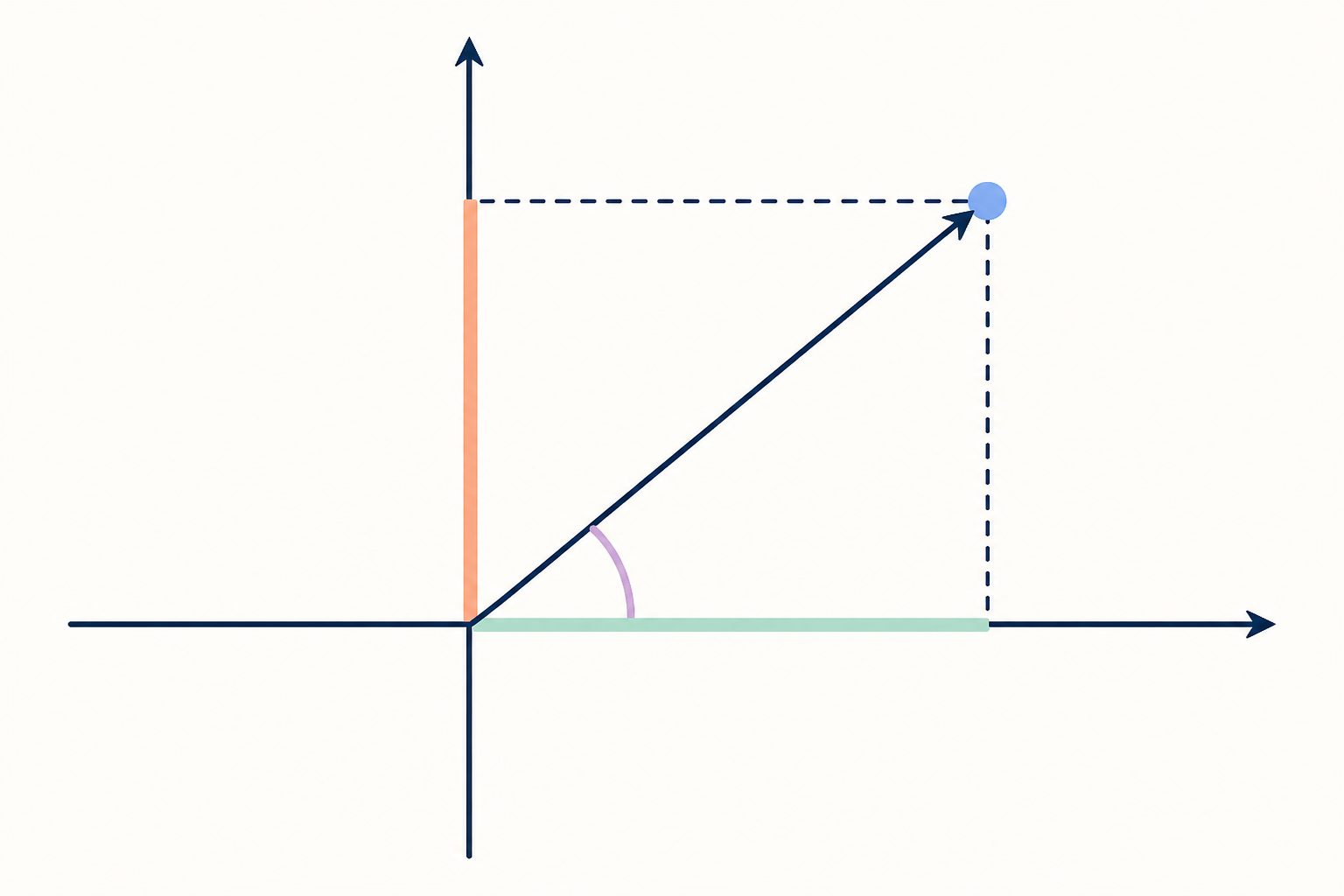 The vector has modulus , argument , and Cartesian projections and .
In the visual, the diagonal vector has length , the angle arc represents , and the two perpendicular projections represent and . Exact labels remain in the surrounding mathematical text so the diagram stays visually clean.
Key terms
- Modulus
- The non-negative distance |z| from the origin to z.
- Argument
- A directed angle from the positive real axis to the position vector of a non-zero complex number.
- Argand diagram
- A coordinate plane whose horizontal and vertical axes represent real and imaginary parts.
- Position vector
- The directed segment from the origin to the point representing z.
Worked examples
Modulus from Cartesian coordinates
Find the modulus of .
- 1Identify and .
- 2Use .
- 3Calculate .
Answer: .
Argument in the first quadrant
Find an argument of .
- 1The point lies in quadrant I.
- 2Use .
- 3Choose the quadrant-I angle.
Answer: .
Read Cartesian components from polar data
A complex number has modulus 6 and argument . Find its Cartesian coordinates.
- 1Use .
- 2Use .
Answer: The point is , so .
Rules and formulas
Modulus
Cartesian projections
Tangent relation
- non-zero real component
Cartesian and polar forms
Cartesian form displays horizontal and vertical components. Polar form displays size and direction.
For a non-zero complex number, . Arguments that differ by a whole turn represent the same direction, so gives the same complex number for every integer .
Polar form is especially efficient for multiplication and division because moduli scale while arguments rotate. Cartesian form remains efficient for addition and subtraction.
Always state whether an angle is a principal argument, a particular argument, or the general family of arguments.
Key terms
- Cartesian form
- The representation x + yi.
- Polar form
- The representation , where r is the modulus.
- Equivalent arguments
- Angles differing by 2kπ that point in the same direction.
Worked examples
Cartesian to polar in quadrant I
Write in polar form.
- 1Find .
- 2The argument is .
- 3Substitute r and θ into polar form.
Answer: .
Polar to Cartesian
Convert to Cartesian form.
- 1Use .
- 2Use .
- 3Multiply both components by 2.
Answer: .
A general argument
Give all arguments of .
- 1The principal direction is .
- 2Add any integer multiple of .
Answer: , where .
Rules and formulas
Polar form
Equivalent arguments
Cartesian reconstruction
Cis notation
Cis notation abbreviates the trigonometric factor: . Therefore .
The notation is compact but carries exactly the same information as full polar form. It does not mean the product of three variables c, i, and s.
Because sine and cosine are both -periodic, .
On the unit circle, has modulus 1 and argument . Multiplication by r scales this unit vector to modulus r.
Key terms
- Cis
- The abbreviation cis θ = cos θ + i sin θ.
- Unit complex number
- A complex number of modulus 1.
- Trigonometric factor
- The unit-modulus directional part cos θ + i sin θ.
Worked examples
Expand cis notation
Write in Cartesian form.
- 1Use and .
- 2Multiply both components by 4.
Answer: .
Compress full polar form
Rewrite using cis notation.
- 1Replace the parenthesized trigonometric factor by .
Answer: .
Equivalent cis angles
Explain why .
- 1Subtract the angles: .
- 2A complete turn does not change the direction.
Answer: The two expressions represent the same complex number.
Rules and formulas
Cis definition
Cis form
Cis periodicity
Exponential form and Euler's relation
Euler's relation connects exponential and trigonometric notation: . Hence .
The exponential form of a non-zero complex number is , where and θ is an argument.
The familiar exponential index laws explain polar multiplication and division: multiplying adds arguments, while dividing subtracts them.
Exponential form is a representation, not a numerical approximation. Keep angles exact in terms of when exact values are available.
Key terms
- Euler's relation
- The identity .
- Exponential form
- The representation of a non-zero complex number.
- Natural exponential base
- The number e used in exponential functions.
Worked examples
Cis to exponential form
Write in exponential form.
- 1Use .
- 2Substitute .
Answer: .
Exponential to Cartesian form
Convert to Cartesian form.
- 1Use Euler's relation.
- 2Evaluate and .
- 3Multiply by 5.
Answer: .
Euler's famous special value
Evaluate .
- 1Use .
- 2Substitute and .
Answer: , so .
Rules and formulas
Euler's relation
Exponential form
Equivalent notation
Principal and general arguments
A non-zero complex number has infinitely many arguments because adding completes one full turn. The multivalued notation can describe this entire family.
The principal argument is the unique representative in a specified interval. In these notes the convention is .
Under this convention, a negative real number has principal argument , not . A negative imaginary number has principal argument .
Some calculators or texts use . If so, convert the result to the convention requested by the question.
Key terms
- General argument
- The family θ + 2kπ for all integers k.
- Principal argument
- The unique argument in the adopted principal interval.
- Principal interval
- Here, the interval −π < Arg z ≤ π.
Worked examples
Convert to a principal argument
Find the principal argument equivalent to .
- 1The angle exceeds .
- 2Subtract : .
Answer: .
Quadrant II argument
Find the principal argument of .
- 1The point lies in quadrant II.
- 2Its reference angle is .
- 3Use .
Answer: .
Quadrant III argument
Find the principal argument of .
- 1The point lies in quadrant III.
- 2The reference angle is .
- 3Choose the clockwise representative inside the principal interval.
Answer: .
Point on a negative axis
Find under .
- 1The point lies on the negative real axis.
- 2The included endpoint is .
Answer: .
Rules and formulas
Principal-argument convention
General arguments
Converting Cartesian form to polar, cis and exponential forms
Start with . First calculate , then determine a quadrant-correct argument θ.
A reliable manual method is: sketch the point, find a positive reference angle from , then adjust it for the quadrant.
Once r and θ are known, the three equivalent outputs are , , and .
For points on an axis, read the direction directly rather than dividing by zero. For example, has modulus 3 and principal argument .
Key terms
- Reference angle
- The acute positive angle between a position vector and the nearest real-axis direction.
- Quadrant correction
- Adjusting an inverse-tangent result so that it matches the signs of x and y.
Worked examples
First-quadrant exact conversion
Convert to cis and exponential forms.
- 1Find .
- 2Find .
- 3Write both equivalent representations.
Answer: .
Second-quadrant exact conversion
Convert to principal polar form.
- 1Find .
- 2The reference angle is .
- 3Quadrant II gives .
Answer: .
Fourth-quadrant conversion
Convert (1-i) to principal exponential form.
- 1Find .
- 2The point is in quadrant IV with reference angle .
- 3Use the principal argument .
Answer: .
Axis conversion
Convert to cis form using a principal argument.
- 1The modulus is 3.
- 2The direction is straight down, so θ is .
Answer: .
Rules and formulas
Cartesian-to-polar modulus
Cartesian-to-polar argument
Equivalent output forms
Converting polar, cis and exponential forms to Cartesian form
To convert from polar form, evaluate and , then write .
Use exact unit-circle values whenever the angle is a standard angle. Do not replace by a rounded decimal unless approximation is requested.
For a non-standard angle, use a calculator in radian mode and keep extra digits during the calculation. Round only the final real and imaginary parts as instructed.
Negative sine or cosine values automatically place the Cartesian result in the correct quadrant.
Key terms
- Exact conversion
- A conversion using exact trigonometric values, fractions, and radicals.
- Approximate conversion
- A decimal conversion rounded to a stated accuracy.
Worked examples
Cis to exact Cartesian form
Convert to Cartesian form.
- 1Use .
- 2Use .
- 3Multiply by 4.
Answer: .
Exponential to exact Cartesian form
Convert to Cartesian form.
- 1Replace the exponential factor by .
- 2Use cosine 0 and sine .
Answer: .
Non-standard angle
Convert to Cartesian form, correct to three significant figures.
- 1Set the GDC to radian mode.
- 2Calculate and .
- 3Round only the final components.
Answer: .
Rules and formulas
Real component
Imaginary component
Polar-to-Cartesian conversion
Multiplication in polar form
If and , then their product has modulus and argument .
Geometrically, multiplication by scales every distance from the origin by and rotates every direction by .
After adding arguments, an answer may be normalized to the requested principal interval by adding or subtracting .
The same rule follows immediately from exponential form: .
Key terms
- Complex multiplication
- A combined scaling and rotation about the origin.
- Argument addition
- The rule that product directions add.
Worked examples
Multiply two cis forms
Calculate .
- 1Multiply moduli: .
- 2Add arguments: .
Answer: .
Normalize a product argument
Multiply by , using a principal argument.
- 1The modulus is 8.
- 2The angle sum is .
- 3Subtract to obtain .
Answer: .
Cartesian product using polar structure
Find the polar form of .
- 1Write .
- 2Write .
- 3Multiply moduli and add arguments.
Answer: .
Rules and formulas
Product in cis form
Product in exponential form
Product modulus
Powers in polar and exponential form
Polar form makes integer powers systematic. If , then each multiplication multiplies the modulus by and adds another copy of the argument . Therefore for every integer , with when .
The same rule in exponential form is . This follows directly from the ordinary index laws and is a form of De Moivre's theorem.
After multiplying the argument by , normalize it to the requested interval only at the end. For an exact Cartesian answer, use exact sine and cosine values after the power has been simplified.
Geometrically, raising to the nth power raises the distance from the origin to the nth power and multiplies the direction angle by . This gives a fast reasonableness check for both magnitude and quadrant.
Key terms
- De Moivre's theorem for powers
- The rule that raises the modulus to n and multiplies the argument by n.
- Integer power
- A power whose exponent is an integer; negative powers require a non-zero base.
- Argument normalization
- Adding or subtracting whole turns so an angle lies in the required interval.
Worked examples
Raise an exact polar form to a power
Calculate in exact Cartesian form.
- 1Raise the modulus: .
- 2Multiply the argument: .
- 3Convert to Cartesian form.
Answer: .
Power of a Cartesian complex number
Find using polar form.
- 1Write .
- 2Raise the modulus: .
- 3Multiply the argument and normalize: .
Answer: .
Negative integer power
Write in principal exponential form.
- 1Raise the modulus: .
- 2Multiply the argument by .
Answer: .
Rules and formulas
Power in cis form
- integer exponent
Power in exponential form
- integer exponent
Modulus of a power
Division, reciprocals and conjugates in polar form
For , division divides the moduli and subtracts the arguments. This is usually shorter than rationalizing a complex denominator in Cartesian form.
The reciprocal of is : the scale is inverted and the rotation is reversed.
The conjugate of is . Conjugation preserves modulus and reflects the direction in the real axis.
Normalize the final argument only after subtracting. Preserve exact angles when possible.
Key terms
- Polar quotient
- A quotient found by dividing moduli and subtracting arguments.
- Polar reciprocal
- The inverse with reciprocal modulus and negated argument.
- Polar conjugate
- The reflection with unchanged modulus and negated argument.
Worked examples
Divide two cis forms
Calculate .
- 1Divide moduli: .
- 2Subtract arguments: .
- 3Convert if useful.
Answer: .
Find a reciprocal
Write the reciprocal of in cis form.
- 1Replace the modulus by .
- 2Negate the argument.
Answer: .
Find a conjugate
Write the conjugate of in exponential form.
- 1Keep modulus 4.
- 2Negate the argument .
Answer: .
Solve a polar equation
Solve .
- 1Divide moduli: .
- 2Subtract arguments: .
Answer: .
Rules and formulas
Quotient in cis form
- non-zero divisor
Reciprocal
Conjugate in polar form
Quotient modulus
Geometric interpretation: scaling and rotation
Multiplying z by a positive real number k stretches its position vector by factor k without changing its direction. Multiplying by a unit complex number rotates it by without changing its length.
Multiplication by combines both transformations: a dilation of scale factor k centered at the origin and a rotation of angle .
Division by scales by and rotates by .
This interpretation is a strong reasonableness check. A product modulus or direction inconsistent with the predicted transformation signals an arithmetic error.
Key terms
- Dilation
- A scaling from the origin by a positive factor.
- Rotation
- A turn about the origin through a directed angle.
- Unit multiplier
- A complex multiplier of modulus 1 that performs only a rotation.
Worked examples
Rotate without scaling
Describe multiplication by .
- 1The multiplier modulus is 1.
- 2Its argument is .
Answer: It rotates every point 90 degrees counterclockwise about the origin.
Scale and rotate
Describe multiplication by .
- 1The modulus 2 gives scale factor 2.
- 2The argument gives a clockwise rotation of .
Answer: A dilation by factor 2 followed by a 60-degree clockwise rotation.
Apply a transformation exactly
Find the image of under multiplication by .
- 1Write the multiplier in Cartesian form: .
- 2Multiply .
- 3Use .
Answer: The image is .
Rules and formulas
Scaling and rotation
Modulus transformation
- positive scale factor
Argument transformation
Applications: phasors, signals and transformations
Polar complex numbers are useful when a quantity has both magnitude and phase. In alternating-current models, a voltage, current, or impedance can be represented as a phasor . The modulus gives amplitude and the argument gives phase angle.
Multiplication and division then describe physical scaling and phase shift. For example, the phasor model divides voltage magnitude by impedance magnitude and subtracts the impedance phase from the voltage phase.
Repeated rotations and dilations are modeled by powers. If each step multiplies a state by , then after steps the state is . This appears in iterative graphics, rotating mechanisms, signal processing and planar motion.
Phasors simplify operations only when the model's assumptions apply. State the meaning and units of the modulus and argument, and convert to Cartesian form before adding phasors with different directions.
Key terms
- Phasor
- A complex-number representation of a sinusoidal quantity using magnitude and phase.
- Amplitude
- The size of a modeled oscillation, represented by the phasor modulus.
- Phase difference
- The difference between two arguments, describing their relative angular shift.
Worked examples
AC phasor division
A voltage is modeled by volts and an impedance by ohms. Find .
- 1Divide the moduli: .
- 2Subtract the arguments: .
- 3Interpret the modulus and phase with their units.
Answer: amperes: magnitude 23 A and phase .
Add two signal phasors
Combine and , giving the result in polar form.
- 1Convert to Cartesian form: and .
- 2Add components to obtain .
- 3Convert the sum back to polar form.
Answer: .
Repeated rotation and dilation
A point starts at . Each step multiplies it by . Find the state after three steps.
- 1Use .
- 2Calculate the modulus: .
- 3Calculate the argument: .
Answer: .
Rules and formulas
Phasor quotient model
- voltage phasor
- non-zero impedance phasor
Repeated scale-and-rotate model
Phase difference
Special cases, axes and boundary conventions
Positive real numbers have principal argument 0, negative real numbers have principal argument , positive pure imaginary numbers have principal argument , and negative pure imaginary numbers have principal argument .
The zero complex number may be written as for any θ, but this does not give zero a well-defined argument. For uniqueness, polar form is normally discussed for .
A negative quantity should not be used as the modulus. If an expression begins with a negative radial coefficient, make the modulus positive and add to the argument.
Angles exactly at a principal-interval boundary must follow the stated convention. With , use instead of .
Key terms
- Axis argument
- A standard direction 0, π/2, π, or −π/2.
- Positive modulus convention
- For a non-zero number, polar radius r is strictly positive.
- Boundary convention
- The rule deciding which endpoint represents the negative real axis.
Worked examples
Repair a negative modulus
Rewrite with positive modulus and a principal argument.
- 1Replace the negative factor by a rotation of .
- 2Add : .
- 3Convert to the principal interval by subtracting .
Answer: .
Pure imaginary direction
Write in exponential form.
- 1The modulus is 7.
- 2The principal argument is .
Answer: .
Negative real direction
Write in principal cis form.
- 1The modulus is 4.
- 2The principal argument is .
Answer: .
Rules and formulas
Axis arguments
Imaginary-axis arguments
Positive-modulus conversion
Mixed conversion and operation problems
Mixed questions often present values in different forms. Convert them to the form that makes the requested operation simplest, then convert the final answer only if required.
For multiplication or division, identify each modulus and argument before operating. For addition or subtraction, convert each number to Cartesian form first.
Use exact standard-angle values throughout. If one angle is non-standard, retain full calculator precision until the final answer.
A complete AI HL solution communicates the chosen form, quadrant reasoning, operation rule, and final argument convention.
Key terms
- Mixed representation
- A problem using Cartesian, cis, polar, or exponential forms together.
- Strategic conversion
- Changing form specifically to simplify the requested operation.
Worked examples
Add numbers supplied in polar form
Find .
- 1Addition is easiest in Cartesian form.
- 2Convert the terms to 2 and .
- 3Add the components.
Answer: .
Divide mixed forms
Find in principal cis form.
- 1Convert .
- 2Divide moduli: .
- 3Subtract arguments: .
Answer: .
Recover a missing factor
If and , find z.
- 1Divide moduli: .
- 2Subtract arguments: .
Answer: .
Rules and formulas
Operation choice
Calculator/GDC methods and exam strategy
Set the GDC to complex mode, radian angle mode, and the output form required by the question. Common output choices are rectangular and polar .
Use rectangular-to-polar and polar-to-rectangular commands where available. On other models, calculate and use a two-argument angle function such as atan2.
Check whether the calculator reports an argument in , then convert to the required convention.
For exact standard angles, provide exact mathematical values even if the display gives decimals. Use the GDC to check, not replace, exact reasoning.
After multiplication or division, verify the modulus and the expected rotation independently. This catches incorrect angle signs quickly.
Key terms
- Radian mode
- The calculator angle setting required for standard complex exponential notation.
- Rectangular mode
- A display setting that returns a + bi.
- Polar mode
- A display setting that returns magnitude and angle.
- atan2
- A quadrant-aware angle function taking the imaginary and real coordinates separately.
Worked examples
GDC Cartesian-to-polar check
Check on a GDC.
- 1Enter the complex number in rectangular mode.
- 2Use the polar-conversion command or calculate modulus and atan2.
- 3Convert the displayed angle to an exact standard angle.
Answer: and .
GDC approximate conversion
Convert to Cartesian form on a GDC.
- 1Confirm radian mode.
- 2Enter the exponential expression with parentheses.
- 3Read both components before rounding.
Answer: to three significant figures.
GDC operation check
Check .
- 1Predict modulus .
- 2Predict argument .
- 3Use the GDC and compare.
Answer: .
Rules and formulas
Quadrant-aware argument
Post-operation check
Common mistakes and IB AI HL exam communication
Most errors come from an incorrect quadrant, an inconsistent principal interval, degree mode, a negative modulus, or applying polar rules to addition and subtraction.
A clear conversion solution should show the modulus, a reference-angle or atan2 calculation, the quadrant, and the selected argument.
A clear operation solution should identify the two moduli and arguments, state the multiplication or division rule, normalize the final argument if requested, and retain exact values.
Always distinguish , which may represent every coterminal argument, from , which denotes the chosen principal argument.
Key terms
- Coterminal angles
- Angles differing by complete turns and sharing the same terminal direction.
- Normalization
- Moving an angle into the required interval by adding or subtracting 2π.
Worked examples
Diagnose a quadrant error
A student claims . Explain the error.
- 1The reference angle is .
- 2But the point lies in quadrant III.
- 3Choose the representative in the principal interval.
Answer: .
Diagnose the wrong operation rule
A student adds by adding moduli and angles. Why is this invalid?
- 1Polar modulus-angle rules apply to products and quotients.
- 2Convert the addends to Cartesian form.
Answer: The correct sum is , not .
Normalize a final angle
Normalize to (.
- 1The angle is below .
- 2Add .
Answer: .
Rules and formulas
Principal normalization
IB AI HL-style practice with worked solutions
Attempt each problem before reading the steps. The sequence moves from basic conversion to mixed representation, geometric interpretation and multi-step operation problems.
Unless stated otherwise, give exact values and principal arguments in (.
Key terms
- Exact polar answer
- A positive modulus and exact angle, normally expressed using π where appropriate.
- Worked solution
- A transparent sequence of mathematical steps leading to a verified answer.
Worked examples
Practice 1: first-quadrant conversion
Write in cis and exponential forms.
- 1The modulus is .
- 2The argument is .
Answer: .
Practice 2: quadrant-II argument
Find the modulus and principal argument of .
- 1The modulus is 2.
- 2The reference angle is .
- 3Quadrant II gives .
Answer: and .
Practice 3: polar to Cartesian
Convert to Cartesian form.
- 1Use cosine and sine .
- 2Multiply both components by 4.
Answer: .
Practice 4: exponential to Cartesian
Convert to Cartesian form.
- 1Use Euler's relation.
- 2Evaluate the exact cosine and sine values.
- 3Multiply by 5.
Answer: .
Practice 5: principal-argument normalization
Write using a principal argument.
- 1Subtract from .
- 2Keep modulus 3.
Answer: .
Practice 6: multiplication
Calculate .
- 1Multiply moduli to obtain 6.
- 2Add arguments to obtain .
Answer: .
Practice 7: division
Calculate .
- 1Divide moduli to obtain 4.
- 2Subtract arguments to obtain .
Answer: .
Practice 8: Cartesian product through polar form
Write in polar form.
- 1Convert the factors to and .
- 2Multiply moduli and add arguments.
Answer: .
Practice 9: solve for a polar factor
Solve .
- 1Divide the moduli: .
- 2Subtract the arguments: .
Answer: .
Practice 10: conjugate and reciprocal
For , give and in cis form.
- 1Conjugation keeps modulus 4 and negates the argument.
- 2A reciprocal also replaces 4 by .
Answer: and .
Practice 11: exact GDC-style conversion
Find the modulus and principal argument of .
- 1The modulus is .
- 2The point is in quadrant II with reference angle .
- 3Use .
Answer: and .
Practice 12: geometric transformation
The point z is multiplied by . Describe the transformation and find the image of in Cartesian form.
- 1The multiplier gives a dilation by factor 2 and a counterclockwise rotation by .
- 2Convert the multiplier to .
- 3Expand .
Answer: The image is .
Practice 13: integer power
Calculate in exact Cartesian form.
- 1Raise the modulus to obtain 16.
- 2Multiply the argument by 4 to obtain .
- 3Convert the result to Cartesian form.
Answer: .
Practice 14: applied phasor quotient
Given and , calculate .
- 1Divide the moduli: .
- 2Subtract the arguments: .
Answer: .
Practice 15: repeated transformation
A state is multiplied twice by . Find the final state in principal exponential form.
- 1Use .
- 2The modulus is .
- 3The argument is .
Answer: .
Rules and formulas
Conversion-operation workflow
Topic summary and cheat sheet
Polar, cis and exponential forms describe the same non-zero complex number using its modulus and direction. Conversion accuracy depends on a correct quadrant and a clear argument convention.
For products and quotients, operate directly on moduli and arguments; for sums and differences, return to Cartesian components.
Key terms
- Polar fluency
- Moving accurately between Cartesian, trigonometric, cis and exponential representations.
Worked examples
Final checklist
What should be checked before submitting a polar-form answer?
- 1Check first whether the result is zero. Zero has modulus 0 and no defined argument.
- 2For a nonzero result, the modulus is positive and the angle must be in the required interval and unit.
- 3The form matches the question.
- 4A conversion or geometric check confirms the result.
Answer: Submit an exact, convention-compliant form unless an approximation is requested.
Rules and formulas
Modulus
Polar form
Cis form
Exponential form
Product
Quotient
Topic summary
- For , the modulus is .
- An argument is a directed angle from the positive real axis to the position vector of z.
- The argument of zero is undefined.
- Cartesian and polar components satisfy and .
- Polar form is with for .
- Cis notation is defined by .
- Euler's relation is .
- The exponential form is .
- Arguments differing by represent the same direction.
- These notes use the principal interval .
- A negative real number has principal argument under this convention.
- Use the signs of x and y to choose the correct quadrant.
- A two-argument atan2 calculation is safer than an unadjusted inverse tangent.
- To convert to Cartesian form, calculate .
- Use exact unit-circle values whenever possible.
- To multiply in polar form, multiply moduli and add arguments.
- To divide in polar form, divide moduli and subtract arguments.
- Multiplication by scales by k and rotates by φ.
- The conjugate of is .
- The reciprocal of is .
- Use Cartesian form for addition and subtraction.
- Normalize a final angle only after completing the operation.
- Check calculator complex mode, rectangular or polar output, and radian mode.
- Verify results using modulus, argument, Cartesian conversion, or geometric scaling and rotation.
- For integer , .
- A negative integer power requires a non-zero base and inverts the modulus.
- After a power, normalize the multiplied argument only when presenting the final answer.
- Phasor modulus represents magnitude or amplitude, while its argument represents phase.
- Repeated scaling and rotation can be modeled by .
- For applied answers, state the meanings and units of both modulus and phase.
- Complex numbers are removed from the revised AI HL syllabus first assessed in May 2029; check which specification applies.