Integer exponent foundations
An exponent tells us how a base is used as a factor. For a positive integer , the expression means a product of factors, each equal to . For example, . The base is , the exponent is , and the power is the complete expression .
The exponent applies only to the quantity immediately before it unless brackets extend its scope. Thus , but . With a negative base, an even integer exponent gives a positive result and an odd integer exponent gives a negative result.
For every non-zero base, . This follows from the quotient law: , while the fraction itself equals . The restriction matters: is not assigned the ordinary value in this course.
A negative exponent creates a reciprocal: for . The minus sign belongs to the exponent; it does not make the whole value negative. For instance, , which is positive.
Key terms
- Base
- The repeated factor in a power. In , the base is .
- Exponent
- The number that describes how the base is powered. In , the exponent is .
- Power
- The complete expression consisting of a base and exponent, such as .
- Reciprocal
- The multiplicative inverse of a non-zero number. The reciprocal of is .
- Integer exponent
- An exponent in : a positive whole number, zero, or a negative whole number.
Worked examples
Interpret positive, zero, and negative exponents
Evaluate , , and .
- 1Use repeated multiplication: .
- 2Because , use the zero-exponent rule: .
- 3Use the reciprocal rule: .
Answer: , , and .
Read brackets before evaluating
Compare and .
- 1In , the exponent applies to only, so .
- 2Therefore .
- 3In , brackets make the base.
- 4Therefore .
Answer: , whereas .
Rules and formulas
Positive integer exponent
- the base
- a positive integer exponent
Zero exponent
Negative integer exponent
Laws of integer exponents
The exponent laws are consequences of counting equal factors. When powers with the same non-zero base are multiplied, add their exponents. When they are divided, subtract the denominator exponent from the numerator exponent. These rules work for positive, zero, and negative integer exponents whenever the expressions are defined.
A power raised to another power multiplies the exponents. A product or quotient raised to a power applies that power to every factor in the brackets. The same-base condition is essential for the product and quotient laws: cannot be simplified by adding the exponents, although it can be written as .
Exponent laws change products, quotients, and powers—not sums. In general, . For example, , while .
Key terms
- Product law
- For the same base, multiplication adds exponents: .
- Quotient law
- For the same non-zero base, division subtracts exponents: .
- Power of a power
- Multiply the exponents: .
Worked examples
Multiply and divide powers
Simplify , where .
- 1Multiplication adds the first two exponents: .
- 2Division subtracts the denominator exponent: .
Answer: .
Apply a power to a quotient
Simplify , where .
- 1First note that dividing by is multiplying by , so the bracket is .
- 2Square every factor: .
- 3Use the power-of-a-power law: and .
Answer: .
Rules and formulas
Product law
Quotient law
Power of a power
Power of a product
Power of a quotient
Simplifying expressions with powers
A strong simplification method is to work factor by factor. Expand only when it helps, collect numerical coefficients, combine each repeated base using exponent laws, and then rewrite negative exponents as reciprocals if the question asks for positive exponents.
An algebraic expression with a negative exponent is not automatically wrong. However, IB questions often request an answer with positive exponents. Move a factor across the fraction bar to change the sign of its exponent: .
Restrictions should be carried with algebra involving division or negative exponents. If the original expression contains , then , even if later cancellation removes the visible denominator.
Key terms
- Positive-exponent form
- An equivalent expression in which no variable has a negative exponent.
- Restriction
- A condition such as required to keep an expression defined.
- Equivalent expression
- A different-looking expression with the same value for every input in the permitted domain.
Worked examples
Simplify a multi-factor expression
Simplify using positive exponents, where .
- 1Square the numerator: .
- 2Divide by : the coefficient becomes .
- 3Subtract exponents for : .
- 4Subtract exponents for : .
- 5Rewrite in the denominator.
Answer: .
Simplify before substituting
Given and , evaluate .
- 1Combine the powers of : .
- 2Rewrite , giving .
- 3Substitute: .
Answer: .
Rules and formulas
Moving a negative power across a fraction bar
Logarithms as inverse exponents
A logarithm answers one precise question: what exponent must the base be raised to in order to obtain this number? The statement means exactly the same thing as . Logarithms and exponentiation are inverse operations, just as subtraction reverses addition.
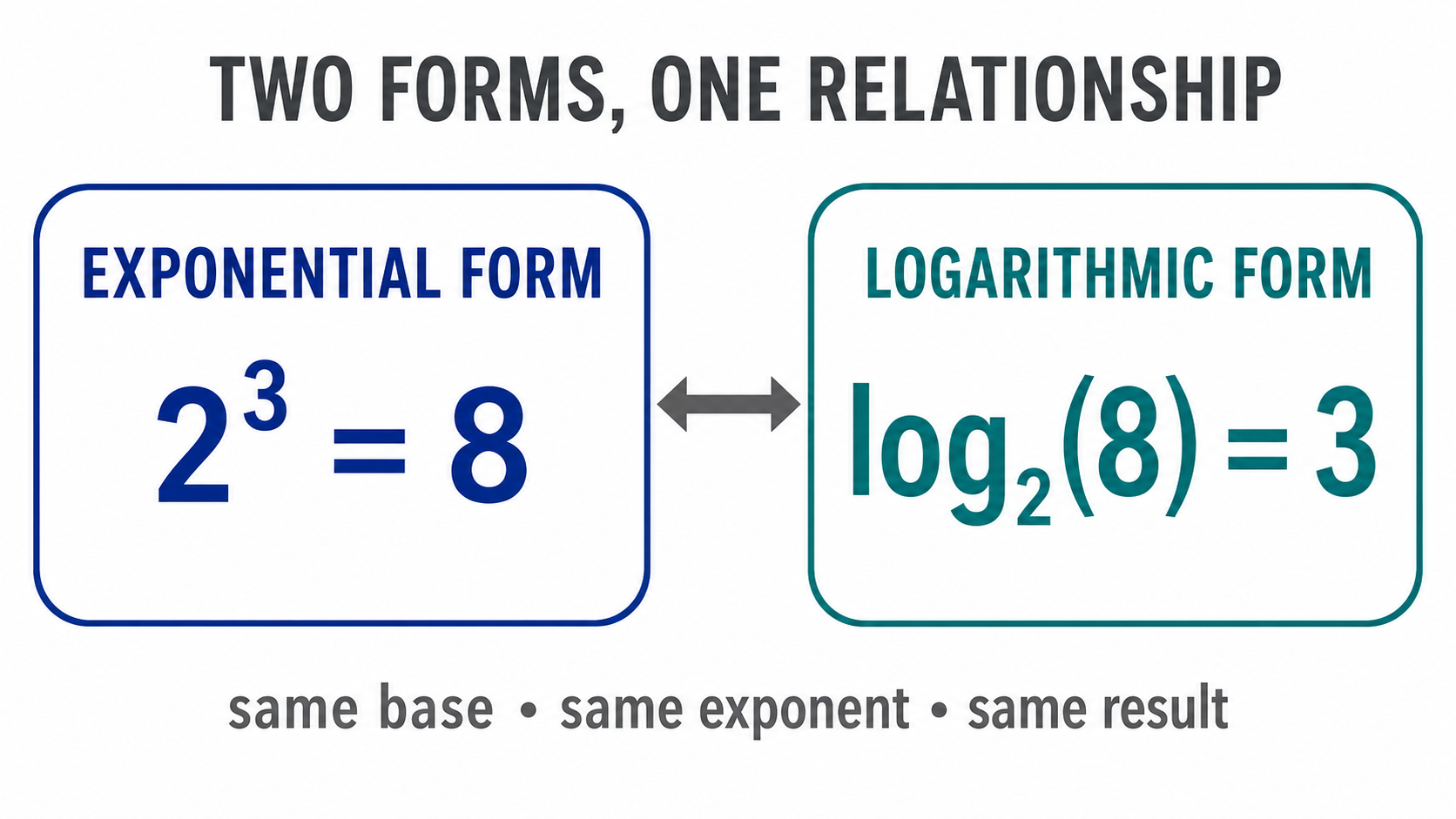 The base, exponent and result do not change when we switch forms: .
For real logarithms, the base must satisfy and , and the argument must satisfy . A positive base never produces zero or a negative result when raised to a real power, so and are undefined in the real number system.
Two bases are especially common. The common logarithm usually means . The natural logarithm means , where . Both are calculator functions and both obey the same logarithm laws.
Key terms
- Logarithm
- The exponent to which a valid base must be raised to produce a positive argument.
- Argument
- The positive quantity inside a logarithm. In , the argument is .
- Common logarithm
- A logarithm with base , usually written .
- Natural logarithm
- A logarithm with base , written .
- Inverse operations
- Operations that undo one another; exponentiation and logarithms form an inverse pair.
Worked examples
Convert exponential form to logarithmic form
Rewrite in logarithmic form.
- 1Identify the base: .
- 2Identify the exponent: .
- 3Identify the result or logarithm argument: .
- 4Use .
Answer: .
Convert logarithmic form to exponential form
Rewrite in exponential form.
- 1The logarithm base is .
- 2The logarithm value is the exponent .
- 3The argument is the result.
Answer: .
Evaluate exact logarithms
Evaluate and .
- 1Write , so the required exponent is .
- 2The exponent that turns into is .
Answer: and .
Rules and formulas
Exponential-logarithmic equivalence
- the logarithm base, with and
- the positive argument
- the exponent or logarithm value
Common and natural logarithms
Inverse identities
Basic logarithm rules and properties
Logarithm laws turn multiplication into addition, division into subtraction, and powers into coefficients. They follow directly from the exponent laws. For example, if and , then , so .
Every logarithm argument involved in a rule must be positive, and the base must be positive and not equal to 1. There is no general identity . The expressions can coincide for special values, but logarithms do not generally distribute over addition or subtraction.
The power rule is useful in both directions. It can expand to , or condense to , provided the domain conditions are satisfied.
Key terms
- Product property
- For and , . Each factor, not just the product, must be positive.
- Quotient property
- For and , . Both numerator and denominator must be positive.
- Power property
- An exponent on a positive argument can be written as a coefficient of the logarithm.
- Condense
- Combine a sum or difference of logarithms into one logarithm.
- Expand
- Rewrite one logarithm of a product, quotient, or power as several simpler terms.
Worked examples
Expand a logarithmic expression
Expand , where .
- 1Use the quotient law: .
- 2Use the product law: .
- 3Use the power law: .
- 4Evaluate .
Answer: .
Condense logarithms
Write as one logarithm, where .
- 1Use the power law backwards: .
- 2Use the quotient law backwards: .
Answer: .
Rules and formulas
Product property
Quotient property
Power property
Useful exact values
Solving exponential equations
First look for a common base. If both sides can be written as powers of the same valid base, equate the exponents. This gives an exact solution and is usually the fastest non-calculator method.
If a common base is not convenient, isolate the exponential expression and take a logarithm of both sides. Either or works because the change-of-base ratio cancels consistently. Keep full calculator precision until the final answer.
In contextual problems, the algebraic value may need interpretation. If time is counted in complete years or cycles and a quantity must first exceed a target, test the neighbouring integers rather than simply rounding the logarithmic answer.
Key terms
- Common-base method
- Rewrite both sides with the same base and equate the exponents.
- Logarithmic method
- Take logarithms after isolating an exponential term, then use the power property to bring down the variable exponent.
- Exact solution
- A value written without rounding, such as or .
Worked examples
Solve by matching bases
Solve .
- 1Write .
- 2The bases now match: .
- 3Equate exponents: .
- 4Solve the linear equation: .
Answer: .
Solve using logarithms
Solve , giving the answer to 3 significant figures.
- 1Take natural logarithms: .
- 2Use the power property: .
- 3Divide: .
- 4Evaluate with full calculator precision, then round.
Answer: (3 s.f.).
Interpret a growth threshold
A population is . Find the first whole period for which it exceeds .
- 1Solve the boundary equation .
- 2Divide by : .
- 3Take logarithms: .
- 4The first complete period after is .
- 5Check that period 5 is below and period 6 is above the target.
Answer: The population first exceeds after complete periods.
Rules and formulas
Common-base principle
Solving a basic exponential equation
Solving simple logarithmic equations
For a single logarithm, convert directly to exponential form. For several logarithms with the same base, first condense them using the logarithm laws, then convert to exponential form. Solve the resulting algebraic equation and check every candidate in the original logarithms.
Domain checks are part of the solution. A candidate that makes any logarithm argument zero or negative must be rejected, even if it satisfies the transformed polynomial equation.
When logarithms appear on both sides with the same one-to-one base, equal logarithms of valid positive arguments imply equal arguments: , subject to both domain conditions.
Key terms
- Extraneous solution
- A value produced by algebraic manipulation that is invalid in the original equation, often because it violates a logarithm domain.
- Domain check
- Substitution into every original logarithm argument to confirm it is strictly positive.
- One-to-one
- A property ensuring equal outputs of a logarithmic function come from equal valid inputs.
Worked examples
Solve one logarithm
Solve .
- 1Require , so .
- 2Convert to exponential form: .
- 3Solve: , so .
- 4Check: and .
Answer: .
Condense and reject an invalid root
Solve , where has base 10.
- 1Require and , so .
- 2Use the product law: .
- 3Convert to exponential form: .
- 4Solve : .
- 5The candidates are and . Reject because it violates .
Answer: only.
Use equal logarithms
Solve .
- 1Require and , so in particular .
- 2Because is one-to-one, set .
- 3Solve: , giving .
- 4Both original arguments are positive at .
Answer: .
Rules and formulas
Single logarithm equation
Equality of logarithms
Exponential growth and decay applications
An exponential model has the form , where is the initial value and is the multiplier per time period. Growth has ; decay has . A rate of gives for growth and for decay.
Always match the time variable to the rate period. If a population grows by each hour, then must count hours in . If time is given in minutes, convert it to hours before substituting unless the model defines a minute-by-minute multiplier.
Logarithms answer inverse questions in a model. Substitution finds the quantity at a known time; solving finds the time required to reach a target: , provided all quantities are positive and .
A mathematical answer still needs contextual interpretation. A time of years may mean approximately years for a continuous model, but if a value is checked only once per whole year, test years and and report the first year that satisfies the condition. Exponential models also assume a constant multiplier; this may become unrealistic over long intervals.
Key terms
- Initial value
- The value when .
- Growth factor
- The multiplier when the decimal growth rate is .
- Decay factor
- The multiplier when the decimal decay rate is and .
- Threshold
- A target level that a modeled quantity must reach, exceed or fall below.
Worked examples
Predict exponential growth
A bacteria culture starts with cells and grows by each hour. Estimate the population after hours.
- 1The growth factor is .
- 2Use .
- 3The GDC gives . A cell count must be a whole number.
Answer: Approximately cells.
Predict exponential decay
A medicine dose is modeled by milligrams, where is measured in hours. Find the amount after hours.
- 1Substitute : .
- 2Evaluate with full precision: .
- 3Round only the final value and include the unit.
Answer: to 3 significant figures.
Find when a value falls below a target
A machine worth depreciates according to . Find when its value first falls below .
- 1Solve the boundary equation .
- 2Divide by : .
- 3Take logarithms: .
- 4Because , the value is below the target for . If values are recorded at the end of each whole year, test years and .
Answer: After about years, or first at the end of year if only whole years are allowed.
Rules and formulas
Exponential growth or decay model
- initial value
- multiplier per period
- number of matching time periods
Percentage multiplier
- percentage rate per period
Time to a target
- positive target value
Logarithmic scales in context
Logarithmic scales compress quantities that vary across many powers of . A change of unit on a base-10 logarithmic scale represents multiplication by in the original quantity. This is why logarithms are useful for acidity, sound intensity and earthquake measurements.
The pH model is , where is the hydrogen-ion concentration in moles per litre. Because of the minus sign, a lower pH corresponds to a larger hydrogen-ion concentration. A difference of one pH unit represents a factor of in concentration.
The decibel model compares intensity with a reference intensity . The model matters: logarithms compare ratios, so the ratio must be positive and unitless. In any application, state what the model output represents rather than reporting an unexplained number.
Key terms
- Logarithmic scale
- A scale on which equal steps represent equal multiplicative factors.
- Reference value
- A fixed comparison quantity such as the intensity in a decibel model.
- Order of magnitude
- A factor of ten, represented by a difference of 1 in a base-10 logarithm.
Worked examples
Calculate pH
A solution has . Find its pH.
- 1Use .
- 2The calculator gives .
- 3Round as requested and interpret it as a pH value.
Answer: .
Compare sound intensities
A sound has intensity times a reference intensity. Find its level above the reference using .
- 1Here .
- 2Calculate .
Answer: The level is approximately above the reference.
Interpret a magnitude difference
Two earthquake measurements are and on a simplified base-10 magnitude scale. Compare their measured amplitudes.
- 1The magnitude difference is .
- 2Convert the logarithmic difference to a ratio: .
Answer: The larger measurement corresponds to about times the measured amplitude in this simplified model.
Rules and formulas
pH model
Sound-intensity level
Ratio from a base-10 scale difference
- difference between the two scale readings
Calculator and GDC methods
Use the , power, or caret key for general powers. Enter negative exponents with brackets when needed: type , not . Many calculators also distinguish the negative-number key from the subtraction key.
Use the key for base and the key for base . To evaluate another base, use change of base: . Never mix bases within the same ratio.
For a numerical exponential or logarithmic equation, a GDC graph or numerical solver can confirm the algebraic result. Define the two sides as functions and find their intersection, or enter the equation into the solver with a sensible initial estimate. In an IB solution, record the equation and relevant calculator result rather than writing only a decimal answer.
Retain guard digits. Store or reuse the full calculator value and round once at the end to the requested number of decimal places or significant figures.
For a model such as , use a table to inspect whole-number times and a graph or solver for a continuous-time estimate. Set a window that includes both the model and the target line. An intersection gives the boundary value; the wording of the problem determines which side of that boundary is valid.
A reliable technology check uses two methods when possible. For example, solve with , then confirm by graphing and . Agreement supports the calculation but does not replace units or interpretation.
Key terms
- Change of base
- A formula that evaluates a logarithm in any valid base using or .
- Numerical solver
- A GDC tool that approximates a solution to an entered equation.
- Guard digits
- Unrounded intermediate digits retained to protect final accuracy.
- Intersection method
- Graph both sides of an equation and find the input where their outputs are equal.
Worked examples
Evaluate a non-standard logarithm
Evaluate to 4 decimal places.
- 1Use change of base: .
- 2Enter the entire quotient with brackets if the calculator requires them.
- 3The display gives approximately .
- 4Round once to 4 decimal places.
Answer: .
Confirm an equation graphically
Use a GDC to solve approximately.
- 1Enter and .
- 2Choose a window that displays both intersections.
- 3Use the intersection command near each crossing.
- 4The intersections occur at approximately and .
- 5Substitute or inspect both sides to confirm each numerical result.
Answer: or .
Use a table for a whole-period threshold
An account follows . Find the first whole year in which it exceeds .
- 1The boundary equation gives .
- 2A GDC table shows .
- 3The next row gives .
Answer: The account first exceeds in year .
Rules and formulas
Change-of-base formula
IB-style practice with worked solutions
The following mixed questions bring together exponent laws, logarithmic notation, equation solving, domains, and calculator accuracy. Attempt each question without reading the steps first, then compare your working line by line.
In an IB response, exact values should remain exact unless a decimal is requested. For numerical answers, show the equation, keep full precision during working, and attach the requested accuracy to the final line.
Worked examples
Practice 1 · Product and quotient laws
Simplify , where .
- 1Combine the numerator: .
- 2Divide: .
Answer: .
Practice 2 · Zero and negative exponents
Evaluate .
- 1Use .
- 2Use .
- 3Add .
Answer: .
Practice 3 · Simplification
Simplify using positive exponents.
- 1Cube the numerator: .
- 2Divide the coefficients: .
- 3For , subtract : .
- 4Rewrite in the denominator.
Answer: , for .
Practice 4 · Convert notation
Write in exponential form and explain its meaning.
- 1The base is , the logarithm value is the exponent , and the argument is .
- 2Use .
Answer: ; the exponent on 4 required to produce 64 is 3.
Practice 5 · Exact logarithm values
Evaluate .
- 1Since , .
- 2Since , .
- 3Add the exact values.
Answer: .
Practice 6 · Exponential equation with a common base
Solve .
- 1Rewrite with base 3: and .
- 2Then .
- 3Equate exponents: .
Answer: .
Practice 7 · Numerical exponential equation
Solve to 3 significant figures.
- 1Take logarithms: .
- 2Rearrange: .
- 3Evaluate without intermediate rounding.
Answer: (3 s.f.).
Practice 8 · Logarithmic equation
Solve .
- 1Require , so .
- 2Convert to exponential form: .
- 3Solve .
- 4Check that the argument is positive.
Answer: .
Practice 9 · Domain and extraneous roots
Solve .
- 1Require .
- 2Condense: .
- 3Set valid arguments equal: .
- 4Solve , giving or .
- 5Reject because it violates .
Answer: only.
Practice 10 · IB-style growth model
A quantity follows . Find the first integer for which .
- 1Solve the boundary equation .
- 2Divide: .
- 3Take logs: .
- 4Because must be an integer and the inequality is strict, test the next integer.
Answer: The first valid value is .
Practice 11 · Growth prediction
A wildlife population is modeled by , where is in years. Find after years to the nearest whole number.
- 1Substitute : .
- 2The GDC gives .
- 3Round the population to the nearest whole number.
Answer: Approximately animals.
Practice 12 · Decay threshold
A pollutant level is modeled by . Find the first whole day for which .
- 1Solve : .
- 2Because the model is decreasing, for .
- 3The first allowable whole day is therefore .
Answer: Day .
Practice 13 · pH application
Find the pH when .
- 1Use .
- 2The GDC gives .
Answer: .
Practice 14 · Model interpretation
A social-media post is modeled by , where is hours. A GDC gives when . Explain two checks needed before reporting an answer.
- 1Check whether the context permits fractional hours or asks for the first complete hour.
- 2Check neighbouring values if a whole hour is required: compare and with .
- 3State that a constant 35% hourly growth rate may not remain realistic for long periods.
Answer: Report about hours for continuous time, or hour if the first qualifying whole hour is required, and state the constant-rate limitation.
Topic summary and cheat sheet
For exponents, identify the base and the operation before choosing a law. Products add same-base exponents, quotients subtract them, and a power of a power multiplies them. A zero exponent requires a non-zero base; a negative exponent means reciprocal.
For logarithms, translate the question into “what exponent?” Use , with , , and . Match bases for exact equations; otherwise isolate the power and use logarithms or technology.
For applications, write the model, identify units and time periods, calculate with guard digits, then interpret. A decimal time, a whole-period threshold and a long-term forecast are different kinds of answers.
Rules and formulas
Product and quotient laws
Power laws
Zero and negative exponents
Exponential-logarithmic equivalence
Change of base
Growth or decay model
Topic summary
- For positive integers, represents repeated multiplication of the base .
- For , and .
- Same-base multiplication adds exponents; same-base division subtracts them.
- A power raised to a power multiplies the exponents: .
- Exponent laws act on products, quotients and powers—not on addition or subtraction.
- The equivalence defines a logarithm as an exponent.
- For real logarithms, require , , and a positive argument.
- Use product, quotient and power laws only with valid positive logarithm arguments; there is no law for .
- Solve exponential equations by matching bases when possible; otherwise isolate the power and take logarithms.
- Solve logarithmic equations by converting or condensing, then check candidates in the original equation.
- Growth uses , decay uses , and requires matching time periods.
- To find time to a target, solve with logarithms and interpret any integer constraint.
- Logarithmic scales turn multiplicative ratios into additive differences.
- On a GDC, use brackets carefully, graph both sides or use a solver, and use a table for whole-period thresholds.
- Retain guard digits and round only the final answer to the requested accuracy.
- Every contextual answer should include units, a meaningful interpretation and any important model limitation.