Why scientific notation matters
Many applications involve scales that ordinary decimals hide. The diameter of a cell might be , while a national budget might be dollars. Scientific notation keeps the meaningful digits visible and makes the scale easy to compare.
A non-zero number is written in normalized scientific notation as , where and is an integer. The coefficient carries the significant digits; the exponent tells how many factors of 10 change the scale.
For a positive quantity, the normalization condition is often written . Negative values are also allowed: is normalized because lies between 1 and 10. Zero is normally written simply as , because no unique non-zero normalized coefficient represents it.
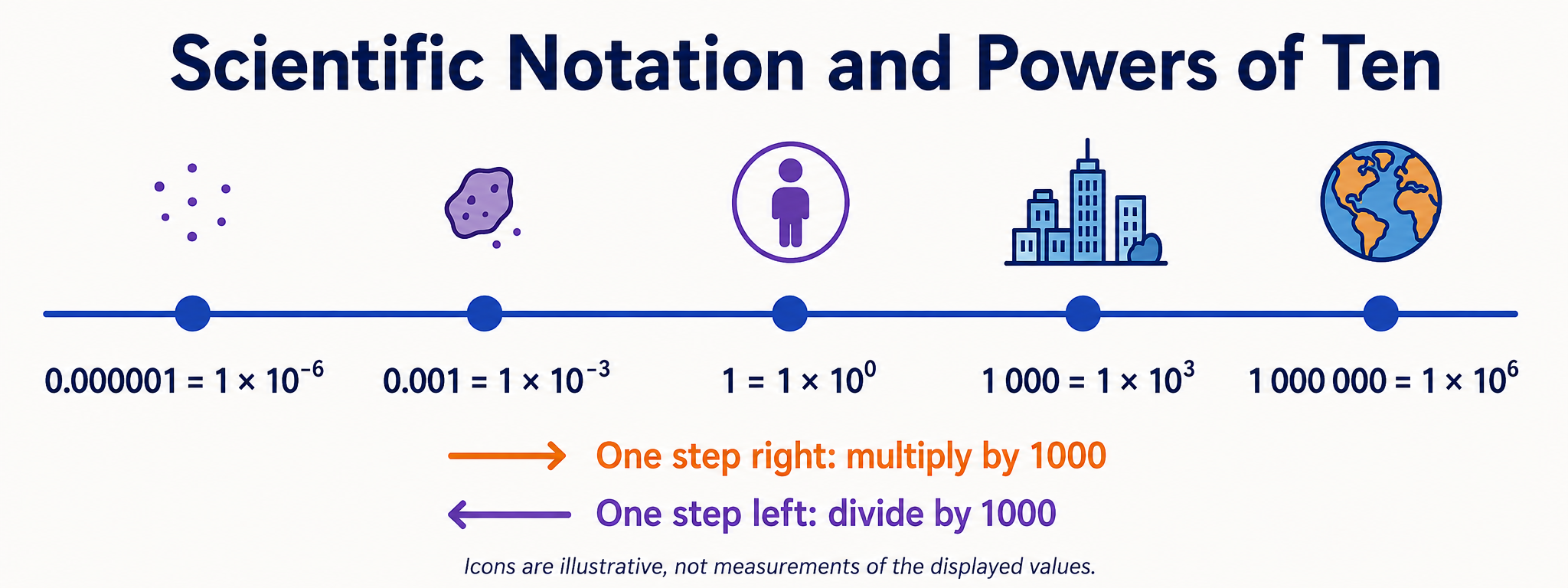 Each one-place move changes the value by a factor of 10. Scientific notation records the significant digits in the coefficient and the overall scale in the exponent.
Key terms
- Scientific notation
- A representation with and integer .
- Coefficient
- The number , which contains the significant digits.
- Exponent
- The integer , which records the power-of-ten scale.
- Normalized form
- A form with exactly one non-zero digit before the decimal point in the coefficient.
Worked examples
Identify normalized form
Which of , and is normalized?
- 1Check the coefficient against .
- 2The coefficients and do not satisfy the condition.
- 3The coefficient does satisfy it.
Answer: Only is normalized, although all three expressions have the same value.
Rules and formulas
Normalized scientific notation
- the original non-zero quantity
- the normalized coefficient
- the integer exponent
Powers of ten and place value
A positive exponent counts multiplication by 10: . A negative exponent counts division by 10: . The special value leaves a coefficient unchanged.
Increasing an exponent by 1 multiplies the value by 10, while decreasing it by 1 divides the value by 10. This relationship is the safest way to reason about decimal movement instead of memorizing an arrow rule without meaning.
The laws of indices remain valid: , , and .
Key terms
- Positive exponent
- A power that makes 10 larger than or equal to 10.
- Negative exponent
- A reciprocal power of ten, producing a value between 0 and 1.
- Factor of ten
- A multiplicative change from one place-value step to the next.
Worked examples
Move between powers of ten
Complete .
- 1Multiplying the coefficient by 10 must be balanced by reducing the exponent by 1.
- 2Dividing the coefficient by 10 must be balanced by increasing the exponent by 1.
Answer: .
Rules and formulas
Product of powers of ten
Quotient of powers of ten
Power of a power
Converting large numbers to scientific notation
Place the decimal point after the first non-zero digit. Count how many places the decimal point moved from its original position. For a number greater than or equal to 10, the exponent is positive.
Keep every digit justified by the original value or stated precision. For example, . Writing would claim extra precision unless those trailing zeros were known to be significant.
Worked examples
Convert a large population
Write in scientific notation.
- 1Place the decimal after the first non-zero digit: .
- 2The decimal point moves 9 places left.
- 3A large number needs a positive exponent.
Answer: .
Normalize a non-standard expression
Normalize .
- 1Rewrite as .
- 2Combine .
Answer: .
Converting small numbers to scientific notation
For a positive value between 0 and 1, place the decimal after the first non-zero digit. Count the places moved to the right; the exponent is the negative of that count.
Leading zeros locate the decimal point but are not significant figures. In , the digits , and the final are significant, so the value is .
Key terms
- Leading zeros
- Zeros before the first non-zero digit; they are place holders, not significant figures.
Worked examples
Convert a microscopic length
Write in scientific notation.
- 1The coefficient is .
- 2The decimal point moves 7 places right.
- 3Because the original value is between 0 and 1, use a negative exponent.
Answer: .
Converting scientific notation to ordinary form
Multiplying by shifts place value. If , the value grows; if , the value shrinks. Insert zeros when no digit occupies a required place.
A reliable check is to ask whether the ordinary number has the expected scale. For instance, must be positive and smaller than 1.
Worked examples
Return to ordinary notation
Write and in ordinary form.
- 1For , move the place value 6 positions right.
- 2For , move the place value 4 positions left.
Answer: and .
Comparing quantities and interpreting scale
For positive normalized quantities, compare exponents first. A larger exponent gives a larger number. If the exponents match, compare coefficients.
A ratio answers how many times as large one quantity is. If and , then , so is 3000 times as large as .
An order of magnitude describes power-of-ten scale. In an exam, state the comparison the question requests rather than treating exponent difference and exact ratio as interchangeable.
Key terms
- Order of magnitude
- A power of ten used to describe approximate scale.
- Relative size
- A multiplicative comparison found using a ratio.
Worked examples
Compare two measurements
A file contains bytes and another contains bytes. How many times larger is the first?
- 1Form the ratio .
- 2Divide coefficients: .
- 3Subtract exponents: .
- 4Normalize .
Answer: The first file is 30 times larger.
Rules and formulas
Relative-size ratio
Multiplication and division in scientific notation
For multiplication, multiply coefficients and add exponents. For division, divide coefficients and subtract exponents. Normalize only after completing the operation.
Keep units with the calculation. Multiplying lengths can create square or cubic units; dividing distance by time creates a rate.
Worked examples
Multiply and normalize
Evaluate .
- 1Multiply coefficients: .
- 2Add exponents: .
- 3Obtain , then normalize.
Answer: .
Divide and normalize
Evaluate .
- 1Divide coefficients: .
- 2Subtract exponents: .
Answer: .
Rules and formulas
Multiplication rule
Division rule
Addition and subtraction in scientific notation
Coefficients may be added or subtracted only after the powers of ten match. Rewrite one term using the other exponent, combine coefficients, and normalize the result.
This is the scientific-notation version of aligning place values in ordinary addition. The invalid shortcut should never be used.
Key terms
- Common exponent
- The same power of ten used for every term before coefficients are combined.
Worked examples
Add quantities of different scales
Evaluate .
- 1Rewrite .
- 2Add coefficients: .
- 3The coefficient is already normalized.
Answer: .
Subtract and renormalize
Evaluate .
- 1Rewrite .
- 2Subtract coefficients: .
Answer: .
Rules and formulas
Addition with common exponent
Raising scientific notation to a power
Apply the exponent to both the coefficient and the power of ten. Then normalize and attach any powered unit.
For example, squaring a length in metres produces square metres: .
Worked examples
Square a scientific-notation value
Evaluate .
- 1Square the coefficient: .
- 2Multiply the exponent by 2: .
- 3Normalize .
Answer: .
Rules and formulas
Power rule
Significant figures
Significant figures communicate measurement precision. Start counting at the first non-zero digit. Zeros between non-zero digits are significant; leading zeros are not. A trailing zero after a decimal point is significant because it records measured precision.
Scientific notation makes intended precision clear. The quantities , , and have two, three and four significant figures respectively, even though their displayed central values are equal.
Exact counts and defined conversions are not measured approximations. For example, 60 seconds in a minute is exact and should not force a calculated result to one significant figure.
Key terms
- Significant figure
- A digit that communicates the precision of a measured or rounded quantity.
- Trailing zero
- A zero after the last non-zero digit; its significance depends on how the number is written.
- Exact value
- A counted or defined value that does not limit numerical precision.
Worked examples
Round in scientific notation
Write in scientific notation correct to 3 significant figures.
- 1First write .
- 2The first three significant digits are ; the next digit is .
- 3Round up to .
Answer: .
Rounding, guard digits and answer accuracy
Carry full calculator precision through intermediate steps and round only the final answer unless a question explicitly instructs otherwise. Retained extra digits are called guard digits and reduce accumulated rounding error.
If a question specifies a number of significant figures, obey it. If no accuracy is stated, give an appropriate level of precision for the data and context, commonly three significant figures for a non-exact decimal result.
Always check whether rounding changes the normalized coefficient. For example, rounding 9.996 to 3 significant figures gives 10.0, which must be renormalized to a coefficient below 10.
Key terms
- Guard digits
- Extra unrounded digits retained during intermediate calculations.
- Premature rounding
- Rounding an intermediate value so early that it changes the final result.
Worked examples
Round and renormalize
Round to 3 significant figures.
- 1The fourth significant digit is , so rounds upward.
- 2This gives .
- 3Normalize the coefficient and preserve three significant figures.
Answer: .
Calculator and GDC methods
Most calculators use an , , or key. To enter , type , press that key, then enter . Do not type an extra multiplication sign and another 10 unless your model requires it.
A display such as means . The display is convenient input or output notation, but it must be rewritten conventionally in your solution.
Use parentheses around compound numerators and denominators. Check the calculator mode if results appear automatically in scientific notation or ordinary notation; display mode changes appearance, not value.
Key terms
- E-notation
- Calculator notation in which represents .
- Scientific display mode
- A calculator setting that displays results with a chosen number of digits and a power of ten.
Worked examples
Translate a GDC result
A GDC shows . Write the result to 4 significant figures in mathematical notation.
- 1Read the display as .
- 2The first four significant digits are ; the next digit is .
- 3Round the fourth digit upward.
Answer: .
Rules and formulas
Calculator translation
Units and power-of-ten conversions
Metric prefixes are powers of ten. For example, , , , and .
Write a conversion factor equal to 1 so unwanted units cancel. This prevents an exponent from being reversed accidentally.
For area or volume, the conversion factor must also be squared or cubed. Since , it follows that , not .
Key terms
- Metric prefix
- A prefix such as kilo-, milli-, micro- or nano- representing a power of ten.
- Dimensional check
- A check that units cancel or combine consistently throughout a calculation.
Worked examples
Convert nanometres to metres
A wavelength is . Express it in metres in scientific notation.
- 1Use .
- 2Calculate .
- 3Normalize the coefficient.
Answer: .
Rules and formulas
Common metric prefixes
Real-world applications
Scientific notation appears in astronomy, microscopic measurement, chemistry, environmental science, computing, medicine, population data and finance. The method is the same, but interpretation depends on the units and the meaning of the variables.
In applications, start with a formula or relationship, substitute values with units, calculate using full precision, then state a contextual conclusion. A result of means little until it is identified as bytes, dollars, cells or kilometres.
AI HL questions often test judgement as well as arithmetic: is the result physically possible, does it have the right order of magnitude, and is the chosen precision meaningful?
Key terms
- Model
- A mathematical representation connecting quantities in a real situation.
- Reasonableness check
- A check of sign, scale, units and context before accepting a result.
Worked examples
Estimate data-transfer time
A file contains bytes and transfers at bytes per second. Find the transfer time.
- 1Use .
- 2Calculate .
- 3Divide coefficients and subtract exponents: .
- 4Convert if useful: .
Answer: The transfer takes , or 5 minutes.
Find a total mass
One particle has mass . Find the mass of particles.
- 1Multiply number of particles by mass per particle.
- 2.
- 3Normalize and retain the precision supported by the data.
Answer: The total mass is to 2 significant figures.
Multi-step modelling and validation
For a multi-step problem, identify the required quantity, list the data with units, choose relationships, perform the calculation without premature rounding, and validate the result. This structure makes long AI HL questions manageable.
Estimate the exponent before using a GDC. If values near a billion are divided by values near a million, the result should be near a thousand. An output near a trillion signals an input or exponent error.
Domain constraints can matter. Counts must be whole and non-negative; time and physical lengths are usually non-negative; a rounded estimate should not claim more precision than the inputs.
Key terms
- Constraint
- A condition the answer must satisfy because of mathematics or context.
- Validation
- Checking a model output against units, scale, assumptions and practical meaning.
Worked examples
A storage-capacity model
A sensor records bytes each minute. It runs for minutes. A storage card has capacity bytes. Determine whether the data fit and find the unused capacity.
- 1Total data bytes.
- 2Compare , so the data fit.
- 3Align exponents for the remainder: .
- 4Unused capacity bytes.
Answer: Yes. The data fit, leaving bytes unused.
IB AI HL problem-solving and exam strategy
Write down the relationship before substitution. This shows mathematical communication and makes units and exponent operations easier to audit.
Use the GDC efficiently, but convert any -display into . Normalize, attach units and round only at the end to the requested accuracy.
For compare, interpret or comment questions, include a sentence in context. For “show that” questions, show the transformation or calculation that reaches the stated result rather than quoting it.
If a final coefficient is outside the normalized interval, adjust the exponent. Then perform four checks: sign, coefficient, exponent and units.
Worked examples
A complete exam response
The distance is travelled at . Find the time to 3 significant figures.
- 1Use .
- 2.
- 3A GDC gives .
- 4Round only now and state the result with units.
Answer: to 3 significant figures.
Common mistakes and how to avoid them
The most common errors are leaving an unnormalized coefficient, giving the wrong sign to a small-number exponent, adding unequal powers directly, subtracting exponents in the wrong order, and copying -notation into the final response.
Other frequent errors are rounding too early, counting leading zeros as significant, forgetting that a squared unit squares its conversion factor, and omitting units or contextual interpretation.
Repair a suspicious answer by returning to place value or by estimating with one-digit coefficients. A calculation involving only positive quantities cannot produce a negative result, and multiplication by a very small positive number should usually reduce scale.
Worked examples
Diagnose an incorrect sum
A student writes . Explain and correct the error.
- 1The exponent laws for multiplication do not apply to addition.
- 2Rewrite .
- 3Add .
Answer: The correct sum is .
Practice questions with worked solutions
Attempt each question before revealing the steps. The set progresses from notation and operations to AI HL application and validation.
Unless another accuracy is stated, keep exact values or give a sensible final accuracy supported by the data.
Worked examples
Practice 1 · Normalized notation
Normalize .
- 1Rewrite .
- 2Combine .
Answer: .
Practice 2 · Large number
Write in scientific notation.
- 1The coefficient is .
- 2The decimal point moves 11 places left.
Answer: .
Practice 3 · Small number
Write in scientific notation.
- 1The coefficient is .
- 2The decimal moves 8 places right, so the exponent is negative.
Answer: .
Practice 4 · Ordinary form
Write in ordinary notation.
- 1A negative exponent makes the value smaller than 1.
- 2Move place value 5 positions left and insert zeros.
Answer: .
Practice 5 · Product
Evaluate .
- 1.
- 2.
- 3Normalize .
Answer: .
Practice 6 · Quotient
Evaluate .
- 1.
- 2.
Answer: .
Practice 7 · Addition
Evaluate .
- 1Rewrite .
- 2Add .
Answer: .
Practice 8 · Power
Evaluate .
- 1Cube the coefficient: .
- 2Multiply exponents: .
Answer: .
Practice 9 · Significant figures
Write in scientific notation correct to 3 significant figures.
- 1Write .
- 2Round to .
- 3Renormalize while keeping three significant figures.
Answer: .
Practice 10 · Calculator notation
A GDC displays . Write the value to 4 significant figures in correct mathematical notation.
- 1Translate to .
- 2The fifth significant digit is 1, so the fourth digit does not increase.
Answer: .
Practice 11 · Unit conversion
A bacterium is long. Express this length in metres.
- 1Use .
- 2Multiply by .
Answer: .
Practice 12 · AI HL modelling challenge
A research instrument produces bytes each second for seconds. Data are compressed to of the original size. Find the compressed size in bytes and state whether it fits on a -byte drive.
- 1Original size bytes.
- 2Compressed size bytes.
- 3Compare .
- 4Unused capacity bytes.
Answer: The compressed data occupy bytes, so they fit, with bytes unused.
Topic summary and cheat sheet
Use this checklist for quick revision. A strong answer combines correct calculation with correct notation, accuracy, units and interpretation.
Rules and formulas
Normalized form
Product
Quotient
Power
Common-exponent sum
Topic summary
- Scientific notation has the normalized form .
- For non-zero values, and .
- The coefficient contains the significant digits; the exponent records scale.
- , so a zero exponent leaves the coefficient unchanged.
- Positive powers of ten increase scale; negative powers decrease it.
- For a large ordinary number, the normalized exponent is positive.
- For a positive ordinary number between 0 and 1, the normalized exponent is negative.
- To return to ordinary form, use the exponent to reconstruct place value and insert zeros if required.
- For positive normalized values, compare exponents before coefficients.
- A ratio gives an exact multiplicative comparison between quantities.
- For multiplication, multiply coefficients and add exponents.
- For division, divide coefficients and subtract denominator exponent from numerator exponent.
- For addition or subtraction, first create a common exponent.
- After every operation, normalize the final coefficient.
- When raising scientific notation to a power, power both the coefficient and the power of ten.
- Leading zeros are not significant figures.
- Zeros between non-zero digits are significant.
- A trailing zero after a decimal point records significant precision.
- Scientific notation makes intended significant figures explicit.
- Keep guard digits and round only the final answer.
- If rounding produces a coefficient of 10, renormalize.
- Calculator means .
- Do not submit calculator E-notation as the final mathematical form.
- Use parentheses for complete numerators and denominators on a GDC.
- Metric prefixes such as kilo-, milli-, micro- and nano- are powers of ten.
- Square or cube a unit-conversion factor when converting area or volume.
- Carry units through every applied calculation.
- Estimate the expected exponent before accepting a calculator result.
- Check the sign, normalized coefficient, exponent, units and requested precision.
- Finish an application with a contextual sentence that answers the question.