Sequences and series: the essential distinction
A sequence is an ordered list of values called terms. We write , where is the value at position . The position is part of the information: the same values in another order form a different sequence.
A series is a sum of sequence terms. For example, is a sequence, while is a finite series. The notation means the sum of the first terms.
In modelling, a term often represents one period or location—such as sales in week 12 or seats in row 20—whereas a series represents an accumulated total over several periods or locations.
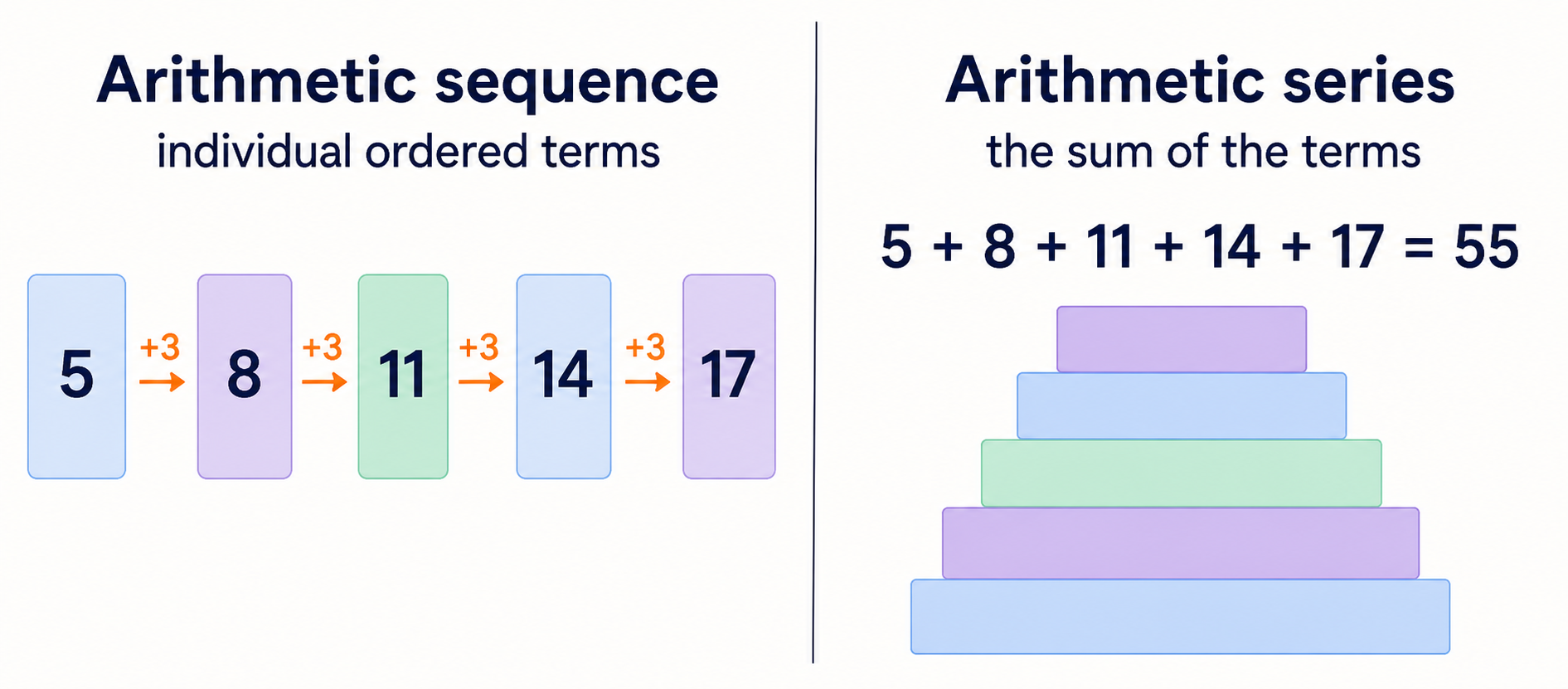 A sequence lists individual ordered terms. A series adds those terms. The common difference belongs to the sequence; the sum belongs to the series.
Key terms
- Sequence
- An ordered list .
- Term
- One value in a sequence; is the term at position .
- Series
- The result or expression obtained by adding sequence terms.
- Partial sum
- The sum of the first terms.
Worked examples
Term or total?
A theatre has 18 rows. A question asks for the seats in row 18, then the total seats in all 18 rows. Which mathematical objects are needed?
- 1Seats in row 18 require one term, .
- 2Total seats in rows 1 through 18 require a series sum, .
Answer: Use for the last row and for the accumulated total.
Rules and formulas
First n terms as a series
Arithmetic sequences and the common difference
An arithmetic sequence changes by the same additive amount at every step. This fixed amount is the common difference , found using later term minus earlier term: .
If , the sequence increases. If , it decreases. If , it is constant. Arithmetic change is additive; multiplying by the same factor instead produces a geometric pattern.
Check every consecutive difference supplied. One matching pair is not sufficient evidence that an entire data set is arithmetic.
Key terms
- Arithmetic sequence
- A sequence with a constant difference between consecutive terms.
- First term
- The initial value, usually written or .
- Common difference
- The constant additive change .
Worked examples
Test a decreasing sequence
Determine whether is arithmetic and state and .
- 1Calculate , , , and .
- 2Every difference is identical.
- 3The first listed term is .
Answer: It is arithmetic with and .
Rules and formulas
Common difference
- constant difference between consecutive terms
Generating terms with recurrence notation
A recurrence relation defines each new term using the previous term. For an arithmetic sequence, state the starting value and the repeated change: , .
Recurrence notation describes a step-by-step process and works naturally in spreadsheets or programs. It is convenient for generating consecutive terms but inefficient for a distant term such as the 500th.
A recurrence rule is incomplete without an initial value. The rule describes infinitely many possible sequences until is specified.
Key terms
- Recurrence relation
- A rule that defines a term from one or more earlier terms.
- Initial value
- The starting term required to begin a recursive sequence.
Worked examples
Generate from a recurrence
Given and , write the first five terms.
- 1Start with .
- 2Subtract repeatedly: , , , .
Answer: .
Rules and formulas
Arithmetic recurrence
Finding the nth term
To reach term from term 1, there are equal steps. Therefore the explicit formula is . This finds any term directly without generating all earlier terms.
Expanding gives , which is linear in . The gradient is , but the vertical intercept at is , not usually the first term.
In an application, define what term 1 represents. If a data table starts at year 0, the indexing must match the formula rather than being silently shifted.
Key terms
- Explicit formula
- A rule that calculates directly from .
- Term number
- The integer position .
Worked examples
Find a distant term
For , find .
- 1Identify and .
- 2Substitute into .
- 3.
Answer: .
Write a formula first
Find an expression for the nth term of .
- 1 and .
- 2.
- 3Simplify only if useful.
Answer: .
Rules and formulas
Arithmetic nth term
- first term
- common difference
- positive integer term number
Linear form
Tables and graphs of arithmetic sequences
Plot term number horizontally and term value vertically. Arithmetic-sequence points lie on a straight line because equal increases in produce equal changes in .
Only positive integer term numbers normally belong to the sequence. A GDC may draw a continuous line between points, but values at non-integer positions may have no meaning in the model.
From a regression line , the approximate common difference is . If indexing begins at , the estimated first term is .
Key terms
- Discrete graph
- A graph of separate points because term numbers are integers.
- Gradient
- The change in term value per one-position increase; for an arithmetic sequence it equals the common difference.
Worked examples
Interpret a sequence graph
A fitted line for weekly output is . Identify and the modelled first term.
- 1The coefficient of is the gradient, so .
- 2At , .
Answer: The common difference is 12 units per week and the first term is 98 units.
Finding an unknown term number
When a term value is known but its position is not, set equal to the given value and solve for .
Then validate the solution. A term number must be a positive integer. If the algebra produces a non-integer, the target value is not an exact term of that arithmetic sequence.
For threshold language such as “first exceeds,” solve an inequality and select the first integer satisfying the condition.
Key terms
- Integer constraint
- The requirement that a term number belongs to .
- Threshold
- A boundary a model value must reach, exceed or remain below.
Worked examples
Find the position of a term
In , which term is ?
- 1, , so .
- 2Solve .
- 3, so and .
Answer: is the 23rd term.
Show that a value is not a term
Does occur in ?
- 1Solve .
- 2This gives .
- 3A term number cannot be fractional.
Answer: No. is not a term of the sequence.
Finding unknown terms, first term or common difference
If two non-consecutive terms and are known, there are equal steps between them. Therefore . Substitute back to find .
Alternatively, write two equations using the nth-term formula and solve simultaneously. This method generalizes well when parameters or contextual information are involved.
Once and are found, verify both given terms. One successful substitution is not enough to detect every sign or indexing error.
Worked examples
Use two known terms
An arithmetic sequence has and . Find and .
- 1There are steps, and the total change is .
- 2.
- 3Use : .
- 4Hence .
Answer: and .
Rules and formulas
Difference from two terms
Arithmetic series and finite sums
An arithmetic series adds consecutive terms of an arithmetic sequence. The sum of the first terms is . Unlike an infinite geometric series, a non-constant arithmetic series does not approach a finite total as increases indefinitely, so AI HL uses finite sums here.
If the first and last terms are known, the average term is . Multiplying this average by the number of terms gives .
Replacing by gives the equivalent formula . Choose the form that uses the information provided most directly.
Key terms
- Finite arithmetic series
- The sum of a fixed number of consecutive terms from an arithmetic sequence.
- Last term
- The final included term in .
Worked examples
Sum using first and last terms
Find the sum .
- 1Here , , and .
- 2Find : , so .
- 3Use .
- 4.
Answer: .
Rules and formulas
Sum using first and last terms
Sum using first term and difference
Why the arithmetic-series formula works
Write the same sum forwards and backwards: and .
Adding corresponding positions gives every time. There are such pairs, so , and therefore .
This pairing explanation prevents formula memorization from becoming disconnected from meaning: an arithmetic-series total equals number of terms multiplied by average of first and last terms.
Key terms
- Pairing argument
- A derivation that pairs first with last, second with second-last, and so on.
Worked examples
Check by averaging
Explain quickly why .
- 1There are terms.
- 2Their average is .
- 3Total .
Answer: The sum is .
Rules and formulas
Number times average term
Finding the number of terms from a sum
If is known, substitute into a sum formula. Because appears both outside and inside the bracket, the resulting equation is often quadratic.
Solve algebraically or with a GDC, then apply the domain: the number of terms must be a positive integer. Reject negative, zero or non-integer solutions unless the context uses an inequality and asks for a threshold.
Substitute the accepted integer back into the sum formula to verify the total.
Worked examples
Solve a sum condition
For an arithmetic sequence with and , find if .
- 1.
- 2Simplify to .
- 3Factor or use a GDC to obtain or a negative root.
- 4Reject the negative root and verify the sum.
Answer: .
Sigma notation for arithmetic sums
The Greek capital letter sigma, , means “add.” In , the index takes the integer values , generating and adding the first arithmetic terms.
The lower limit gives the first index, the upper limit gives the last index, and the expression tells what to add. The number of included integers from lower limit p to upper limit q is q minus p plus 1.
The index letter is a dummy variable: and have the same meaning if the expression changes consistently.
Key terms
- Sigma notation
- Compact notation for a finite or infinite sum.
- Index
- The variable that takes successive integer values in a sigma expression.
- Limits
- The first and last index values shown below and above sigma.
Worked examples
Evaluate an arithmetic sigma sum
Evaluate .
- 1The generated sequence has , , and .
- 2.
- 3.
Answer: The sum is .
Count terms with a shifted lower limit
How many terms are included in ?
- 1Use .
Answer: There are 12 terms.
Rules and formulas
Arithmetic sum in sigma notation
Number of indexed terms
- lower integer limit
- upper integer limit
Application: simple interest
Under simple interest, the same interest amount is added each period, where is principal and is the interest rate per period as a decimal. The balances therefore form an arithmetic sequence.
After periods, . If balances are listed at the end of years 1, 2, 3, and so on, the first listed balance is and the common difference is .
Do not confuse simple interest with compound interest. Compound interest multiplies by the same factor each period and is modelled geometrically.
Key terms
- Principal
- The initial amount invested or borrowed.
- Simple interest
- Interest calculated on the original principal only.
- Rate per period
- The percentage rate converted to a decimal and matched to the time period.
Worked examples
Model simple-interest balances
An investment of earns simple interest per year. Find the balance after 6 years and identify the yearly common difference.
- 1Convert .
- 2Yearly interest .
- 3.
Answer: The balance is , and the yearly common difference is .
Rules and formulas
Simple-interest amount
- principal
- rate per period as a decimal
- number of periods
Simple interest earned
Applications with constant additive change
Arithmetic models apply when an amount changes by a fixed number each step: seats per row, regular weekly savings, straight-line depreciation, production quotas, fitness targets or a fixed annual increase.
Define the first term and what one step means. Decide whether the question asks for one period, a cumulative total, a threshold or an unknown parameter.
A negative common difference can model depletion or depreciation, but the model must stop before it predicts impossible values such as negative stock or negative length.
Key terms
- Additive model
- A model in which the same amount is added or subtracted each step.
- Model domain
- The term numbers for which the model is meaningful.
Worked examples
Seats in a theatre
A theatre has 24 seats in the first row and 3 more seats in each later row. Find the seats in row 18 and the total in the first 18 rows.
- 1, , .
- 2.
- 3.
Answer: Row 18 has 75 seats, and the first 18 rows contain 891 seats.
Check a decreasing model
A tank contains 850 L and loses 45 L each hour. For how many complete hours does the arithmetic model predict a non-negative amount?
- 1At hour after the start, use .
- 2Solve , giving .
- 3Choose complete integer hours within the domain.
Answer: The model remains non-negative for 18 complete hours after the start.
When real data are only approximately arithmetic
Real measurements rarely have perfectly equal differences. If consecutive changes are close and show no strong curvature, an arithmetic model may still be useful as an approximation.
A simple estimated difference over equally spaced data is . Using widely separated endpoints averages short-term fluctuations, although a linear regression uses all data and is usually stronger when technology is available.
For a fitted model , calculate residuals . Small residuals with no systematic pattern support the model; a curved residual pattern suggests that constant additive change is unsuitable.
Predictions within the observed interval are generally safer than extrapolation far beyond it. Always mention relevant practical limits or changing conditions.
Key terms
- Approximate common difference
- A representative additive change used when observed differences are similar but not identical.
- Residual
- Observed value minus model-predicted value.
- Extrapolation
- Using a model outside the range of observed data.
Worked examples
Model imperfect data
Weekly counts are . Estimate from the endpoints and predict week 10.
- 1Differences are , so the data are close to arithmetic.
- 2.
- 3Use .
- 4.
Answer: The model predicts about 197 in week 10. This is an extrapolation, so the result should be treated cautiously.
Rules and formulas
Approximate difference from two positions
Residual
Calculator, GDC and spreadsheet methods
A sequence table can generate many terms quickly. Enter the term number in one column and the explicit formula in another, or enter the first term and fill the next cells using previous term plus the fixed difference.
A graph of term number against term value should show equally spaced points on a straight line. Use a linear regression for approximately arithmetic data, then interpret its gradient and intercept using the chosen indexing.
A GDC summation command can check a finite sum, and an equation solver can find n from a term or total. However, record the defining formula and apply integer and contextual constraints yourself.
Calculator menus vary, so practise sequence, table, list, sum and regression features on the model allowed in your examinations.
Key terms
- Sequence table
- A technology-generated list pairing term numbers with term values.
- Linear regression
- A technology method fitting a straight-line model to paired data.
Worked examples
Use a GDC model responsibly
A regression gives . Interpret the estimated common difference and first term.
- 1The gradient gives units per term.
- 2Because the first term is at , .
Answer: The model increases by about 13.2 units per step and predicts a first term of about 204.8.
An AI HL modelling workflow
First identify the unit of one step and the meaning of term 1. Next decide whether constant additive change is exact or approximate. Then define a, d and n with units.
Choose for one term and for an accumulated total. Use technology where efficient, but retain unrounded values until the final step.
Finally validate the result: term numbers and counts should be integers, units must match, and the model must stay within practical bounds. Conclude in a sentence that answers the application.
Key terms
- Validation
- Checking mathematical output against the model domain, units and real situation.
Worked examples
Choose term, sum and constraint
A workshop produces 140 units in week 1 and 12 more each week. It can produce at most 260 units in one week. What quantities would you calculate to find total production before the limit is exceeded?
- 1Solve for the last valid integer week.
- 2Then use to total production through that week.
- 3Interpret the next term to confirm it exceeds the limit.
Answer: The last valid week is found from an nth-term inequality; the cumulative production is then .
Common mistakes and IB AI HL exam strategy
Frequent errors include using instead of , reversing the sign of , confusing with , and counting terms incorrectly when sigma limits do not begin at 1.
Context errors include treating simple interest as compound, rounding a non-integer exact term number, accepting a negative quadratic root, omitting units, or extrapolating an approximate model without comment.
For full communication, state the formula, substitute values, use technology transparently, retain precision, apply constraints and finish with a contextual sentence.
Worked examples
Correct an indexing error
A student models the 10th term of as . Correct the method.
- 1There are only changes after the first term.
- 2Use .
Answer: .
Practice questions with worked solutions
Attempt each question before reading the steps. The progression moves from pattern recognition to exact models, sigma notation, technology interpretation and imperfect real data.
Show formulas and working even when using a GDC. Give money to a sensible currency precision and round approximate model outputs appropriately.
Worked examples
Practice 1 · Identify the arithmetic pattern
For , state and .
- 1The first term is .
- 2Each consecutive difference is .
Answer: , .
Practice 2 · Recurrence relation
Write a recurrence relation for .
- 1The starting term is .
- 2The common difference is .
Answer: , .
Practice 3 · Find a distant term
Find for and .
- 1.
- 2.
Answer: .
Practice 4 · Find the term number
Which term of is ?
- 1Solve .
- 2This gives .
Answer: is the 23rd term.
Practice 5 · Find a and d
Given and , find and .
- 1.
- 2, so .
Answer: , .
Practice 6 · Finite series
Find the sum of the first 30 terms when and .
- 1.
- 2.
Answer: .
Practice 7 · Find n from a sum
For and , find if .
- 1Set .
- 2Solve .
- 3The positive integer root is 12.
Answer: .
Practice 8 · Sigma notation
Evaluate .
- 1The sequence has , , and .
- 2.
- 3.
Answer: The sum is .
Practice 9 · Simple interest
earns simple interest per year. Find the balance after 5 years.
- 1Use .
- 2.
Answer: The balance is .
Practice 10 · Rows of seats
A hall has 28 seats in row 1 and 4 more in each later row. Find the seats in row 16 and the total seats in the first 16 rows.
- 1.
- 2.
Answer: Row 16 has 88 seats; the first 16 rows contain 928 seats.
Practice 11 · Approximate arithmetic data
Weekly subscriptions are . Estimate an arithmetic model using the endpoints and predict week 9.
- 1.
- 2Use .
- 3.
Answer: The model predicts about 309 subscriptions in week 9; this is an extrapolation.
Practice 12 · AI HL capacity challenge
Daily bookings start at and increase by per day. A system can process at most bookings in one day. Find the first day the model exceeds capacity, the total bookings over all earlier valid days, and the revenue if each booking earns .
- 1Solve . The first integer solution is .
- 2Day 17 has , so days 1 through 17 are valid.
- 3.
- 4Revenue .
Answer: Capacity is first exceeded on day 18. The valid 17 days contain bookings and generate .
Topic summary and cheat sheet
Use this checklist to choose efficiently between a term formula, a sum formula, sigma notation and a technology-supported approximate model.
Rules and formulas
Common difference
Nth term
Sum from first and last terms
Sum from first term and difference
Sigma form
Topic summary
- A sequence is an ordered list; a series is a sum of terms.
- is one term, while is the sum of the first terms.
- An arithmetic sequence has constant additive change.
- The common difference is .
- Positive d increases, negative d decreases, and zero d is constant.
- A recurrence requires both and .
- The explicit formula is .
- There are changes between and .
- A term number must normally be a positive integer.
- From and , use .
- Arithmetic-sequence points form a discrete straight-line pattern.
- In , the gradient is .
- Use when the last term is known.
- Use when and are known.
- An arithmetic-series sum is number of terms times average of first and last terms.
- Finding n from a sum often produces a quadratic equation.
- Reject roots that violate positive-integer or contextual constraints.
- Sigma notation states an index, lower limit, upper limit and term expression.
- From integer p through q inclusive, there are q minus p plus 1 terms.
- Simple interest adds the same amount each period and is arithmetic.
- For simple interest, and yearly change is .
- Define clearly whether indexing starts at time 0 or term 1.
- Use an nth term for one period and a series for an accumulated total.
- Real data can be approximately arithmetic even when differences are not identical.
- An endpoint estimate averages change over several equal intervals.
- Linear regression uses all paired data and estimates the common difference from its gradient.
- Residuals help evaluate whether constant additive change is appropriate.
- Extrapolations are less reliable than predictions within observed data.
- A GDC can generate tables, sums and solutions but does not remove the need for interpretation.
- Always report units per step for a common difference in context.
- Check indexing, sign, formula choice, integer constraints and units.
- Finish an application with a contextual conclusion and model limitation where relevant.