Matrix meaning and notation
A matrix is a rectangular array of numbers or algebraic expressions arranged in rows and columns. Matrices organize data, represent linear rules and encode relationships compactly.
Capital letters such as , and usually name matrices. The element in row , column of is written . The first subscript always identifies the row.
A row matrix has one row, a column matrix has one column, and a square matrix has the same number of rows and columns. A column matrix is often used as a state vector or coordinate vector.
Brackets contain the entire array. Commas are normally omitted inside a matrix because position separates the elements.
Key terms
- Matrix
- A rectangular array of elements arranged in rows and columns.
- Element
- A single entry in a matrix, identified by its row and column.
- Row matrix
- A matrix with exactly one row.
- Column matrix
- A matrix with exactly one column.
Worked examples
Read an element
For , find and .
- 1Row 1, column 2 contains .
- 2Row 2, column 3 contains 0.
Answer: and .
Construct a matrix from a rule
Construct the matrix with .
- 1Evaluate the rule for and .
- 2Place each result in its specified position.
Answer: .
Represent contextual data
Rows represent two stores and columns represent sales of three products. Store 1 sold 12, 8 and 5 units; Store 2 sold 9, 11 and 7 units. Form the sales matrix.
- 1Keep the stated row and column meanings consistent.
Answer: .
Rules and formulas
General matrix notation
Example element
Matrix dimensions and equality
The dimensions, order or size of a matrix are written rows by columns. An matrix has rows and columns.
Two matrices are equal only when they have the same dimensions and every pair of corresponding elements is equal.
Equality of matrices can create several scalar equations. Equate corresponding positions, then solve those real equations.
Dimensions are the first compatibility check before any matrix operation. Write them beside the matrices before calculating.
Key terms
- Dimensions
- The number of rows followed by the number of columns.
- Square matrix
- A matrix of order n by n.
- Matrix equality
- Same dimensions and equal corresponding entries.
Worked examples
State matrix dimensions
State the dimensions of .
- 1Count three rows.
- 2Count two columns.
Answer: is a matrix.
Use matrix equality
If , find and .
- 1Equate the top-left entries: .
- 2Equate the top-right entries: .
Answer: and .
Detect impossible equality
Can a matrix equal a matrix?
- 1Compare their dimensions before comparing entries.
Answer: No. Equal matrices must have identical dimensions.
Rules and formulas
Dimensions
Matrix addition and subtraction
Matrices can be added or subtracted only when they have the same dimensions. Combine corresponding entries in the same positions.
Addition is commutative and associative: and , provided all matrices have compatible dimensions.
Subtraction is not commutative. Distribute the negative sign to every element of the second matrix.
In models, addition can combine data tables with identical row and column meanings; subtraction can measure change between two time periods.
Key terms
- Compatible for addition
- Matrices having exactly the same dimensions.
- Corresponding entries
- Entries occupying the same row and column positions.
Worked examples
Add two matrices
Calculate .
- 1Add entries position by position.
Answer: .
Subtract two data matrices
Find for and .
- 1Subtract every entry of from the matching entry of .
Answer: .
Reject incompatible addition
Explain why a matrix cannot be added to a matrix.
- 1The arrays do not have matching positions.
Answer: The addition is undefined because the dimensions differ.
Rules and formulas
Matrix addition
Matrix subtraction
Scalar multiplication and zero matrices
A scalar is an ordinary number. Multiplying a matrix by a scalar multiplies every element by that number without changing the dimensions.
The zero matrix has zero in every position. It is the additive identity because for matching dimensions.
Scalar multiplication distributes over matrix addition: .
In applications, scalar multiplication changes every entry by the same scale factor, such as converting costs from dollars to thousands of dollars.
Key terms
- Scalar
- A single number multiplying every matrix entry.
- Zero matrix
- A matrix whose entries are all zero.
- Additive identity
- An object that leaves another object unchanged under addition.
Worked examples
Multiply by a scalar
Calculate .
- 1Multiply all four entries by .
Answer: .
Combine scalar multiplication and addition
For and , find .
- 1Calculate .
- 2Subtract corresponding entries of .
Answer: .
Use a zero matrix
Find .
- 1Every zero remains zero after scalar multiplication.
Answer: .
Rules and formulas
Scalar multiplication
Additive identity
Matrix multiplication: row by column
The product exists when the number of columns of equals the number of rows of . If is and is , then is .
Each entry of the product is a row-column dot product. Multiply corresponding entries of a row of and a column of , then add the results.
Matrix multiplication is generally not commutative: may differ from , and one order may exist when the other does not.
Multiplication represents composition or aggregation. In a model, the units and meanings of the inner dimensions must match, not just their numerical sizes.
Key terms
- Conformable matrices
- Matrices whose inner dimensions match for multiplication.
- Row-column product
- The sum of products of matching entries from one row and one column.
- Non-commutative
- Changing the order can change the result or make a product undefined.
Worked examples
Multiply two 2 by 2 matrices
Calculate for and .
- 1First row by first column gives .
- 2Complete the remaining three row-column products.
Answer: .
Multiply a matrix by a column vector
Calculate .
- 1The product has dimensions .
- 2Use one dot product for each row.
Answer: .
Check product dimensions
If is and is , state the dimensions of and whether exists.
- 1For , the inner dimensions 4 match.
- 2For , the inner dimensions 2 and 3 do not match.
Answer: is ; is undefined.
Rules and formulas
Product dimensions
Product entry
Identity matrices and matrix powers
The identity matrix is the square matrix with ones on its main diagonal and zeros elsewhere. It leaves compatible matrices unchanged: .
For a square matrix, and means repeated matrix multiplication. It does not mean raising each element separately.
Matrix powers describe repeated transformations or repeated state transitions. Technology is especially useful for large exponents.
The zero power of an invertible square matrix is , matching ordinary exponent conventions.
Key terms
- Identity matrix
- A square matrix with 1 on the main diagonal and 0 elsewhere.
- Main diagonal
- Entries running from the top-left to the bottom-right of a square matrix.
- Matrix power
- Repeated multiplication of a square matrix by itself.
Worked examples
Use an identity matrix
Verify for .
- 1Multiply by .
Answer: The product is .
Calculate a matrix square
Find for .
- 1Calculate using row-column products.
Answer: .
Recognize a power pattern
Conjecture for .
- 1Compare , and .
- 2The upper-right entry increases by 1 each time.
Answer: for positive integers .
Rules and formulas
Identity matrix
Identity property
Matrix power
Determinants and singular matrices
The determinant is a scalar associated with a square matrix. For , the determinant is .
A square matrix is singular when its determinant is zero. A singular matrix has no inverse and collapses area or volume in its geometric interpretation.
For a two-dimensional transformation, is the area scale factor. A negative determinant also reverses orientation.
For larger matrices, use the approved GDC when permitted and report enough working to identify the matrix and operation.
Key terms
- Determinant
- A scalar measuring invertibility and signed scale change of a square matrix.
- Singular matrix
- A square matrix with determinant zero and no inverse.
- Non-singular matrix
- A square matrix with non-zero determinant.
Worked examples
Find a 2 by 2 determinant
Find the determinant of .
- 1Calculate .
Answer: .
Find a singular parameter
Find if is singular.
- 1Set the determinant equal to zero.
- 2Solve .
Answer: .
Interpret determinant as area scale
A linear transformation has matrix . By what factor are areas scaled?
- 1Calculate .
Answer: Areas are multiplied by 6.
Rules and formulas
Two-by-two determinant
Invertibility condition
Product determinant
Inverse matrices
The inverse reverses the effect of a non-singular square matrix: .
For a matrix, swap the diagonal entries, change the signs of the off-diagonal entries, and divide by the determinant.
The inverse exists only when the determinant is non-zero. Never divide by a zero determinant.
Order remains important with inverses: . The order reverses because the last transformation must be undone first.
Key terms
- Inverse matrix
- A matrix that produces the identity when multiplied on either side of its original matrix.
- Invertible
- Having a matrix inverse.
- Singular
- Not invertible because the determinant is zero.
Worked examples
Find a 2 by 2 inverse
Find the inverse of .
- 1The determinant is .
- 2Apply the two-by-two inverse formula.
Answer: .
Verify an inverse
Verify that is the inverse of .
- 1Calculate .
- 2Check that the result is .
Answer: , so .
Reject a singular inverse
Explain why has no inverse.
- 1Calculate .
Answer: is singular, so does not exist.
Rules and formulas
Two-by-two inverse
Inverse definition
Inverse of a product
Matrix equations and order-sensitive rearrangement
Matrix equations resemble algebraic equations, but multiplication order must be preserved. From , premultiply by to obtain .
From , postmultiply by to obtain . These answers are generally different.
An equation may also be solved elementwise by assigning unknown entries to and equating corresponding elements.
Always state the invertibility condition for any matrix whose inverse is used.
Key terms
- Premultiply
- Multiply both sides on the left by the same matrix.
- Postmultiply
- Multiply both sides on the right by the same matrix.
- Unknown matrix
- A matrix whose entries or full array must be determined.
Worked examples
Solve AX equals B
Solve where and .
- 1Calculate .
- 2Use .
Answer: .
Solve XA equals B
If , state the solution for invertible .
- 1Postmultiply both sides by .
Answer: .
Solve elementwise
Find and if .
- 1The product is .
- 2Equate corresponding entries.
Answer: and .
Rules and formulas
Left-sided unknown
Right-sided unknown
Solving systems of equations using matrices
A linear system can be written compactly as , where is the coefficient matrix, is the unknown column vector and is the constants vector.
If is square and invertible, the unique solution is . This is efficient for several right-hand sides with the same coefficient matrix.
If , the inverse method fails. The system may be inconsistent or dependent, so use row reduction, graphs or contextual reasoning to distinguish the cases.
In an application, interpret every component of the solution and reject values that violate physical constraints such as non-negativity.
Key terms
- Coefficient matrix
- The matrix containing the coefficients of the unknowns.
- Constants vector
- The column vector containing values on the right sides of the equations.
- Augmented matrix
- The coefficient matrix with the constants vector appended.
Worked examples
Solve a two-variable system
Solve and using matrices.
- 1Write .
- 2Multiply by the inverse of the coefficient matrix.
Answer: and .
Recognize a dependent system
Classify and .
- 1The coefficient determinant is zero.
- 2The second equation is exactly twice the first.
Answer: The system has infinitely many solutions.
Recognize an inconsistent system
Classify and .
- 1The coefficient determinant is zero.
- 2Doubling the first left side would require the constant 10, not 12.
Answer: The system has no solution.
Rules and formulas
Matrix form of a system
Unique inverse solution
Augmented matrix
Larger systems and row reduction
Three-variable systems use the same structure . On a GDC, inverse, solve or reduced-row-echelon-form commands can obtain the solution.
Row operations preserve the solution set: swap rows, multiply a row by a non-zero scalar, or add a multiple of one row to another.
In reduced row-echelon form, a row with signals inconsistency. A missing pivot with no contradiction signals at least one free variable and infinitely many solutions.
Technology output must be translated back into the original variables and context. A calculator matrix is not a complete written conclusion.
Key terms
- Row operation
- A reversible operation used to simplify an augmented matrix.
- Pivot
- A leading non-zero entry used to eliminate other entries in its column.
- Free variable
- A variable not fixed by a pivot, leading to a family of solutions.
Worked examples
Solve a three-variable system
Solve , , and .
- 1Enter the coefficient matrix and constants vector or row-reduce the augmented matrix.
- 2Read the three pivot values.
Answer: , , .
Interpret an inconsistent RREF
An augmented matrix reduces to a row . What does this mean?
- 1The row represents the false equation .
Answer: The system is inconsistent and has no solution.
Interpret a free variable
An augmented matrix has pivots in only the first two variable columns and no contradiction. Classify the system.
- 1One variable is free.
Answer: The consistent system has infinitely many solutions.
Rules and formulas
Elementary row replacement
Row scaling
Matrix transformations in two dimensions
A matrix transforms a coordinate vector by . The columns of are the images of the standard basis vectors and .
Common matrices represent stretches, reflections, rotations and shears. A horizontal shear maps to .
Composing transformations corresponds to matrix multiplication. With column vectors, means apply first and then .
The determinant describes area scaling. If the determinant is zero, a two-dimensional region collapses onto a line or point.
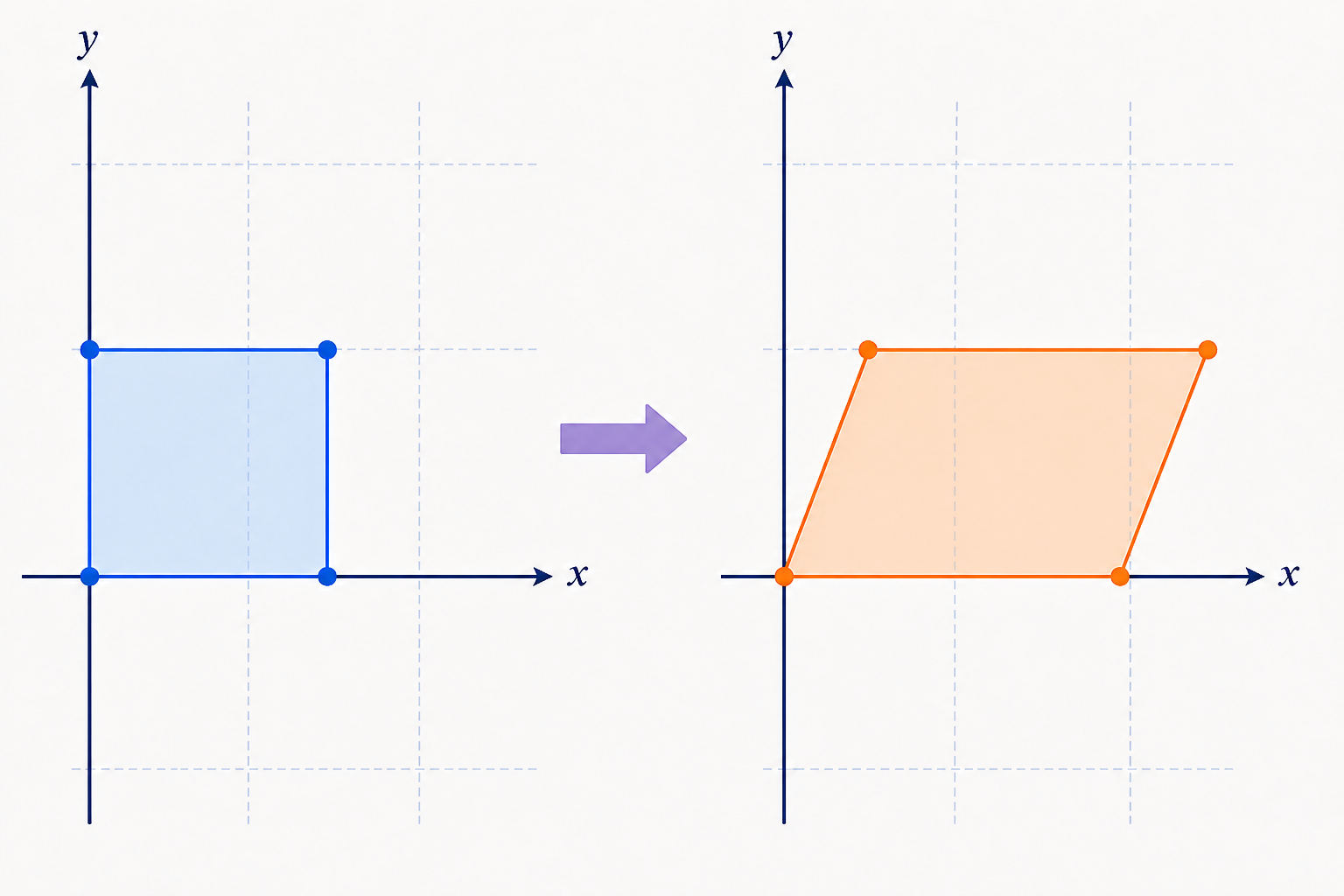 A horizontal shear , with , keeps horizontal levels fixed while shifting points to the right in proportion to their height.
Key terms
- Linear transformation
- A mapping represented by matrix multiplication that preserves vector addition and scalar multiplication.
- Shear
- A transformation that shifts one coordinate in proportion to another.
- Composition
- Applying transformations one after another.
Worked examples
Apply a shear
Apply to .
- 1Calculate .
Answer: .
Reflect in the y-axis
Find the image of under .
- 1Multiply .
Answer: The image is .
Compose two transformations
A reflection is followed by a rotation . Write the composite matrix.
- 1With column vectors, the first transformation is closest to the vector.
Answer: The composite matrix is , not .
Rules and formulas
Coordinate transformation
Horizontal shear
Composition order
Applications: matrix models and transition matrices
Matrices can turn repeated rules into a compact state model. With a column-state convention, , so .
For a transition matrix acting on probability or population columns, each column records where one current category moves next. Under this convention, non-negative transition proportions in each column sum to 1.
A steady state satisfies . It is unchanged by another transition. The total population or total probability supplies an additional equation when needed.
Matrices also model production resources, input-output relationships and weighted totals. Always check dimensions, units, non-negativity and whether the model assumptions remain reasonable over repeated steps.
Key terms
- State vector
- A column matrix describing the system at a particular step.
- Transition matrix
- A matrix that maps one state to the next.
- Steady state
- A state vector left unchanged by the transition matrix.
Worked examples
One transition step
Let and . Find .
- 1Calculate .
- 2Check that the total remains 1000.
Answer: .
Find a steady-state distribution
Find the probability steady state for .
- 1Solve .
- 2Use .
Answer: .
Production-resource model
A product vector is and the resource matrix is . Find total resource use.
- 1Calculate .
- 2Interpret the two output components using the stated resource units.
Answer: .
Rules and formulas
One-step state model
Repeated state model
Steady-state condition
Calculator/GDC matrix methods
On an approved GDC, create a matrix with the correct dimensions before entering its elements. Check row and column order directly from the display.
Use matrix commands for addition, multiplication, determinant, inverse, powers and reduced row-echelon form. Menu names vary, so practise the exact workflow on the permitted model.
For a system, either calculate , use a simultaneous-equation solver, or row-reduce . Choose a method consistent with the question and show mathematical setup.
Retain full calculator precision. Small displayed decimals near zero may be round-off rather than exact zeros, so use exact inputs whenever possible.
Technology verifies arithmetic but does not replace dimension checks, determinant conditions, model interpretation or an explicit final conclusion.
Key terms
- Matrix editor
- The calculator screen used to define dimensions and enter elements.
- RREF
- Reduced row echelon form, used to solve or classify linear systems.
- Numerical round-off
- Small error caused by finite calculator precision.
Worked examples
GDC inverse workflow
Use a GDC to find the inverse of .
- 1Store as a matrix.
- 2Evaluate .
- 3Check by calculating .
Answer: .
GDC solve for three variables
Describe how to solve and classify a three-variable linear system using an augmented matrix on a GDC.
- 1Store .
- 2Apply RREF.
- 3First inspect for a contradictory row , ; that means no solution.
- 4If consistent, three variable-column pivots give a unique solution. Otherwise use the free variables as parameters and express the pivot variables in terms of them.
Answer: Report either no solution, all three unique values, or a parameterized family of solutions, in the original variable order and context.
GDC repeated transition
Evaluate for a transition model.
- 1Store and .
- 2Calculate the power before multiplying by the initial state.
- 3Check totals and round only the final contextual result.
Answer: Use the displayed state as a prediction, with units and appropriate rounding.
Rules and formulas
Technology system check
Repeated GDC model
Common mistakes and IB AI HL exam strategy
The most frequent errors are incompatible dimensions, entrywise multiplication, reversing matrix order, missing a negative sign in the inverse, and using an inverse when the determinant is zero.
For every product, write the dimension chain. For every inverse, check the determinant. For every system, define the coefficient matrix, unknown vector and constants vector.
In modelling questions, label state-vector components, state the transition convention and interpret the final vector with units. A mathematically correct array without context is incomplete.
Use exact arithmetic for small matrices when requested. Use technology for larger calculations, but include the mathematical structure and a reasonableness check.
Key terms
- Reasonableness check
- A dimension, determinant, total, sign or substitution check supporting an answer.
- Exact matrix
- A matrix containing exact integers, fractions or radicals rather than premature decimals.
Worked examples
Diagnose an order error
A student replaces by . Why is this unsafe?
- 1Matrix multiplication is not generally commutative.
Answer: The products may differ, and may not even exist.
Diagnose an inverse error
A student finds an inverse without calculating the determinant. What check is missing?
- 1An inverse exists only if the determinant is non-zero.
Answer: Calculate and state before using .
Communicate a model answer
A transition calculation returns . What else should be stated?
- 1Identify what the two components represent.
- 2Include units or population meaning and the time step.
Answer: Interpret the vector in a complete contextual sentence.
Rules and formulas
Core workflow
IB AI HL-style practice with worked solutions
Attempt each question before reading its steps. The set progresses from notation and arithmetic to inverses, systems, transformations and repeated-state models.
Show dimension checks, determinant conditions and contextual interpretation where relevant. Use exact values unless an approximation is requested.
Key terms
- Retrieval practice
- Attempting a question from memory before checking its solution.
- Matrix verification
- Checking dimensions, multiplication, substitution, totals or an identity product.
Worked examples
Practice 1: dimensions and elements
For , state its dimensions and find .
- 1Count rows and columns.
- 2Read row 2, column 3.
Answer: is and .
Practice 2: combined arithmetic
Given and , find .
- 1Calculate .
- 2Subtract matching entries.
Answer: .
Practice 3: rectangular product
Calculate .
- 1The answer must be .
- 2Use two row-column products.
Answer: .
Practice 4: non-commutativity
For and , calculate and .
- 1Calculate both products independently.
Answer: and .
Practice 5: determinant
Find .
- 1Use .
Answer: .
Practice 6: inverse
Find .
- 1The determinant is 1.
- 2Swap diagonal entries and negate off-diagonal entries.
Answer: .
Practice 7: singular parameter
Find if is singular.
- 1Set .
Answer: .
Practice 8: solve a two-variable system
Solve and using matrices.
- 1Write .
- 2Use .
Answer: , .
Practice 9: solve a three-variable system
Solve , , and .
- 1Form the augmented matrix.
- 2Use row reduction or a GDC solve command.
Answer: .
Practice 10: solve a matrix equation
Solve for and .
- 1Use .
Answer: .
Practice 11: apply a shear
Apply to .
- 1Multiply the matrix by the column vector.
Answer: .
Practice 12: compose transformations
A reflection in the y-axis is followed by a 90-degree counterclockwise rotation. Find the image of .
- 1Use and .
- 2Apply to the vector.
Answer: The image is .
Practice 13: one transition
Let and . Find .
- 1Calculate .
Answer: .
Practice 14: two transitions
Using the same and , find .
- 1Use or apply to .
Answer: .
Practice 15: production model
A resource matrix is and production is . Find total resource use.
- 1Calculate .
- 2Interpret both output components.
Answer: .
Rules and formulas
Practice workflow
Topic summary and cheat sheet
Matrices are reliable when dimensions, multiplication order and invertibility conditions are checked before calculating. In applications, a final matrix must be interpreted as labeled data, a transformation or a state.
Use the formulas below as a quick reference, then practise choosing the correct operation without looking at the section title.
Key terms
- Cheat sheet
- A compact reference for revision, not a replacement for worked practice.
Worked examples
Final checklist
What should be checked before submitting a matrix answer?
- 1Dimensions and order.
- 2Determinant before inversion.
- 3Units, labels or state meaning in context.
- 4Substitution, identity product or conserved total.
Answer: Submit the exact matrix and a complete contextual interpretation where required.
Rules and formulas
Product compatibility
Determinant
Inverse
System solution
Transformation
Repeated model
Topic summary
- A matrix is a rectangular array of elements arranged in rows and columns.
- The element lies in row , column .
- An matrix has rows and columns.
- Equal matrices have identical dimensions and equal corresponding entries.
- Addition and subtraction require matching dimensions and operate entrywise.
- Scalar multiplication multiplies every matrix entry by the scalar.
- The zero matrix is the additive identity: .
- For , the columns of must equal the rows of .
- If is and is , then is .
- Matrix multiplication uses row-column dot products, not entrywise multiplication.
- Matrix multiplication is generally non-commutative: .
- The identity matrix satisfies .
- A matrix power such as means .
- For , .
- A matrix is singular exactly when its determinant is zero.
- A square matrix has an inverse exactly when its determinant is non-zero.
- The inverse satisfies .
- For , the solution is when is invertible.
- For , the solution is ; order matters.
- A linear system is written .
- If the coefficient matrix is invertible, the unique solution is .
- A singular system may have no solution or infinitely many solutions.
- RREF reveals pivots, contradictions and free variables in larger systems.
- A transformation maps a vector by .
- With column vectors, applies first and second.
- The absolute determinant is the area scale factor of a two-dimensional transformation.
- A repeated state model has the form .
- A steady state satisfies .
- Under a column-state transition convention, each transition-matrix column sums to 1.
- GDC output must be supported by setup, exact conditions, verification and contextual interpretation.